Jonathan Foer - Here I Am
Здесь есть возможность читать онлайн «Jonathan Foer - Here I Am» весь текст электронной книги совершенно бесплатно (целиком полную версию без сокращений). В некоторых случаях можно слушать аудио, скачать через торрент в формате fb2 и присутствует краткое содержание. Год выпуска: 2016, Издательство: Hamish Hamilton, Жанр: Историческая проза, на английском языке. Описание произведения, (предисловие) а так же отзывы посетителей доступны на портале библиотеки ЛибКат.
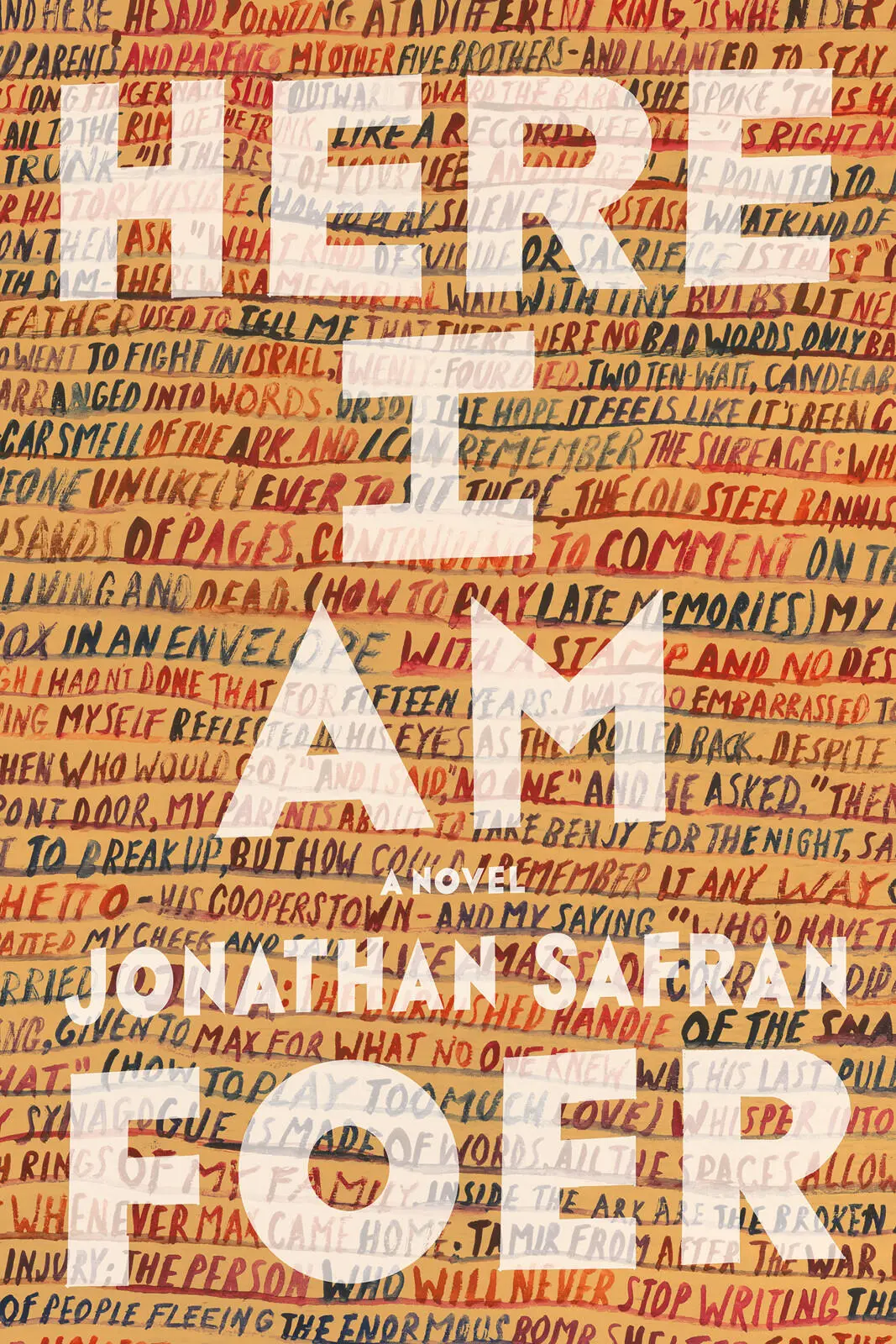
- Название:Here I Am
- Автор:
- Издательство:Hamish Hamilton
- Жанр:
- Год:2016
- ISBN:нет данных
- Рейтинг книги:5 / 5. Голосов: 1
-
Избранное:Добавить в избранное
- Отзывы:
-
Ваша оценка:
Here I Am: краткое содержание, описание и аннотация
Предлагаем к чтению аннотацию, описание, краткое содержание или предисловие (зависит от того, что написал сам автор книги «Here I Am»). Если вы не нашли необходимую информацию о книге — напишите в комментариях, мы постараемся отыскать её.
How do we fulfill our conflicting duties as father, husband, and son; wife and mother; child and adult? Jew and American? How can we claim our own identities when our lives are linked so closely to others’? These are the questions at the heart of Jonathan Safran Foer’s first novel in eleven years-a work of extraordinary scope and heartbreaking intimacy.
Unfolding over four tumultuous weeks in present-day Washington D.C.,
is the story of a fracturing family in a moment of crisis. As Jacob and Julia and their three sons are forced to confront the distances between the lives they think they want and the lives they are living, a catastrophic earthquake sets in motion a spiraling conflict in the Middle East. At stake is the very meaning of home — and the fundamental question of how much life one can bear.
Showcasing the same high-energy inventiveness, hilarious irreverence, and emotional urgency that readers and critics loved in his earlier work,
is Foer’s most searching, hard-hitting, and grandly entertaining novel yet. It not only confirms Foer’s stature as a dazzling literary talent but reveals a mature novelist who has fully come into his own as one of the most important writers of his generation.
Here I Am — читать онлайн бесплатно полную книгу (весь текст) целиком
Ниже представлен текст книги, разбитый по страницам. Система сохранения места последней прочитанной страницы, позволяет с удобством читать онлайн бесплатно книгу «Here I Am», без необходимости каждый раз заново искать на чём Вы остановились. Поставьте закладку, и сможете в любой момент перейти на страницу, на которой закончили чтение.
Интервал:
Закладка:
“What are you supposed to do?”
That made Jacob laugh. And his laughter made Tamir laugh. With his small joke, the tension eased. With his small joke, the stupidest of all ideas became reasonable, even almost sensible, maybe even genius. The alternative — sanity — became insane. Because they were young. Because one is young only once in a life lived only once. Because recklessness is the only fist to throw at nothingness. How much aliveness can one bear?
It happened so quickly, and took forever. Tamir jumped down, landing with a thud he obviously didn’t anticipate, because his eyes met Jacob’s with a flash of terror. And as if the ground were lava, he tried to get off it. He wasn’t quite able to reach the rail on his first jump, but the second try looked easy. He pulled himself up, Jacob hoisted him over the glass, and together they fell onto the pavement, laughing.
What did Jacob feel, laughing with his cousin? He was laughing at life. Laughing at himself. Even a thirteen-year-old knows the thrill and terror of his own insignificance. Especially a thirteen-year-old.
“Now you,” Tamir said as they picked themselves up and brushed themselves off.
“No fucking way.”
This is so unlike me.
“Come on.”
“I’d rather die.”
“You can have it both ways. Come on, you have to.”
“Because you did it?”
“Because you want to do it.”
“I don’t.”
“Come on,” he said. “You’ll be so happy. For years you’ll be happy.”
“Happiness isn’t that important to me.”
And then, firmly: “ Now , Jacob.”
Jacob tried to laugh off Tamir’s flash of aggressiveness.
“My parents would kill me if I died before my bar mitzvah.”
“This will be your bar mitzvah.”
“No way.”
And then Tamir got up in Jacob’s face. “I’m going to punch you if you don’t do it.”
“Give me a break.”
“I am literally going to punch you.”
“But I have glasses and acne.”
That small joke diffused nothing, made nothing almost sensible. Tamir punched Jacob in the chest, hard enough to send him into the railing. It was the first time Jacob had ever been punched.
“What the fuck, Tamir?”
“What are you crying about?”
“I’m not crying.”
“If you’re not crying, then stop crying.”
“I’m not.”
Tamir rested a hand on each of Jacob’s shoulders, and rested his forehead against Jacob’s. Jacob had breast-fed for a year, been given baths in the kitchen sink, fallen asleep on his father’s shoulder a thousand times — but this was an intimacy he had never experienced.
“You have to do it,” Tamir said.
“I don’t want to.”
“You do, but you’re afraid.”
“I don’t.”
But he did. But he was afraid.
“Come,” Tamir said, bringing Jacob to the wall. “It’s easy. It will take only a second. You saw. You saw that it wasn’t a big deal. And you’ll remember it forever.”
This is so unlike me.
“Dead people don’t have memories.”
“I won’t let you die.”
“No? What will you do?”
“I’ll jump in with you.”
“So we die together?”
“Yes.”
“But that doesn’t make me any less dead.”
“It does. Now go .”
“Did you hear something?”
“No, because there was nothing to hear.”
“Seriously: I don’t want to die.”
Somehow it happened without happening, without any decision having been made, without a brain sending any signal to any muscle. At a certain point, Jacob was halfway over the glass, without ever having climbed it. His hands were shaking so violently he could only barely hold on.
This is so unlike me.
“Let go,” Tamir said.
He held on.
This is so unlike me.
“Let go.”
He shook his head and let go.
And then he was on the ground, inside the lion’s den.
This is the opposite of me.
There, on the dirt, in the middle of the simulated savannah, in the middle of the nation’s capital, he felt something so irrepressible and true that it would either save or ruin his life.
Three years later he would touch his tongue to the tongue of a girl for whom he so happily would have cut off his arms, if only she had let him. And the following year an air bag would tear his cornea and save his life. Two years after that he would gaze with amazement at a mouth around his penis. And later that year he would say to his father what for years he had been saying about him. He would smoke a bushel of pot, watch his knee bend the wrong way during a stupid touch-football game, be inexplicably moved to tears in a foreign city by a painting of a woman and her baby, touch a hibernating brown bear and an endangered pangolin, spend a week waiting for a test result, pray silently for his wife’s life as she screamed as new life came out of her body — many moments when life felt big, precious. But they made up such an utterly small portion of his time on earth: Five minutes a year? What did it sum to? A day? At most? A day of feeling alive in four decades of life?
Inside the lion’s den, he felt surrounded and embraced by his own existence. He felt, perhaps for the first time in his life, safe.
But then he heard it, and was brought back. He looked up, met Tamir’s eyes, and could see that Tamir heard it, too. A stirring. Flattening foliage. What did they exchange in their glance? Fear? But it felt like laughter. Like the greatest of all jokes had passed between them.
Jacob turned and saw an animal. Not in his mind, but an actual animal in the actual world. An animal that didn’t deliberate and expound. An uncircumcised animal. It was fifty feet away, but its hot breath was steaming Jacob’s glasses.
Without saying a word, Tamir climbed back over the fence and extended his hand. Jacob leaped for it but couldn’t reach. Their fingers touched, which made the distance feel infinite. Jacob jumped again, and again their fingertips brushed, and now the lion was running, halving the distance between them with each stride. Jacob had no time to gather himself or contemplate how he might get an extra inch or two, he simply tried again, and this time — because of the adrenaline, or because of God’s sudden desire to prove His existence — he caught hold of Tamir’s wrist.
And then Jacob and Tamir were once again sprawled on the pavement, and Tamir started laughing, and Jacob started laughing, and then, or at the same time, Jacob started crying.
Maybe he knew. Maybe he was somehow aware, a teenager laughing and crying on that pavement, that he would never again feel anything like it. Maybe he saw, from the peak of that mountaintop, the great flatness before him.
Tamir was crying, too.
Thirty years later, they were still on the brink of the enclosure, but despite all the inches they’d grown, it no longer felt possible to enter. The glass had grown, too. It had grown more than they’d grown.
“I’ve never felt alive since that night,” Jacob said, bringing Tamir another beer.
“Life has been that boring?”
“No. A lot of life has happened. But I haven’t felt it.
“There are versions of happiness,” Tamir said.
Jacob paused before opening the bottle and said, “You know, I’m not sure I believe that.”
“You don’t want to believe it. You want to believe that your work should have the significance of a war, that a long marriage should offer the same kind of excitement as a first date.”
“I know,” Jacob said. “Don’t expect too much. Learn to love the numbness.”
“That’s not what I said.”
“I’ve spent my life clinging to the belief that all the things we spoke about as children had at least a grain of truth to them. That the promise of a felt life isn’t a lie.”
Читать дальшеИнтервал:
Закладка:
Похожие книги на «Here I Am»
Представляем Вашему вниманию похожие книги на «Here I Am» списком для выбора. Мы отобрали схожую по названию и смыслу литературу в надежде предоставить читателям больше вариантов отыскать новые, интересные, ещё непрочитанные произведения.





Обсуждение, отзывы о книге «Here I Am» и просто собственные мнения читателей. Оставьте ваши комментарии, напишите, что Вы думаете о произведении, его смысле или главных героях. Укажите что конкретно понравилось, а что нет, и почему Вы так считаете.