Marina Cramer - Roads
Здесь есть возможность читать онлайн «Marina Cramer - Roads» весь текст электронной книги совершенно бесплатно (целиком полную версию без сокращений). В некоторых случаях можно слушать аудио, скачать через торрент в формате fb2 и присутствует краткое содержание. Город: Chicago, Год выпуска: 2017, ISBN: 2017, Издательство: Academy Chicago Publishers, Жанр: Историческая проза, на английском языке. Описание произведения, (предисловие) а так же отзывы посетителей доступны на портале библиотеки ЛибКат.
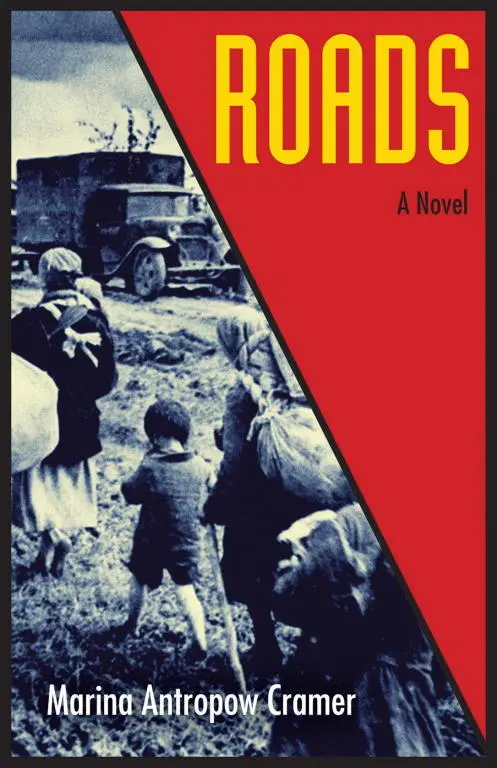
- Название:Roads
- Автор:
- Издательство:Academy Chicago Publishers
- Жанр:
- Год:2017
- Город:Chicago
- ISBN:978-1-61373-558-9
- Рейтинг книги:5 / 5. Голосов: 1
-
Избранное:Добавить в избранное
- Отзывы:
-
Ваша оценка:
Roads: краткое содержание, описание и аннотация
Предлагаем к чтению аннотацию, описание, краткое содержание или предисловие (зависит от того, что написал сам автор книги «Roads»). Если вы не нашли необходимую информацию о книге — напишите в комментариях, мы постараемся отыскать её.
By winter 1945, Allied air raids destroy strategic sites; Dresden, a city of no military consequence, seems safe. The world knows Dresden’s fate.
Roads
Roads — читать онлайн бесплатно полную книгу (весь текст) целиком
Ниже представлен текст книги, разбитый по страницам. Система сохранения места последней прочитанной страницы, позволяет с удобством читать онлайн бесплатно книгу «Roads», без необходимости каждый раз заново искать на чём Вы остановились. Поставьте закладку, и сможете в любой момент перейти на страницу, на которой закончили чтение.
Интервал:
Закладка:
He tried to raise himself on his elbows, but fell back, weak with the fever still wracking his body. “Anneliese,” he said, “you are an angel.”
“Pfft. Angels are for babies.” She leaned forward, wiped his face with a damp cloth. “Who is Borya? Your brother? A friend for chess?”
“Borya? How do you know Borya?”
“You say his name, when you are sick. And before, you mention. When we play chess.”
He told her everything. The wedding registry, the lucky green tie, the firewood, the mushrooms. The white shirt dripping with red paint. Matted blond hair falling over Borya’s lifeless face. The bare feet. The drone of SS threats like distant thunder, a storm from which there is no escape. Everything. Even the things he could not put into words.
Anneliese was silent, her head lowered, one hand over her eyes.
“Was it me?” Filip whispered. “Did I do it?”
She rose, pushed another cot up to his and lay down. She held him while he wept, her body pressed against his back, her arms wrapped around his chest, her head nestled into his neck.
He woke alone. On the desk near the door, a single lamp sent feeble rays of light into the dark room. The fever was gone.
5
THE PRISONERS WERE SINGING. In the May twilight, the day’s heat abating with the setting sun, the compound empty of all but the sentry at the gate, their voices floated over the camp. More than a few men, whether Russian refugees or American troops, raised their heads to listen. Energetic martial tunes gave way to slower, sadder songs that echoed each man’s own longing for home, peace, and loved ones, no matter what the language or the words.
They had been brought in a few at a time, arriving in trucks, hands tied, sometimes at night. They were searched, stripped of all belongings but their uniforms, and registered in the POW logbook: name, rank, serial number. Hometown, date, and place of capture.
It was odd, wearing the same uniforms as the captured enemy. Filip thought it wise to sew the now meaningless ROA patch back on his sleeve, so there would be no mistaking his allegiance. There was no question now of mounting any kind of resistance movement; General Vlasov was himself in captivity in the Soviet Union and likely to be shot or hanged as a traitor. But until Filip could find other clothes, it seemed a necessary precaution.
The enclosure had filled up quickly. Within a few days, there was no room for anyone to lie down. The men stood, or squatted back-to-back to avoid leaning against the barbed wire. Food was dispensed through a chest-high opening in the fence. Each man received his bowl and spoon, moving in a line around the inside perimeter, a soldier counting off the empty vessels and utensils as they were returned.
“It’s not right,” Ilya observed, watching the line snake around in a spiral, unwinding like a grim dance, those in the center working their way to the periphery to receive their portion. “They are not animals.”
“I’m not so sure about that,” Sergeant Evans, standing nearby to oversee the meal, shot back. “I’ve seen the German prison camps.”
“The men can’t even lie down. These barracks”—Ilya gestured to the buildings—“are standing empty.” His voice was hard, steely, as if uncoiling from a spring of anger in his chest. Filip had never seen his father-in-law so angry.
“Waiting for orders to move them out,” the sergeant growled. “Anyway, it’s not your concern.”
“I am a Wehrmacht officer.” They all turned toward the next man in line to receive his dinner. His voice, too, had a sharp edge, pitched higher than Ilya’s. It rang out like that of a man used to command. “These men need protection from the sun and rain, and boards to cover the latrine. Geneva Conventions.”
“Becker.” Filip recognized the lieutenant. He was unshaven and his coat was stained, with a long gash in one sleeve. At the sound of his name, he turned, his back perceptibly straighter, and ran a hand through his dirty hair. He and Filip locked eyes.
“Keep moving. I’ll get back to you.” Evans turned on his heel and walked off toward the house.
Geneva Conventions. Rules for the humane treatment of prisoners. Filip thought of the thousand small humiliations he had witnessed and endured at the hands of German overseers—the gleeful way one would slather rancid butter on stale bread, then scrape all but the lightest coating off with his knife before tossing it on the detainee’s plate; the endless taunts and insults— idiot , half-wit , swine ; days filled with pointless degrading tasks invented for the Nazis’ amusement.
Filip shuddered at the memory of Ilya and Ksenia facing imminent execution, when no Conventions stopped the action but the reluctance to waste a bullet. And for prisoners, no doubt, it had been many times worse. What must it be like for women , he wondered, living in constant fear of being assaulted by almost anyone?
Yet he admired Becker’s courage, his commitment to the welfare of men of lower rank who were not even under his command. And he remembered the civility, the lieutenant treating him with something that bordered on respect. Hadn’t Becker shared his stamps with him, expecting nothing in return?
That evening, Filip waited for a moment when no one was paying attention. He found the officer dozing at the edge of the enclosure, his back wedged in the corner, the wires digging into the cloth of his coat. “Becker,” Filip whispered. “No, don’t move,” he advised when the man shuddered awake and tried to rise. Filip took a chunk of bread from his pocket, tore it in pieces small enough to fit through the space between barbs.
“ Danke ,” Becker’s voice was hoarse, as if he’d been shouting for hours, but his eyes were clear and alert. “We need more water, also. To wash.”
Filip nodded and moved away. He had no sway with the Americans, no power to persuade the leadership to do anything for the prisoners. Evans had given them two water buckets, some planks to cover the latrine, plus a daily sprinkling of lime to control the stench. Even so, the ditch teemed with flies. No wonder they sing , he thought. That endless buzzing would drive anyone insane.
What would happen to these men? Their clothes, after several cycles of sun and rain and the inescapable rubbing against the wire enclosure, were starting to look as bedraggled as the refugees’; their unshaven faces were streaked with dirt and sweat. People were waiting for them, somewhere, like Ksenia had waited for her son, wondering when they might return. Were they hurt, or missing limbs, like Maksim, their lives shattered? Were they alive? My own mother doesn’t know where I am , he thought. What might she imagine has happened to me? He resolved to write to her as soon as they left the camp, by whatever means. It was unwise to write now and betray their Russian origins until the Americans had decided their fate.
“Sergeant Evans,” Becker addressed the noncommissioned officer with barely suppressed contempt. “My men need water, to wash.” He was still a few paces from the food dispensing window. “Water. To wash.”
“I heard you.” Evans, standing at the fence, took a last drag on his cigarette. “Damn Kraut,” he muttered, crushing the butt with his boot. “Go to hell.”
“Geneva Conventions,” Becker called out. “Your country signed—”
“Shut up! Just shut the hell up!” He turned his back on the Germans still moving in the food line behind the fence. Filip, on his way to his own breakfast, glanced up just in time to see Becker’s arm shoot out of the opening and encircle the sergeant’s neck, pulling him up against the fence in a tight clinch. Before anyone could react, he whipped a length of cord from his other hand and passed it under Evans’s chin, pulling the ends tight. The other prisoners tried to back away, but there was little free room in the cage; they stood silent.
Читать дальшеИнтервал:
Закладка:
Похожие книги на «Roads»
Представляем Вашему вниманию похожие книги на «Roads» списком для выбора. Мы отобрали схожую по названию и смыслу литературу в надежде предоставить читателям больше вариантов отыскать новые, интересные, ещё непрочитанные произведения.










Обсуждение, отзывы о книге «Roads» и просто собственные мнения читателей. Оставьте ваши комментарии, напишите, что Вы думаете о произведении, его смысле или главных героях. Укажите что конкретно понравилось, а что нет, и почему Вы так считаете.