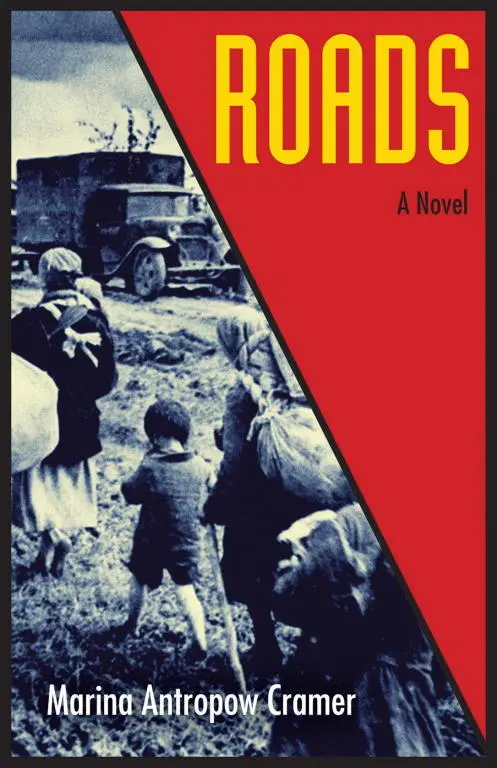
Marina Cramer - Roads
Здесь есть возможность читать онлайн «Marina Cramer - Roads» весь текст электронной книги совершенно бесплатно (целиком полную версию без сокращений). В некоторых случаях можно слушать аудио, скачать через торрент в формате fb2 и присутствует краткое содержание. Город: Chicago, Год выпуска: 2017, ISBN: 2017, Издательство: Academy Chicago Publishers, Жанр: Историческая проза, на английском языке. Описание произведения, (предисловие) а так же отзывы посетителей доступны на портале библиотеки ЛибКат.
- Название:Roads
- Автор:
- Издательство:Academy Chicago Publishers
- Жанр:
- Год:2017
- Город:Chicago
- ISBN:978-1-61373-558-9
- Рейтинг книги:5 / 5. Голосов: 1
-
Избранное:Добавить в избранное
- Отзывы:
-
Ваша оценка:
Roads: краткое содержание, описание и аннотация
Предлагаем к чтению аннотацию, описание, краткое содержание или предисловие (зависит от того, что написал сам автор книги «Roads»). Если вы не нашли необходимую информацию о книге — напишите в комментариях, мы постараемся отыскать её.
By winter 1945, Allied air raids destroy strategic sites; Dresden, a city of no military consequence, seems safe. The world knows Dresden’s fate.
Roads
Roads — читать онлайн бесплатно полную книгу (весь текст) целиком
Ниже представлен текст книги, разбитый по страницам. Система сохранения места последней прочитанной страницы, позволяет с удобством читать онлайн бесплатно книгу «Roads», без необходимости каждый раз заново искать на чём Вы остановились. Поставьте закладку, и сможете в любой момент перейти на страницу, на которой закончили чтение.
Интервал:
Закладка:
He wasn’t the only one to notice. He listened, head down to catch the remarks circulating through the shuffling crowd.
“Why is this city different? Look at all the goods they have.”
“It’s the Romanians. They’re in charge here.”
“Romanians? Aren’t they Nazis too?”
“Kind of. The Germans needed more troops in Europe, north and west of here, and on the Russian front, so they left the occupation of Odessa to their Eastern European allies.”
“But they’re just as bad! I’ve heard stories…”
“Was there ever a war without atrocities? Still, they run things here, not the Germans. Maybe they’re lazier, not so crazy for absolute control.”
“It can’t last. Odessa is a big city, with mountains to the west, where people can hide, and the coast, the seaport. Our Soviet Navy could lock that up and then what? No shipping. No goods, no munitions.”
“True, true. Pravda . But wouldn’t I like to stay a while. A man can make a living here, war or no war.”
Filip slowed down, shifted his suitcase to his other hand. He cast murderous glances at Ksenia’s rigid retreating back, saw Ilya list to one side under the weight of the trunk it was his turn to carry, his toolbox tucked under the other arm. Oh, yes. We can’t stay because we’re going to work on a farm. Isn’t that a stroke of good luck.
He wanted to forget the entire trip, couldn’t wait for it to be over. How he and Ilya took turns with the trunk, which, though small, was cumbersome and knocked against their shins; how the locks on Ilya and Ksenia’s suitcase gave way, and someone produced a length of rope to tie it closed, while the guards prodded the curious crowd and snapped insults and warnings. How they had all missed the evening train out of the city and had to spend the night at the station, propped up against each other, trying to sleep.
Leaving Odessa behind, the morning train took them past fields of wheat and rye, potatoes and cabbage, the country dotted with neat farmhouses alternating with dense stretches of deep loden evergreen forest. Factory smokestacks rose in the distance; warehouses, stone buildings, and churches flashed by the train windows.
It might have been idyllic, a picture of prosperity rising out of orderly, methodical practices and good management, but for the randomly cratered ground, fires smoldering here and there, the sight of women sifting through rubble, toting buckets of broken bricks, tugging at splintered boards. At the railroad stations, bands of boys hawked things taken from wrecked, abandoned houses, chased off by patrolling police only to reappear behind their backs. Why do people have to suffer when their leaders can’t agree? Galina thought, passing a few coins to a skinny boy in an oversized cap in exchange for a pair of apples.
At the Czech border they changed trains, their escort replaced by an SS junior officer and several local police.
“ Juden ?” the SS man asked, watching the passengers descend to the platform, dragging their things, herding exhausted children before them.
“ Nein ,” the departing guard smirked. “ Ost . Arbeitslager .”
Filip asked himself, Why did they laugh? Ost . East, that’s where they had come from, of course. But Arbeitslager ? Work camp? He had seen Ksenia’s letters of introduction. They contained no mention of labor camps. The train must be making other stops along the way, if that’s where some of these people were going. And where is our train? How can we leave with these cattle cars blocking the tracks?
“Filip, look.” Galina tugged at his sleeve. “Those cars are full of people.”
“No,” he said, handing the guard his papers for inspection. “You must be mistaken. They are…”
He turned to look, and blanched. Those were not animal sounds coming from inside the windowless cars. They were words. “Water. Please, water.” He stared in disbelief at fingers protruding between the slats, watched a policeman walk along the length of one wagon, crushing those fingers with his baton, to the amusement of the others.
“Stop!” Galina cried out.
Ksenia took her arm, saying, “Hush. You can’t help them.” Together, all four moved to the side of the platform, to the area designated for waiting.
“Where’s this lot from?” one of the officers asked another, pointing at the crowded cattle cars with his chin.
“Prague. Four days ago.”
“All right.” The first one nodded. He unfurled the station’s water hose, pointing the nozzle at the air space near the roof of the car. “Turn it on.”
What followed, the wailing and keening fueled by panic but also by a desperate need for relief, was unlike the sound of any human voice Galina or Filip had ever heard. The captive bodies strained against the creaking sides of the wagon for what, in spite of the force of the flow, could not have been more than a few drops of water. After a few minutes, the first officer signaled to shut the hose off. “That’s enough. They’re only Jews,” he said.
“There are children in there. Can’t you hear them crying?” Galina whispered, tears running down her own face. Filip set down his suitcase and embraced her, holding her head firmly against his shoulder until she stopped sobbing.
Shuddering, she worked herself free of him, wiping her eyes on her sleeve. They watched the officer move along the tracks to an empty freight car. He raised his arm and, with theatrical flair, chalked the word OST in large capital letters on the side.
“Now you,” he shouted at the Russians. “ Ostarbeiter . In here.” He angled a narrow board against the open freight car doors and shoved the first of the group up the makeshift ramp. Two policemen formed the rest of the travelers into a ragged line, snorting impatiently while the people struggled to keep their balance and hold on to their possessions. At the foot of the ramp, the SS man handed each traveler a square patch and a large safety pin. “Wear these on your coats at all times,” he commanded. “Sew them on when you reach your destination.”
Filip looked down at the roughly woven patch in his hand. OST, it read, black letters on a whitish ground. “Where are we going?” he asked aloud, of no one. No one answered.
3
ONCE LOADED, THE TRAIN traveled fast, speeding through Austria without incident. The wagon smelled of stale sweat and urine, but it was not especially crowded. Everyone found a spot, sitting on their trunks and cases; some stretched out on the grimy straw-covered floor and slept.
“I wish we could see out,” Galina sighed, leaning her head against the wall, rocking with the motion of the train.
“I wish I had a cigarette.” Filip closed his eyes. He had tried peering between the slats at the flickering landscape but gave up, feeling dizzy with the effort.
“Hmm,” Ilya grunted, without clarifying which desire he shared. Perhaps both.
Sometime in the night, the train stopped, jolting the sleepers awake with a great screeching of wheels on metal tracks. It had grown colder. The car doors opened to let in more people, speaking other languages—Serbian, Czech, others Filip did not recognize—but with the same dazed look as the Russian travelers, the same scruffy luggage and OST patches on their coats.
“What day is it?” someone asked.
“November first if it’s after midnight. Tuesday.”
People shifted about, making room for the new occupants. Galina and her mother found themselves pushed to the car’s open door. “Mama,” Galina breathed. “Snow.”
It fell gently. Huge flakes floated on the air as if chipped from a block of soap; they filled every crevice, covered each surface with a lacy, ever-changing pattern until all the spaces disappeared and everything dazzled against the dark.
Читать дальшеИнтервал:
Закладка:
Похожие книги на «Roads»
Представляем Вашему вниманию похожие книги на «Roads» списком для выбора. Мы отобрали схожую по названию и смыслу литературу в надежде предоставить читателям больше вариантов отыскать новые, интересные, ещё непрочитанные произведения.






Обсуждение, отзывы о книге «Roads» и просто собственные мнения читателей. Оставьте ваши комментарии, напишите, что Вы думаете о произведении, его смысле или главных героях. Укажите что конкретно понравилось, а что нет, и почему Вы так считаете.