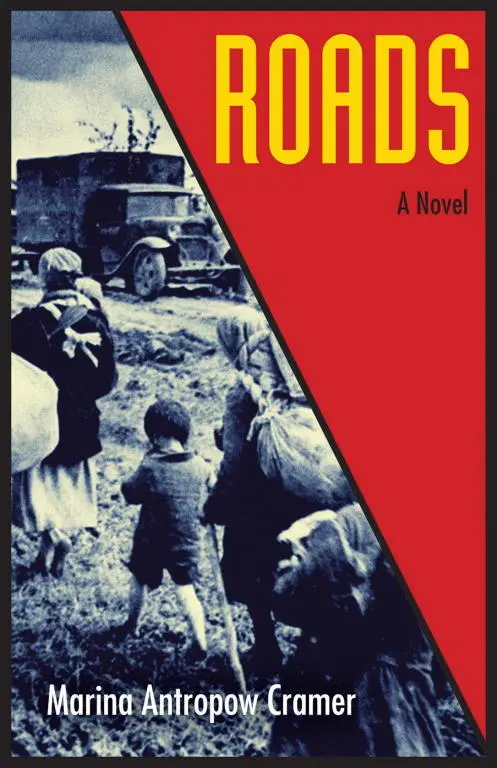
Marina Cramer - Roads
Здесь есть возможность читать онлайн «Marina Cramer - Roads» весь текст электронной книги совершенно бесплатно (целиком полную версию без сокращений). В некоторых случаях можно слушать аудио, скачать через торрент в формате fb2 и присутствует краткое содержание. Город: Chicago, Год выпуска: 2017, ISBN: 2017, Издательство: Academy Chicago Publishers, Жанр: Историческая проза, на английском языке. Описание произведения, (предисловие) а так же отзывы посетителей доступны на портале библиотеки ЛибКат.
- Название:Roads
- Автор:
- Издательство:Academy Chicago Publishers
- Жанр:
- Год:2017
- Город:Chicago
- ISBN:978-1-61373-558-9
- Рейтинг книги:5 / 5. Голосов: 1
-
Избранное:Добавить в избранное
- Отзывы:
-
Ваша оценка:
Roads: краткое содержание, описание и аннотация
Предлагаем к чтению аннотацию, описание, краткое содержание или предисловие (зависит от того, что написал сам автор книги «Roads»). Если вы не нашли необходимую информацию о книге — напишите в комментариях, мы постараемся отыскать её.
By winter 1945, Allied air raids destroy strategic sites; Dresden, a city of no military consequence, seems safe. The world knows Dresden’s fate.
Roads
Roads — читать онлайн бесплатно полную книгу (весь текст) целиком
Ниже представлен текст книги, разбитый по страницам. Система сохранения места последней прочитанной страницы, позволяет с удобством читать онлайн бесплатно книгу «Roads», без необходимости каждый раз заново искать на чём Вы остановились. Поставьте закладку, и сможете в любой момент перейти на страницу, на которой закончили чтение.
Интервал:
Закладка:
He withdrew the hand, concealed it under his coat, but didn’t offer the right. “Is there food at home? I have not eaten since…”
“I will go and tell Mama. Come as fast as you can.” She ran off, disappearing into the alley that led to the apartment courtyard.
“She has cut her hair,” he said out loud, noting the absence of her maiden’s braid. Bah, that’s a country custom , he completed the thought. Many girls cut their hair now, when they want to. It doesn’t mean they’re married.
Ksenia was waiting just inside the door, her face wet with tears. “My son,” she breathed when he entered the room. “ Syn moi , syn ,” she intoned, holding his face in both her hands, kissing the unshaven cheeks three times in the traditional Russian greeting. “So thin,” she said. She embraced him, pushing the overcoat from his shoulders onto the floor.
From the kitchen doorway, they both heard Galina gasp, then burst into tears. When Ksenia stepped back, releasing Maksim, she saw the empty folded sleeve pinned to the right shoulder of his shirt. “ Bozhe moi .” She crossed herself, then made the sign of the cross in the air between them. “My God. Your arm. How you have suffered.”
Maksim bowed his head, accepting the blessing. When he looked at her, his own eyes were brimming. He whispered, “Mama, I am so hungry.”
They sat with him while he ate bread, buckwheat kasha, briny salted cucumbers and onions. “We have heard nothing from you in more than seven months.” Ksenia finally broke the silence, stacking the empty dishes in front of her. “Tell us what happened to you. Where are your things?”
“Then you don’t know. I wrote to you after I left Kharkov, but you don’t know. I have no things, only my papers, the clothes I’m wearing, and these lapti .” He pushed out his feet, showing them the straw slippers tied around his ankles with strips of rags. “A farmer gave them to me, out of pity for my bare feet.”
“Where are your books?” Galina cut in, remembering his extreme possessiveness. “Your notebooks?”
“Who knows? I have no need of them now.” His voice was dull, with no hint of his former irritation at her questions. “I served as a medic in an army field hospital near Moscow. There was heavy fighting. Many died.” He paused. No one spoke. “Many died,” he repeated.
“Where is your uniform, son, your boots?” Ksenia placed the dirty dishes in a washbasin, put water on for tea.
“I had no uniform, just an armband with a red cross on it. Everything was in short supply. Still is, I’m sure. So much confusion. The hospital was bombed in transit, moving from one location to another. I could not see the logic in it. How could it be in a safe place and still close enough to treat the frontline wounded? Anyway, we were bombed. I was hurt.”
“That’s it? ‘We were bombed. I was hurt.’” Galina set a cup of tea in front of him, her tone rising with indignation. “As if it’s an everyday occurrence.”
Maksim stared at her with dead eyes. “It is an everyday occurrence.”
“Never mind, children,” Ksenia stepped in. “There will be time for talking, now you are home. Whatever happened, you survived.”
“I survived,” he echoed, his voice hollow.
They sat in silence for several minutes, the women’s questions frustrated by his wooden expression. When his chin dropped to his chest in exhaustion, Ksenia stood up. “You need to sleep, son. Use our bed. Your father will not return until tomorrow.”
Maksim rose. “I need to wash a little first. Is there a clean shirt I can use?”
“Filip has two or three, about your size,” Galina offered. “We’re married now. We took your room.”
“I meant to ask you about the ring,” he mumbled, “but it slipped my mind. Thank you, Mama. I can manage.” He took the water bucket from his mother in his left hand, the towel draped over his shoulder, and headed for the inner courtyard. In the doorway, he turned. “My boots,” he said. “I traded them to a band of Partisans in the woods, along with your socks, Galya, for some bread and fish. They had no use for a one-armed fighter with a limp.”
2
LIFE TOOK ON a kind of routine, the kind of routine that makes ample allowances for the unexpected. Galina rose early to work more hours in the toy shop, and willingly took on a larger share of household duties.
After finishing tenth grade and receiving his diploma, Filip slept late every day; he had abandoned the pretense of looking for work after a few fruitless weeks, claiming the need to prepare for the upcoming university examinations. Most days, he spent an hour or two at the library before dropping in on his mother. She would be waiting with hot tea or fresh lemonade.
“How is it you always have sugar, Mama? We see it only rarely, and then my mother-in-law hoards every grain. Even when we use it, nothing tastes sweet.”
“Every household has its own rules,” Zoya said judiciously, dipping a stale bread crust into her tea. “And your father is fortunate. Party membership still has a few benefits.”
“Hm.” Filip preferred to remain noncommittal. It was not a matter of ideology. But what if the Germans won the war? The Soviet Partisans had spread the word of the victorious Red Army defense of Moscow, the Fascists beaten back at the city gates. But Ukraine was still firmly under occupation, both major cities, Kharkov and Kiev, now under enemy control. The war could end in a truce, with parts of the Soviet Union remaining under Nazi rule. He had read enough history to know that national boundaries were moveable and arbitrary, governed by shifting allegiances, secret agreements, games of chance played by the gods.
He said none of this to his mother, or to anyone. Zoya wanted only the return of religious freedom, so she could attend church services openly without fear of compromising her husband’s position. Ksenia believed (and Ilya, too, he suspected), along with an ardent minority, in the restoration of the Romanov monarchy—a position he considered too ridiculous to warrant discussion. It was best to wait, see how things turned out.
What was it his friend Vova had said, just before running off to find a Red Army unit to join beyond the occupied territory? “Why, you’re nothing but an opportunist! You believe in nothing.”
“I believe in money in my pocket, meat for my dinner, sugar in my tea. And the right to be left alone,” Filip had replied. “That’s what I believe.”
“Have you forgotten Borya? How many of us must die so that you may be ‘left alone’? You are living a fantasy, my friend. Nothing comes without a price.”
Forgotten. Could he, would he ever forget? Not just the sight, the spectacle of their friend and classmate strung up from a lamppost, turning in the wind like so much dirty laundry. The doubt, the agonizing flashes of conscience had cast an indelible shadow over Filip’s life. Even if he was not guilty, he knew he would never again be innocent.
“I have forgotten nothing. But I can’t help feeling it was a pointless death, brave as it was. He gained the status of a folk hero here in his hometown, but what has he accomplished? Whose life has been improved by his sacrifice?”
Vova had made an impatient sound, something between a grunt and a sigh. “Borya has earned his place among the saints of the new revolution. Many have died, die every day, out of the public eye, hunted like animals in the woods, fleeing the site of one last explosion, one final act of sabotage. His sacrifice will inspire fresh generations of fighters. He stood up for something. That’s what I must do, too.”
They’d parted with a firm handshake, neither convinced of the truth of the other’s argument.
Читать дальшеИнтервал:
Закладка:
Похожие книги на «Roads»
Представляем Вашему вниманию похожие книги на «Roads» списком для выбора. Мы отобрали схожую по названию и смыслу литературу в надежде предоставить читателям больше вариантов отыскать новые, интересные, ещё непрочитанные произведения.





Обсуждение, отзывы о книге «Roads» и просто собственные мнения читателей. Оставьте ваши комментарии, напишите, что Вы думаете о произведении, его смысле или главных героях. Укажите что конкретно понравилось, а что нет, и почему Вы так считаете.