Stephen Wright - Meditations in Green
Здесь есть возможность читать онлайн «Stephen Wright - Meditations in Green» весь текст электронной книги совершенно бесплатно (целиком полную версию без сокращений). В некоторых случаях можно слушать аудио, скачать через торрент в формате fb2 и присутствует краткое содержание. Город: New York, Год выпуска: 2020, ISBN: 2020, Издательство: Little, Brown and Company, Жанр: Историческая проза, prose_military, на английском языке. Описание произведения, (предисловие) а так же отзывы посетителей доступны на портале библиотеки ЛибКат.
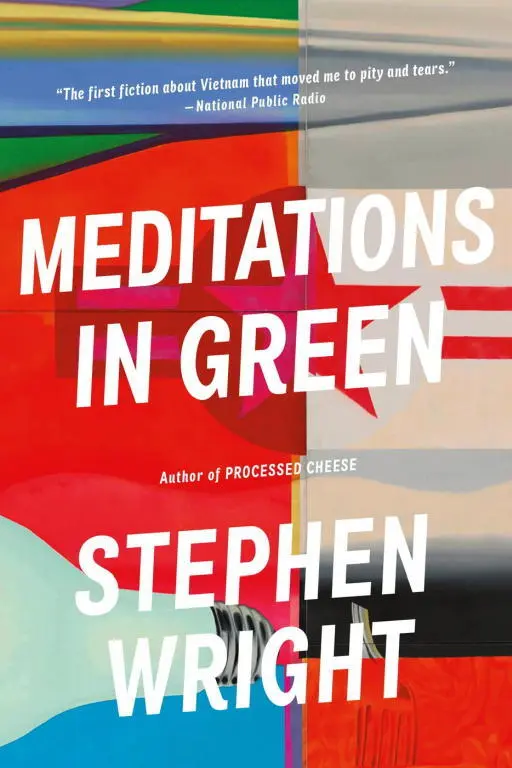
- Название:Meditations in Green
- Автор:
- Издательство:Little, Brown and Company
- Жанр:
- Год:2020
- Город:New York
- ISBN:978-0-316-42736-4
- Рейтинг книги:5 / 5. Голосов: 1
-
Избранное:Добавить в избранное
- Отзывы:
-
Ваша оценка:
Meditations in Green: краткое содержание, описание и аннотация
Предлагаем к чтению аннотацию, описание, краткое содержание или предисловие (зависит от того, что написал сам автор книги «Meditations in Green»). Если вы не нашли необходимую информацию о книге — напишите в комментариях, мы постараемся отыскать её.
Deployed to Vietnam with the U.S. Army’s 1069 Intelligence Group, Spec. 4 James Griffin starts out clear-eyed and hardworking, believing he can glide through the war unharmed. But the kaleidoscope of horrors he experiences gets inside him relentlessly. He gradually collapses and ends up unstrung, in step with the exploding hell around him and waiting for the cataclysm that will bring him home, dead or not.
Griffin survives, but back in the U.S. his battles intensify. Beset by addiction, he takes up meditating on household plants and attempts to adjust to civilian life and beat back the insanity that threatens to overwhelm him.
Meditations in Green is a haunting exploration of the harrowing costs of war and yet-unhealed wounds, “the impact of an experience so devastating that words can hardly contain it” (Walter Kendrick, the New York Times Book Review). Through passages gorgeous, agonizing, and surreal, Stephen Wright paints a searing portrait of a nation driven to the brink by violence and deceit.
Meditations in Green — читать онлайн бесплатно полную книгу (весь текст) целиком
Ниже представлен текст книги, разбитый по страницам. Система сохранения места последней прочитанной страницы, позволяет с удобством читать онлайн бесплатно книгу «Meditations in Green», без необходимости каждый раз заново искать на чём Вы остановились. Поставьте закладку, и сможете в любой момент перейти на страницу, на которой закончили чтение.
Интервал:
Закладка:
Two weeks later a helicopter carrying Major Quimby and Kraft broke radio contact somewhere in the central highlands and Griffin promptly volunteered for the search team. The previous morning, bent in a jeweler’s hunch over one particular frame of defoliated earth, lens magnification multiplying intensely upon one unnaturally smooth-curved shadow—the projection of a truck hood? a random heap of stripped timber?—20×, 30×… the surface of the film itself came abruptly apart plunging him down among the crystals, a pure landscape of geometrically perfect black-and-white pyramids, the tombs where all the images were stored like ancient kings. Then triangles ballooned into concentric circles, his field of vision filled again with white phosphorus, and he slid off the stool, his unresponsive hands reaching out too late for the firmness of the counter that was no longer there. Normality returned in a clean gray vista of linoleum floor tiles shining away toward a distant gray wall. His friends stood there laughing, that Griffin and his dumb jokes, gonna fuck himself up real good one of these days. Griffin was frightened; he didn’t know what had happened. That night he dreamed of tundra again, ice-caked gloves tearing at his wet snow-blind eyes.
Twenty-four hours after the news arrived of Quimby and Kraft, the crash site was located on reconnaissance film, a small somewhat circular wound opened in the rough green skin of a rock bone mountain. A medevac, promptly dispatched to the scene, hovered forlornly above the ragged hole in the foliage. No signs of life. No rhythmic beeps on the emergency channels. Dipping downward for a closer peek, the medevac drew fire, several punctures carefully centered on the large red cross painted on its hull. It was automatically assumed that the enemy had Quimby’s briefcase, the detailed maps, the classified memoranda, the complete set of current code books, an assumption confirmed later that same day when an anonymous attempt was made to call in artillery fire directly upon a besieged ARVN company using the codes, which had of course been immediately changed hours before. It was also assumed that passengers and crew were either captured or dead, probably the latter, but that the bodies still needed to be recovered, the wreckage searched. Word of Quimby’s disappearance sent one long chilly shiver down the I Corps intelligence spine. The man knew virtually everything; he had to be found, dead or alive. Conrad and the agency people offered their services. Major Holly, however, instinctively sensitive to the ever-shifting boundaries of bureaucratic responsibility and power, wisely decided to keep this operation in the family. He would employ a contingent of 1069th volunteers in addition to an armed element of experienced Marines who would ride shotgun on the mission. A quick study of the terrain determined that the nearest point for a safe insertion was a grassy field about three kilometers from the crash site. The search team was presented then with a difficult uphill trek through unbroken jungle, across a couple streams of unknown speed and depth, and up or around several walls of slippery overgrown rock. A violent encounter with those who had brought the helicopter down should not be ruled out.
Griffin outfitted himself in full battle gear for the first time since Basic and, self-conscious as a bride, headed for the waiting choppers. Simon wished him luck. “You’re a braver man than I am.”
“Gunga Din,” replied Griffin and waved good-bye in the jaunty manner of the movie heroes of his not so distant youth.
Griffin hadn’t set foot in a helicopter since his Chief Winkly-arranged “vacation” to Saigon in another life. As he climbed aboard he noticed that neither of the two (two this time!) door gunners was wearing a sun visor. He settled himself into a seat, concentrating for a moment on his breaths, long and deep now, long and deep. As his chest loosened up, he opened his eyes and looked around. He was surrounded by Marines. This was the wrong helicopter. He started to get up. Squatting in the doorway, a Marine captain who might have been an Olympic decathlon champion in civilian life glanced at the monstrous watch on his wrist and signaled with his hand. Outside the ramp dropped away, the door swung into blue sky, Griffin smiled at his traveling companions. Across from him was a row of high school yearbook pictures in helmets and he couldn’t help wondering, okay, who isn’t coming back? as the wind numbed his face and gave his skin the tight feel of a plastic mask. The clouds, spectacular heaps of fluffy white cream, flowed by like time-motion studies of an advancing cold front. All the strength in his body seemed to be draining down his legs, through his soles, into the trembling floor of the helicopter. He gripped with both hands the rifle barrel between his thighs. When the moment came, would he be able to stand, to get through that door? He felt as stoned as if he had just consumed an entire lid by himself. None of the Marines appeared the least bit jumpy; all their nerves had been replaced by brass tubing on Parris Island. The ground was a shrieking green blur. Up ahead the long jade vertebrae of the highlands rose and dipped as though some dreaming creature had begun to turn, to awaken from sleep. Bright squares of flooded paddy flashed past like windows on a train. The Marine corporal beside Griffin began tapping on his leg with tan stubby fingers a soundless arrhythmic tune. The Marines were nervous! Now Griffin was really scared. He had the claustrophobic sensation of being moved in a crowd down some concrete tunnel, dim screened-in bulbs overhead lighting the shadowy way to a huge vaultlike door. Under each armpit, dark deltas spread slowly southward. Suddenly he realized with perfect clarity why he had volunteered for this ride. He wanted to experience some portion of this madness as his own, not as accident or bad luck or whim of his superiors but as choice, freely made, the consequences freely accepted; he wanted a purge, a flushing out of the corners, primitive sacrament if necessary, so that when he returned the office would be simply an office again, neutral objects arranged between four neutral walls, and the film would remain solid as pond ice in January, no cracks, no holes please and maybe a simple unsophisticated unprogrammed muscle of his soul wanted simply to exercise itself and do those things in the flesh that one was doing anyway abstractly and on paper because one guy went crazy and some nights the prisoners cried until dawn and half your superiors were fools and you kept dreaming of blizzards in the tropics and your friend got killed and what else was there to do anyway?
The mountains loomed closer, a sharp file of green teeth sawing back and forth. The Marine captain, smiling, pointed out the door. A pair of Cobra gunships streaked past, trails of smoke pouring from their rocket canisters. “Here we go!” someone shouted and Griffin’s stomach tilted like the bubble in a carpenter’s level. He could see a field of yellow grass rising toward him on balloons of brown smoke left behind by the Cobras’ strafing run. Griffin searched the grass for crouching figures, flashes of light. Under his fingers the rifle barrel was cold and hard. A towering mass of mountain slipped ominously into view. The helicopter began to vibrate more vigorously, its prop wash deflecting off the ground. “Go go go go go!” screamed a bouncing door gunner, the ejected cartridges from his M-60 seeming to erupt out of his open mouth as he directed a stream of fire into the dark solid wall of jungle surrounding the landing zone. Marines, their rifles at port arms, started leaping out the door. “C’mon!” ordered a Marine sergeant. He had a gap between his front teeth. “Let’s move, troop.” He grabbed Griffin’s arm above the elbow. Griffin stumbled toward the door. In the long blades of flattened grass rippling outward from the downdraft a bobbing line of heads and shoulders was drifting slowly away, survivors of a sinking ship, backpacks for life preservers. Griffin paused for a moment, hands clutching the metal edges of the doorway. A boot kicked into his butt and out he went. The grass was much taller than he had guessed and, misjudging his fall, he came down hard, his right leg twisted painfully beneath his body. Flat on his back he looked up through a tunnel of swirling grass and watched the empty helicopter lift dramatically away. He felt like a tiny spider dangling on a thread. The helicopter vanished, the thread snapped, the rustle of the grass ceased. The drone of an engine faded into silence. Silence. No rifle fire. No one was shooting at him. Griffin struggled to his feet. The leg was sore but apparently neither broken nor sprained. He followed the nearest head through the whispering grass toward a tree line so dense and flat it might have been painted on rock. In the shade Captain Raleigh, the mission CO, was conferring with the Marine captain; they looked at a compass, then at a map, then into the bush, visibility no greater than the length of an arm.
Читать дальшеИнтервал:
Закладка:
Похожие книги на «Meditations in Green»
Представляем Вашему вниманию похожие книги на «Meditations in Green» списком для выбора. Мы отобрали схожую по названию и смыслу литературу в надежде предоставить читателям больше вариантов отыскать новые, интересные, ещё непрочитанные произведения.












Обсуждение, отзывы о книге «Meditations in Green» и просто собственные мнения читателей. Оставьте ваши комментарии, напишите, что Вы думаете о произведении, его смысле или главных героях. Укажите что конкретно понравилось, а что нет, и почему Вы так считаете.