Stephen Wright - Meditations in Green
Здесь есть возможность читать онлайн «Stephen Wright - Meditations in Green» весь текст электронной книги совершенно бесплатно (целиком полную версию без сокращений). В некоторых случаях можно слушать аудио, скачать через торрент в формате fb2 и присутствует краткое содержание. Город: New York, Год выпуска: 2020, ISBN: 2020, Издательство: Little, Brown and Company, Жанр: Историческая проза, prose_military, на английском языке. Описание произведения, (предисловие) а так же отзывы посетителей доступны на портале библиотеки ЛибКат.
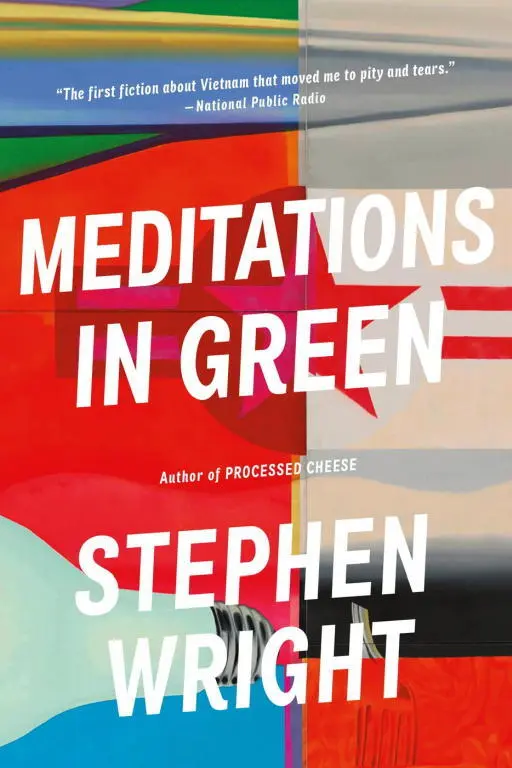
- Название:Meditations in Green
- Автор:
- Издательство:Little, Brown and Company
- Жанр:
- Год:2020
- Город:New York
- ISBN:978-0-316-42736-4
- Рейтинг книги:5 / 5. Голосов: 1
-
Избранное:Добавить в избранное
- Отзывы:
-
Ваша оценка:
Meditations in Green: краткое содержание, описание и аннотация
Предлагаем к чтению аннотацию, описание, краткое содержание или предисловие (зависит от того, что написал сам автор книги «Meditations in Green»). Если вы не нашли необходимую информацию о книге — напишите в комментариях, мы постараемся отыскать её.
Deployed to Vietnam with the U.S. Army’s 1069 Intelligence Group, Spec. 4 James Griffin starts out clear-eyed and hardworking, believing he can glide through the war unharmed. But the kaleidoscope of horrors he experiences gets inside him relentlessly. He gradually collapses and ends up unstrung, in step with the exploding hell around him and waiting for the cataclysm that will bring him home, dead or not.
Griffin survives, but back in the U.S. his battles intensify. Beset by addiction, he takes up meditating on household plants and attempts to adjust to civilian life and beat back the insanity that threatens to overwhelm him.
Meditations in Green is a haunting exploration of the harrowing costs of war and yet-unhealed wounds, “the impact of an experience so devastating that words can hardly contain it” (Walter Kendrick, the New York Times Book Review). Through passages gorgeous, agonizing, and surreal, Stephen Wright paints a searing portrait of a nation driven to the brink by violence and deceit.
Meditations in Green — читать онлайн бесплатно полную книгу (весь текст) целиком
Ниже представлен текст книги, разбитый по страницам. Система сохранения места последней прочитанной страницы, позволяет с удобством читать онлайн бесплатно книгу «Meditations in Green», без необходимости каждый раз заново искать на чём Вы остановились. Поставьте закладку, и сможете в любой момент перейти на страницу, на которой закончили чтение.
Интервал:
Закладка:
Thirty minutes later, astonished at his unexpected change of fortune, he found himself on a plane north all the way to Nha Trang. A temporary tilt in the heavens. He was stuck in Nha Trang, home of the famous Green Berets, for thirty-two hours, sleeping on the floor between indigestible meals of warm Kool-Aid and cold hamburgers that tasted like the plastic lining inside old refrigerators. Up the rest of the coast he hopped like a frog: an overnight stay in Tuy Hoa (steak dinner, fresh sheeted bed compliments the U.S. Air Force), twelve hours in Qui Nhon (shave, shower, interminable movie about Gregory Peck searching for gold in bleak Southwest), and finally five hours in friendly Da Nang entertained by the same group of singing Australians he had encountered there hours or days or weeks ago. At one in the morning Griffin rode home on a C-130 crammed between huge loading palettes of powdered milk and green beans.
“Where the hell have you been?” demanded Captain Patch.
“Get your wick dipped?” asked Chief Winkly.
“Excuse me,” said Griffin, “I don’t think I feel too well.”
Bad ice, he thought, between the chills and the cramps of the next two days, too many cups of flavored water from every Vietnamese snack vendor in every air terminal in South Vietnam. Now here he was poisoned. The chief, it turned out, had been arrested in the Bronco Bill Bar and Grill by club-wielding MPs the night Griffin left. Apparently he punched a prostitute in the face following a sexual remark forever lost in the ensuing melee. The chief proudly exhibited the deep nail scratches across his cheeks as battle wounds worthy of a Purple Heart. Griffin, dragging his ragged intestines from bunk to latrine, wished the girl had had a knife. Seated on one stool and leaning over to take advantage of the adjoining one, he looked up from his misery to see Wendell crouched in the doorway, camera purring. “I’ll glue your lens cap on for this,” croaked Griffin. “Great,” exclaimed Wendell. “Simply great. The War In Vietnam: America On The Pot.” Back in his room Griffin lay on his side, sweating, hands tucked between his legs, the nausea rolling through him like heavy seas. Between spasms he would dream about winter again and a helicopter would wobble out of the whiteness and it wouldn’t be like dreaming anymore but like someone shaking him awake. His insides bubbled and squirted. There was a fever like a machine gun. Countryside zipped past like film on fast forward. His blanket was the texture of a flight suit. There was a big helmet on his head he couldn’t get off. He was suffocating and the visor was so darkly tinted no one could see his face, no one knew who he was. Some bugs dashed out from under cover and tried to bite him. He squashed them with the sole of his boot. None of this ever really happened.
MEDITATION IN GREEN: 12
The sun is white, the sky starched.
The gravel plain, flat as an anvil, projects its speckled black surface into the mirage of a horizon.
In the opposite direction is piled the sand, the high yellow dunes that record the shape of the wind. There is only silence and the abstract beauty of light and shadow, lines curving up, lines curving down, the razor edges of definition drawn against a monotonous intensity. The wind remains constant, hot and dry, lifting a white spray off the curl of a dune. The sand is moving, grain by grain, slipping patiently on, a landscape in motion. Between the dunes a hard corridor leads to a black finger of rock pointing upward.
At noon the color bleaches out. Shadows disappear. Dunes climb on top of one another and the world turns two-dimensional. Rock and gravel and sand burn with a fire that seems to have been ignited from within. In a moment, though, the sun moves on and perspective returns.
A cloud drifts in from nowhere, then incredibly, is joined by another. The clouds approach, merge, rain begins to fall. It evaporates before touching the ground.
Shadows lengthen. The sky glows yellow. The sun sinks. Night pours swiftly in.
A cockroach emerges from a small hole and proceeds to make its way from one point to another.
In the light of the moon the dunes look like mounds of snow.
“My brother’s in the hospital with infected heart valves,” announced Huey. She stood in the kitchen, toasting a marshmallow on a fork over the gas burner of the stove. “He’s tried to escape twice now so they have him tied to the bed with medieval leather straps. Are you listening to me?”
These most common of all rocks are made of debris. Color is extremely varied. Hardness is generally low. “Yes,” I said. “A junkie’s disease.”
“He won’t let me visit.”
“Send flowers.”
“I did. He threw them out the window. The vase broke a light on an ambulance roof. That’s when he ran for the elevator and they buckled him down.”
“Hasn’t the gang been around to cheer him up?”
“I don’t care. I’m finished. I’m through worrying about him. These marshmallows suck.” A ball of fire drooped off the end of the fork and into the sink, hissing. She reached into a grimy canvas bag on the floor beside the refrigerator and pulled out a bare stub of black crayon. “Remember Mrs. Armstrong?” she asked, coming into the room where I sat examining glossy photographs with a magnifying glass. “No show today. First time she’s ever missed an appointment. Something’s wrong. Those scheduled hysterics are what get her through the month.”
“Maybe the gas has been turned off for nonpayment and she’s rigid there in her rocker, arthritic fingers clenched about her knitting, hard glaze coating each frozen eyeball, ice sculpture. The Golden Years.”
“I think we’ll send someone over there tomorrow morning.” Turning her back, she stepped to an open space on the wall, raised her arm above her head, and quickly began to draw.
“Mukluks. Packed sleds. Dog teams. Get the medicine through to the Eskimos.”
Brief furious strokes. Energy revealed itself as clearly as filings under a magnet. A field was created that drew its surroundings down into it. Then the rhythm altered and motion unwound into a complex of curves and swirls, a patterned density somewhat Islamic in appearance, almost frightening in its simultaneous connotations of speed and textured order, intensity and a disdainful calm.
“That’s no Chinese ideogram.”
“Don’t watch me.”
The composition of this clastic rock is primarily grains of quartz cemented together by lime, silica, or other material. Crossbedding and ripple marks are fairly common. This rock is used principally for construction.
The sound of crayon rubbing on plaster stopped. I could feel her staring at me.
“Okay,” I said.
“You know how it is when boundaries start rising into view like lost continents and your own body assumes a definite cookie cutter shape and space becomes a culture for renegade form.”
“I may have to tack a curtain over that one.”
She crossed to the window and paused, contemplating exteriors. For a moment she was simply a missing piece from a jigsaw puzzle of a gray sky. When she turned briefly to glance back at the drawing on the wall, the angles of her face had a polished cast, softened surfaces. The laving of the light. “What’s the book?”
I held up the cover.
“A Field Guide to Rocks and Minerals? Did I miss something?”
“Thinking about starting my own counseling service. Pebble Peace.”
“Why aren’t you meditating? You’re never in the john anymore.” She bent toward the window, her breath flowing in opaque clouds across the cold pane. With the side of her curled hand and the tips of her fingers for toes she made miniature footprints marching up the lowering sky.
Читать дальшеИнтервал:
Закладка:
Похожие книги на «Meditations in Green»
Представляем Вашему вниманию похожие книги на «Meditations in Green» списком для выбора. Мы отобрали схожую по названию и смыслу литературу в надежде предоставить читателям больше вариантов отыскать новые, интересные, ещё непрочитанные произведения.








Обсуждение, отзывы о книге «Meditations in Green» и просто собственные мнения читателей. Оставьте ваши комментарии, напишите, что Вы думаете о произведении, его смысле или главных героях. Укажите что конкретно понравилось, а что нет, и почему Вы так считаете.