Stephen Wright - Meditations in Green
Здесь есть возможность читать онлайн «Stephen Wright - Meditations in Green» весь текст электронной книги совершенно бесплатно (целиком полную версию без сокращений). В некоторых случаях можно слушать аудио, скачать через торрент в формате fb2 и присутствует краткое содержание. Город: New York, Год выпуска: 2020, ISBN: 2020, Издательство: Little, Brown and Company, Жанр: Историческая проза, prose_military, на английском языке. Описание произведения, (предисловие) а так же отзывы посетителей доступны на портале библиотеки ЛибКат.
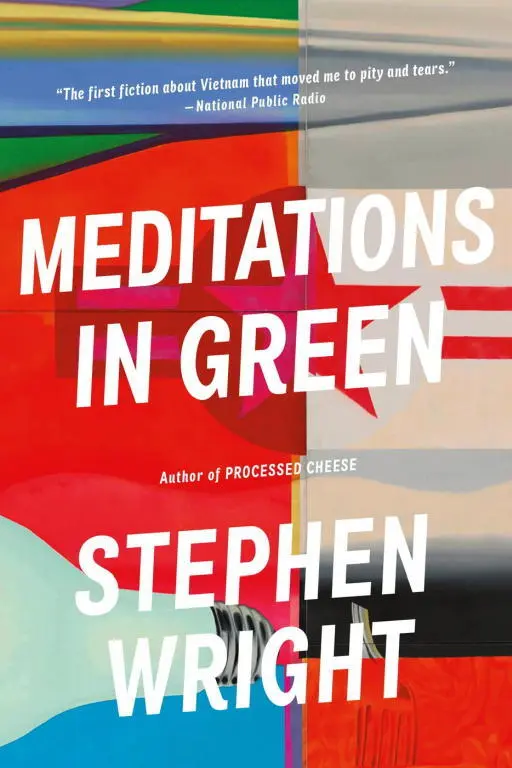
- Название:Meditations in Green
- Автор:
- Издательство:Little, Brown and Company
- Жанр:
- Год:2020
- Город:New York
- ISBN:978-0-316-42736-4
- Рейтинг книги:5 / 5. Голосов: 1
-
Избранное:Добавить в избранное
- Отзывы:
-
Ваша оценка:
Meditations in Green: краткое содержание, описание и аннотация
Предлагаем к чтению аннотацию, описание, краткое содержание или предисловие (зависит от того, что написал сам автор книги «Meditations in Green»). Если вы не нашли необходимую информацию о книге — напишите в комментариях, мы постараемся отыскать её.
Deployed to Vietnam with the U.S. Army’s 1069 Intelligence Group, Spec. 4 James Griffin starts out clear-eyed and hardworking, believing he can glide through the war unharmed. But the kaleidoscope of horrors he experiences gets inside him relentlessly. He gradually collapses and ends up unstrung, in step with the exploding hell around him and waiting for the cataclysm that will bring him home, dead or not.
Griffin survives, but back in the U.S. his battles intensify. Beset by addiction, he takes up meditating on household plants and attempts to adjust to civilian life and beat back the insanity that threatens to overwhelm him.
Meditations in Green is a haunting exploration of the harrowing costs of war and yet-unhealed wounds, “the impact of an experience so devastating that words can hardly contain it” (Walter Kendrick, the New York Times Book Review). Through passages gorgeous, agonizing, and surreal, Stephen Wright paints a searing portrait of a nation driven to the brink by violence and deceit.
Meditations in Green — читать онлайн бесплатно полную книгу (весь текст) целиком
Ниже представлен текст книги, разбитый по страницам. Система сохранения места последней прочитанной страницы, позволяет с удобством читать онлайн бесплатно книгу «Meditations in Green», без необходимости каждый раз заново искать на чём Вы остановились. Поставьте закладку, и сможете в любой момент перейти на страницу, на которой закончили чтение.
Интервал:
Закладка:
“We all here?” asked Captain Raleigh. Sergeant Lacrosse was counting heads.
“Okay,” said Raleigh. “Let’s do it.”
One by one the patrol began picking its way through the foliage. Griffin was fascinated. He had never before seen a limb or a leaf this close or without the interdiction of a lens. He felt like a spy in the camp of the enemy, a judge locked into a prison of those he had condemned. As he moved in deeper and deeper, he had the eerie sense of vegetation thrusting itself at him for inspection and comment. Green tongues lapped at his calves, elastic branches tugged at his arms. And there was no end to it. You pressed through one layer to arrive at another just like it and then one beyond that and another and another like passing through doors in an estate of measureless dimensions. The hallways opened into other halls, the tall ornate stairs led to identical stairs even higher—jungle as architecture—pillar after pillar, arches framing arches, rooms connected one to the other in receding series, drapes and rope and tiered balconies, Gothic ornamental expanding geometrically in every direction, and below, who could be certain what was bubbling and fizzing down in that crypt? The bush was a stifling enclosure—the air as thick and stale as an overinflated tire—of gigantic proportions in no need of tenants or staff. Collapse and regeneration occurred at the same moment. Buckling walls and decaying furniture were repaired automatically here in this home of the future where matter itself was perpetually pregnant. The effort to bring down this house, of which Griffin was a part, seemed at this close distance to be both frightening and ludicrous. On the ground, crawling like a bug through the bed of those deceptive film images, he sensed a force the camera could never record, a chemical hardly subdue. Getting out alive was the major priority now. Already his uniform was as wet and uncomfortable as if he had showered in it. Following the others up the mountain, one leg lifting mechanically after the other, sliding on the slope, tumbling into a blind tangle of roots and branches, lungs working useless clouds of must and pollen in and out, heart thumping in his ears, he realized that were he to die in here among these botanical springs and gears, a Green Machine larger and more efficient than any human bureaucracy or mechanical invention would promptly initiate the indifferent processes of converting flesh and dreams into plant food. He felt weak, out of shape. Even the rocks in here appeared green, fossilized droppings. Physical discomfort and fear combined to produce a painful sense of isolation even though he could see and hear the others all around him. Drops of sweat lined up on his nose to take turns leaping off the tip. He popped salt tablets to no effect. He thought of Claypool. A stream provided momentary relief, wading waist deep across a yellow flow of foul silt. Then it was up the opposite bank, the climb continuing, the incline turning steadily steeper and rockier. They came to a place where all the vegetation seemed to be growing sideways; they crawled for yards, bumping their heads, scraping knees on hard tough horizontal stems. “What is this shit?” Griffin heard someone whisper. “Bamboo?” He hadn’t the vaguest notion. He couldn’t see where he was going, he thought he might actually faint, he felt as though he were locked in a stuffy closet packed with broomsticks and rubber raincoats. He was experiencing a vegetable overdose, a chlorophyll freakout. Then Griffin got mad, indignant, why was he being forced to endure this unnecessary agony? The whole stinking forest should have been sprayed long ago, hosed down, drenched in Orange, leaves blackened, branches denuded, undergrowth dried into brittle paper. The mountain was surely overrun with VC and their camouflaged crops, secret manioc fields, banana groves, rice paddies, water wells. Who permitted these outrages, where was the technology when you needed it? No wonder we were losing the damn war. In spite of the sweat in his eyes, the raw sore rubbing open on his left heel, he discovered he was smiling. Yes, you too, you fucking American.
Then they came to a collection of boulders, narrow passages you could slip through sideways, high walls you climbed hand over hand up the vines clinging to their sides. “What is this?” asked someone on top, pointing out clumps of green excrement. “Monkey shit?” No one knew. No one had heard or seen an animal of any kind. Beyond the boulders there was a second stream, swifter and deeper than the first. Two men slipped under and were carried downcurrent into a rock dam. One man lost his rifle. Griffin kept a careful grip on the rope and safe on the opposite bank watched his pants deflate as the water poured out onto the ground. The rest of the day his feet seemed encased in warm sponges. He was beginning to feel hungry. Suddenly they were on a foot trail or an animal run or a convenient convoluted length of natural erosion. The Marines put their clear-eyed booby trap expert on point. The pace picked up. Griffin, of course, was convinced the ground had been smoothed by hundreds of rubber-sandaled feet. They were close to finding the wreckage. Past the crisis, Griffin’s earlier emotional and physical distress had calmed. Accustomed now to the muscular aches, the tightening of the nerves, the suffocating air, the claustrophobic botany, the sweat slick as slime on his face, he realized at first with a shock, then with a curious mix of pride and embarrassment, that he could actually take this torture, that despite his intentions he truly was a soldier, a fact he had never before been able to imagine. For a moment he saw himself through other eyes, the thin fatigued body in a wet wrinkled uniform, scarred rifle clutched in grimy hand, flushed baby face staring dully beneath battered helmet. Yes, all the details were correct. He had become a photograph, a new image to interpret.
Up ahead a shaft of direct sunlight penetrated the green shadows as if somewhere above there was a skylight built into the foliage roof. Griffin followed the others into a clearing and with freshly-discovered soldier’s eyes saw this: the helicopter, suffering a compound fracture, lay in an uneven heap along a ridge of broken rock, the rocks and surrounding grass littered with hundreds, thousands of variously shaped and sized pieces of bright metal, one window on the pilot’s side having survived the plunge completely intact, reflected a square of blinding sun back up into the sky—a fragment of unexplainable wonder so often left behind by the universe of catastrophe as a sort of perverse signature. His soldier’s eyes tried to avoid the centerpiece of this arrangement, but the soldier’s muscles in his neck kept rotating his head back and back again as if his skull was one huge metal ball uncontrollably drawn by the force of an irresistible magnet. The crew and passengers of the downed helicopter were hanging at spaced intervals from the rotor blades, strung up by the necks with twisted lengths of bicycle chain. Bicycle chain? Their unbuttoned unzipped pants drooped in folds about their ankles. Groins and thighs were black with stale blood, alive with insect movement. Protruding between the lips of each mouth was a small gray mushroom, the severed remains of each man’s penis. Swollen faces had begun to turn colors. Body fluids dripped off boot soles like leaking motor oil, staining the grass and providing puddles of nourishment for thirsty ants and centipedes. In the stillness the sun buzzed like a fluorescent lamp. One of Major Quimby’s boots was missing and revealed, dangling in midair, a long bony foot whose green sock, heavy with blood, had begun slipping off. Griffin thought of how embarrassed the major would have been to be seen like this.
Someone gagged.
“Let’s go,” muttered Captain Raleigh, “get them down from there.”
Читать дальшеИнтервал:
Закладка:
Похожие книги на «Meditations in Green»
Представляем Вашему вниманию похожие книги на «Meditations in Green» списком для выбора. Мы отобрали схожую по названию и смыслу литературу в надежде предоставить читателям больше вариантов отыскать новые, интересные, ещё непрочитанные произведения.











Обсуждение, отзывы о книге «Meditations in Green» и просто собственные мнения читателей. Оставьте ваши комментарии, напишите, что Вы думаете о произведении, его смысле или главных героях. Укажите что конкретно понравилось, а что нет, и почему Вы так считаете.