Ken Follett - World Without End
Здесь есть возможность читать онлайн «Ken Follett - World Without End» весь текст электронной книги совершенно бесплатно (целиком полную версию без сокращений). В некоторых случаях можно слушать аудио, скачать через торрент в формате fb2 и присутствует краткое содержание. Жанр: Историческая проза, на английском языке. Описание произведения, (предисловие) а так же отзывы посетителей доступны на портале библиотеки ЛибКат.
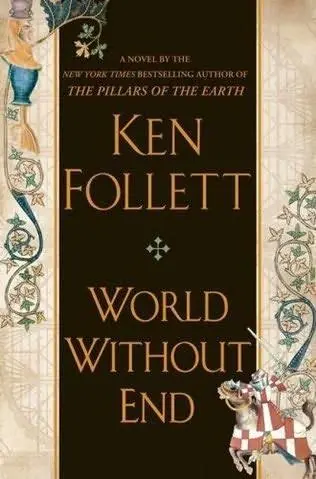
- Название:World Without End
- Автор:
- Жанр:
- Год:неизвестен
- ISBN:нет данных
- Рейтинг книги:5 / 5. Голосов: 1
-
Избранное:Добавить в избранное
- Отзывы:
-
Ваша оценка:
World Without End: краткое содержание, описание и аннотация
Предлагаем к чтению аннотацию, описание, краткое содержание или предисловие (зависит от того, что написал сам автор книги «World Without End»). Если вы не нашли необходимую информацию о книге — напишите в комментариях, мы постараемся отыскать её.
Ken Follett has 90 million readers worldwide. The Pillars of the Earth is his bestselling book of all time. Now, eighteen years after the publication of The Pillars of the Earth, Ken Follett has written the most-anticipated sequel of the year, World Without End.
In 1989 Ken Follett astonished the literary world with The Pillars of the Earth, a sweeping epic novel set in twelfth-century England centered on the building of a cathedral and many of the hundreds of lives it affected. Critics were overwhelmed-"it will hold you, fascinate you, surround you" (Chicago Tribune)-and readers everywhere hoped for a sequel.
World Without End takes place in the same town of Kingsbridge, two centuries after the townspeople finished building the exquisite Gothic cathedral that was at the heart of The Pillars of the Earth. The cathedral and the priory are again at the center of a web of love and hate, greed and pride, ambition and revenge, but this sequel stands on its own. This time the men and women of an extraordinary cast of characters find themselves at a crossroad of new ideas-about medicine, commerce, architecture, and justice. In a world where proponents of the old ways fiercely battle those with progressive minds, the intrigue and tension quickly reach a boiling point against the devastating backdrop of the greatest natural disaster ever to strike the human race-the Black Death.
Three years in the writing, and nearly eighteen years since its predecessor, World Without End breathes new life into the epic historical novel and once again shows that Ken Follett is a masterful author writing at the top of his craft.
World Without End — читать онлайн бесплатно полную книгу (весь текст) целиком
Ниже представлен текст книги, разбитый по страницам. Система сохранения места последней прочитанной страницы, позволяет с удобством читать онлайн бесплатно книгу «World Without End», без необходимости каждый раз заново искать на чём Вы остановились. Поставьте закладку, и сможете в любой момент перейти на страницу, на которой закончили чтение.
Интервал:
Закладка:
She collected herself with an effort. “What about you?” she said. “Have you remarried?”
“No.” He could hardly explain that he was having a love affair with the prioress of Kingsbridge. “I think I could, though, if the right woman were… willing. You might come to feel the same, eventually.”
“But you don’t understand. As the widow of an earl with no heirs, I would have to marry someone King Edward chose for me. And the king would have no thought for my wishes. His only concern would be who should be the next earl of Shiring.”
“I see.” Merthin had not thought of that. He could imagine that an arranged marriage might be particularly loathsome to a widow who had truly loved her first husband.
“How dreadful of me to be speaking of another husband while my first is alive,” she said. “I don’t know what came over me.”
Merthin patted her hand sympathetically. “It’s understandable.”
The door at the top of the stairs opened and Caris came out, drying her hands on a cloth. Merthin suddenly felt uncomfortable about holding Philippa’s hand. He was tempted to thrust it away from him, but realized how guilty that would look, and managed to resist the impulse. He smiled at Caris and said: “How are your patients?”
Caris’s eyes went to their linked hands, but she said nothing. She came down the stairs, untying her linen mask.
Philippa unhurriedly withdrew her hand.
Caris took off her mask and said: “I’m very sorry to have to tell you, my lady, that Earl William is dead.”
“I need a new horse,” said Ralph Fitzgerald. His favourite mount, Griff, was getting old. The spirited bay palfrey had suffered a sprain in its left hind leg that had taken months to heal, and now it was lame again in the same leg. Ralph felt sad. Griff was the horse Earl Roland had given him when he was a young squire, and it had been with him ever since, even going to the French wars. It might serve him a few years longer for unhurried trips from village to village within his domain, but its hunting days were over.
“We could go to Shiring market tomorrow and buy another,” Alan Fernhill said.
They were in the stable, looking at Griff’s fetlock. Ralph liked stables. He enjoyed the earthy smell, the strength and beauty of the horses, and the company of rough-handed men engrossed in physical tasks. It took him back to his youth, when the world had seemed a simple place.
He did not at first respond to Alan’s suggestion. What Alan did not know was that Ralph did not have the money to buy a horse.
The plague had at first enriched him, through the inheritance tax: land that normally passed from father to son once in a generation had changed hands twice or more in a few months, and he got a payment every time – traditionally the best beast, but often a fixed sum in cash. But then land had started to fall into disuse for lack of people to farm it. At the same time, agricultural prices had dropped. The upshot was that Ralph’s income, in money and produce, fell drastically.
Things were bad, he thought, when a knight could not afford a horse.
Then he remembered that Nate Reeve was due to come to Tench Hall today with the quarterly dues from Wigleigh. Every spring that village was obliged to provide its lord with twenty-four hoggets, year-old sheep. They could be driven to Shiring market and sold, and they should raise enough cash to pay for a palfrey, if not a hunter. “All right,” Ralph said to Alan. “Let’s see if the bailiff of Wigleigh is here.”
They went into the hall. This was a feminine zone, and Ralph’s spirits dropped immediately. Tilly was sitting by the fire, nursing their three-month-old son, Gerry. Mother and baby were in vigorous good health, despite Tilly’s youth. Her slight, girlish body had changed drastically: she now had swollen breasts with large, leathery nipples at which the baby sucked greedily. Her belly sagged loosely like that of an old woman. Ralph had not lain with her for many months and he probably never would again.
Nearby sat the grandfather after whom the baby was named, Sir Gerald, with Lady Maud. Ralph’s parents were now old and frail, but every morning they walked from their house in the village to the manor house to see their grandson. Maud said the baby looked like Ralph, but he could not see the resemblance.
Ralph was pleased to see that Nate was also in the hall.
The hunchbacked bailiff sprang up from his bench. “Good day to you, Sir Ralph,” he said.
He had a hangdog look about him, Ralph observed. “What’s the matter with you, Nate?” he said. “Have you brought my hoggets?”
“No, sir.”
“Why the devil not?”
“We’ve got none, sir. There are no sheep left in Wigleigh, except for a few old ewes.”
Ralph was shocked. “Has someone stolen them?”
“No, but some have been given to you already, as heriot when their owners died, and then we couldn’t find a tenant to take over Jack Shepherd’s land, and many sheep died over the winter. Then there was no one to look to the early lambs this spring, so we lost most of those, and some of the mothers.”
“But this is impossible!” Ralph said angrily. “How are noblemen to live if their serfs let the livestock perish?”
“We thought perhaps the plague was over, when it died down in January and February, but now it seems to be coming back.”
Ralph repressed a shudder of terror. Like everyone else, he had been thanking God that he had escaped the plague. Surely it could not return?
Nate went on: “Perkin died this week, and his wife, Peg, and his son, Rob, and his son-in-law, Billy Howard. That’s left Annet with all those acres to manage, which she can’t possibly do.”
“Well, there must be a heriot due on that property, then.”
“There will be, when I can find a tenant to take it over.”
Parliament was in the process of passing new legislation to stop labourers flitting about the country demanding even higher wages. As soon as the ordinance became law, Ralph would enforce it and get his workers back. Even then, he now realized, he would be desperate to find tenants.
Nate said: “I expect you’ve heard of the death of the earl.”
“No!” Ralph was shocked again.
“What’s that?” Sir Gerald said. “Earl William is dead?”
“Of the plague,” Nate explained.
Tilly said: “Poor Uncle William!”
The baby sensed her mood and wailed.
Ralph spoke over the noise. “When did this happen?”
“Only three days ago,” Nate replied.
Tilly gave the baby the nipple again, and he shut up.
“So William’s elder son is the new earl,” Ralph mused. “He can’t be more than twenty.”
Nate shook his head. “Rollo also died of the plague.”
“Then the younger son-”
“Dead too.”
“Both sons!” Ralph’s heart leaped. It had always been his dream to become the earl of Shiring. Now the plague had given him the opportunity. And the plague had also improved his chances, for many likely candidates for the title had been wiped out.
He caught his father’s eye. The same thought had occurred to Sir Gerald.
Tilly said: “Rollo and Rick dead – it’s so awful.” She began to cry.
Ralph ignored her and tried to think through the possibilities. “Let’s see, what surviving relatives are there?”
Gerald said to Nate: “I presume the countess died too?”
“No, sir. Lady Philippa lives. So does her daughter, Odila.”
“Ah!” said Gerald. “So, whoever the king chooses will have to marry Philippa in order to become earl.”
Ralph was thunderstruck. Since he was a lad he had dreamed of marrying Lady Philippa. Now there was an opportunity to achieve both his ambitions at one stroke.
Читать дальшеИнтервал:
Закладка:
Похожие книги на «World Without End»
Представляем Вашему вниманию похожие книги на «World Without End» списком для выбора. Мы отобрали схожую по названию и смыслу литературу в надежде предоставить читателям больше вариантов отыскать новые, интересные, ещё непрочитанные произведения.
Обсуждение, отзывы о книге «World Without End» и просто собственные мнения читателей. Оставьте ваши комментарии, напишите, что Вы думаете о произведении, его смысле или главных героях. Укажите что конкретно понравилось, а что нет, и почему Вы так считаете.