Ken Follett - World Without End
Здесь есть возможность читать онлайн «Ken Follett - World Without End» весь текст электронной книги совершенно бесплатно (целиком полную версию без сокращений). В некоторых случаях можно слушать аудио, скачать через торрент в формате fb2 и присутствует краткое содержание. Жанр: Историческая проза, на английском языке. Описание произведения, (предисловие) а так же отзывы посетителей доступны на портале библиотеки ЛибКат.
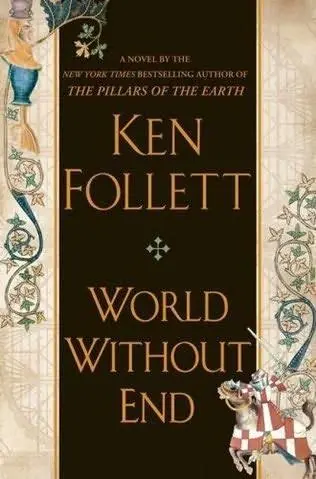
- Название:World Without End
- Автор:
- Жанр:
- Год:неизвестен
- ISBN:нет данных
- Рейтинг книги:5 / 5. Голосов: 1
-
Избранное:Добавить в избранное
- Отзывы:
-
Ваша оценка:
World Without End: краткое содержание, описание и аннотация
Предлагаем к чтению аннотацию, описание, краткое содержание или предисловие (зависит от того, что написал сам автор книги «World Without End»). Если вы не нашли необходимую информацию о книге — напишите в комментариях, мы постараемся отыскать её.
Ken Follett has 90 million readers worldwide. The Pillars of the Earth is his bestselling book of all time. Now, eighteen years after the publication of The Pillars of the Earth, Ken Follett has written the most-anticipated sequel of the year, World Without End.
In 1989 Ken Follett astonished the literary world with The Pillars of the Earth, a sweeping epic novel set in twelfth-century England centered on the building of a cathedral and many of the hundreds of lives it affected. Critics were overwhelmed-"it will hold you, fascinate you, surround you" (Chicago Tribune)-and readers everywhere hoped for a sequel.
World Without End takes place in the same town of Kingsbridge, two centuries after the townspeople finished building the exquisite Gothic cathedral that was at the heart of The Pillars of the Earth. The cathedral and the priory are again at the center of a web of love and hate, greed and pride, ambition and revenge, but this sequel stands on its own. This time the men and women of an extraordinary cast of characters find themselves at a crossroad of new ideas-about medicine, commerce, architecture, and justice. In a world where proponents of the old ways fiercely battle those with progressive minds, the intrigue and tension quickly reach a boiling point against the devastating backdrop of the greatest natural disaster ever to strike the human race-the Black Death.
Three years in the writing, and nearly eighteen years since its predecessor, World Without End breathes new life into the epic historical novel and once again shows that Ken Follett is a masterful author writing at the top of his craft.
World Without End — читать онлайн бесплатно полную книгу (весь текст) целиком
Ниже представлен текст книги, разбитый по страницам. Система сохранения места последней прочитанной страницы, позволяет с удобством читать онлайн бесплатно книгу «World Without End», без необходимости каждый раз заново искать на чём Вы остановились. Поставьте закладку, и сможете в любой момент перейти на страницу, на которой закончили чтение.
Интервал:
Закладка:
He considered the prospect. The house was beautiful. It was home to Lena’s children, and a familiar place to Lolla, and even to Gianni’s baby: all the children would be happy here. He bad inherited enough money to live on for the rest of his life. Lena was a woman of intelligence and experience, and he could readily imagine the pleasures of becoming intimate with her.
She read his mind. She took his hand and pressed it to her bosom. Her breasts felt soft and warm through the light wool dress.
But this was not what he wanted. He drew Lena’s hand to him and kissed it. “I will provide for you and your children,” he said. “Don’t worry.”
“Thank you, lord,” she said, but she looked disappointed, and something in her eyes told Merthin that her offer had not been merely practical. She had genuinely hoped he might be more to her than just her new owner. But that was part of the problem. He could not imagine sex with someone he owned. The idea was distasteful to the point of revulsion.
He sipped his wine and felt stronger. If he was not drawn to an easy life of luxury and sensual gratification, what did he want? His family was almost gone: only Lolla was left. But he still had his work. Around the city were three sites where designs of his were under construction. He was not going to give up the job he loved. He had not survived the great death to become an idler. He recalled his youthful ambition to build the tallest building in England. He would pick up where he had left off. He would recover from the loss of Silvia by throwing himself into his building projects.
He got up to leave. Lena flung her arms around him. “Thank you,” she said. “Thank you for saying you will take care of my children.”
He patted her back. “They are Alessandro’s grandchildren,” he said. In Florence, the children of slaves were not themselves enslaved. “When they grow up they will be rich.” He detached her arms gently and went down the stairs.
All the houses were locked and shuttered. On some doorsteps he saw a shrouded form that he presumed was a dead body. There were a few people on the streets, but mostly the poorer sort. The desolation was unnerving. Florence was the greatest city in the Christian world, a noisy commercial metropolis producing thousands of yards of fine woollen cloth every day, a market where vast sums of money were paid over on no more security than a letter from Antwerp or the verbal promise of a prince. Walking through these silent, empty streets was like seeing an injured horse that has fallen and cannot get up: immense strength was suddenly brought to nothing. He saw no one from his circle of acquaintance. His friends were keeping indoors, he presumed – those that were still alive.
He went first to a square nearby, in the old Roman city, where he was building a fountain for the municipality. He had devised an elaborate system to recycle almost all the water during Florence’s long, dry summers.
But, when he reached the square, he could see immediately that no one was working on the site. The underground pipes had been put in and covered over before he fell ill, and the first course of masonry for the stepped plinth around the pool had been laid. However, the dusty, neglected look of the stones told him that no work had been done for days. Worse, a small pyramid of mortar on a wooden board had hardened into a solid mass that gave off a puff of dust when he kicked it. There were even some tools lying on the ground. It was a miracle they had not been stolen.
The fountain was going to be stunning. In Merthin’s workshop, the best stone carver in the city was sculpting the centrepiece – or had been. Merthin was disappointed that work had stopped. Surely not all the builders had died? Perhaps they were waiting to see whether Merthin would recover.
This was the smallest of his three projects, albeit a prestigious one. He left the square and headed north to inspect another one. But as he walked he worried. He had not yet met anyone knowledgeable enough to give him a wider perspective. What was left of the city government? Was the plague easing off or getting worse? What about the rest of Italy?
One thing at a time, he told himself.
He was building a home for Giulielmo Caroli, the older brother of Buonaventura. It was to be a real palazzo, a high double-fronted house designed around a grand staircase wider than some of the city’s streets. The ground floor wall was already up. The façade was battered, or inclined, at ground level, the slight protrusion giving an impression of fortification; but above were elegant pointed-arch two-light windows with a trefoil. The design said that the people inside were both powerful and refined, which was what the Caroli family wanted.
The scaffolding had been erected for the second floor, but no one was working. There should have been five masons laying stones. The only person on site was an elderly man who acted as caretaker and lived in a wooden hut at the back. Merthin found him cooking a chicken over a fire. The fool had used costly marble slabs for his hearth. “Where is everyone?” Merthin said abruptly.
The caretaker leaped to his feet. “Signor Caroli died, and his son Agostino wouldn’t pay the men, so they left, those that weren’t already dead themselves.”
That was a blow. The Caroli family was one of the richest in Florence. If they felt they could no longer afford to build, the crisis was severe indeed.
“So Agostino is alive?”
“Yes, master, I saw him this morning.”
Merthin knew young Agostino. He was not as clever as his father or his uncle Buonaventura, so he compensated by being extremely cautious and conservative. He would not recommence building until he was sure the family finances had recovered from the effects of the plague.
However, Merthin felt confident his third and largest project would continue. He was building a church for an order of friars much favoured by the city’s merchants. The site was south of the river, so he crossed the new bridge.
This bridge had been finished only two years ago. In fact Merthin had done some work on it, under the leading designer, the painter Taddeo Gaddi. The bridge had to withstand fast-flowing water when the winter snows melted, and Merthin had helped with the design of the piers. Now, as he crossed, he was dismayed to see that all the little goldsmiths’ shops on the bridge were closed – another bad sign.
The church of Sant’ Anna dei Frari was his most ambitious project to date. It was a big church, more like a cathedral – the friars were rich – though nothing like the cathedral at Kingsbridge. Italy had Gothic cathedrals, Milan being one of the greatest, but modern-minded Italians did not like the architecture of France and England: they regarded huge windows and flying buttresses as a foreign fetish. The obsession with light, which made sense in the gloomy north-west of Europe, seemed perverse in sunny Italy, where people sought shade and coolness. Italians identified with the classical architecture of ancient Rome, the ruins of which were all around them. They liked gable ends and round arches, and they rejected ornate exterior sculpture in favour of decorative patterns of different-coloured stone and marble.
But Merthin was going to surprise even the Florentines with this church. The plan was a series of squares, each topped by a dome – five in a row, and two either side of the crossing. He had heard about domes back in England, but had never seen one until he visited Siena cathedral. There were none in Florence. The clerestory would be a row of round windows, or oculi. Instead of narrow pillars that reached yearningly for heaven, this church would have circles, complete in themselves, with the air of earthbound self-sufficiency that characterized the commercial people of Florence.
Читать дальшеИнтервал:
Закладка:
Похожие книги на «World Without End»
Представляем Вашему вниманию похожие книги на «World Without End» списком для выбора. Мы отобрали схожую по названию и смыслу литературу в надежде предоставить читателям больше вариантов отыскать новые, интересные, ещё непрочитанные произведения.





Обсуждение, отзывы о книге «World Without End» и просто собственные мнения читателей. Оставьте ваши комментарии, напишите, что Вы думаете о произведении, его смысле или главных героях. Укажите что конкретно понравилось, а что нет, и почему Вы так считаете.