Ken Follett - World Without End
Здесь есть возможность читать онлайн «Ken Follett - World Without End» весь текст электронной книги совершенно бесплатно (целиком полную версию без сокращений). В некоторых случаях можно слушать аудио, скачать через торрент в формате fb2 и присутствует краткое содержание. Жанр: Историческая проза, на английском языке. Описание произведения, (предисловие) а так же отзывы посетителей доступны на портале библиотеки ЛибКат.
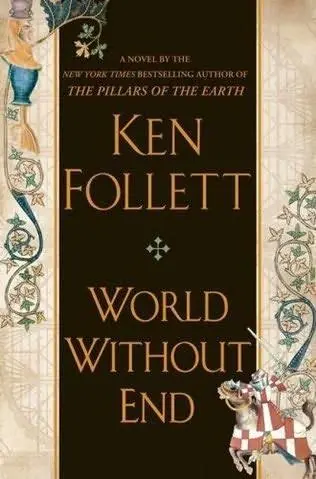
- Название:World Without End
- Автор:
- Жанр:
- Год:неизвестен
- ISBN:нет данных
- Рейтинг книги:5 / 5. Голосов: 1
-
Избранное:Добавить в избранное
- Отзывы:
-
Ваша оценка:
World Without End: краткое содержание, описание и аннотация
Предлагаем к чтению аннотацию, описание, краткое содержание или предисловие (зависит от того, что написал сам автор книги «World Without End»). Если вы не нашли необходимую информацию о книге — напишите в комментариях, мы постараемся отыскать её.
Ken Follett has 90 million readers worldwide. The Pillars of the Earth is his bestselling book of all time. Now, eighteen years after the publication of The Pillars of the Earth, Ken Follett has written the most-anticipated sequel of the year, World Without End.
In 1989 Ken Follett astonished the literary world with The Pillars of the Earth, a sweeping epic novel set in twelfth-century England centered on the building of a cathedral and many of the hundreds of lives it affected. Critics were overwhelmed-"it will hold you, fascinate you, surround you" (Chicago Tribune)-and readers everywhere hoped for a sequel.
World Without End takes place in the same town of Kingsbridge, two centuries after the townspeople finished building the exquisite Gothic cathedral that was at the heart of The Pillars of the Earth. The cathedral and the priory are again at the center of a web of love and hate, greed and pride, ambition and revenge, but this sequel stands on its own. This time the men and women of an extraordinary cast of characters find themselves at a crossroad of new ideas-about medicine, commerce, architecture, and justice. In a world where proponents of the old ways fiercely battle those with progressive minds, the intrigue and tension quickly reach a boiling point against the devastating backdrop of the greatest natural disaster ever to strike the human race-the Black Death.
Three years in the writing, and nearly eighteen years since its predecessor, World Without End breathes new life into the epic historical novel and once again shows that Ken Follett is a masterful author writing at the top of his craft.
World Without End — читать онлайн бесплатно полную книгу (весь текст) целиком
Ниже представлен текст книги, разбитый по страницам. Система сохранения места последней прочитанной страницы, позволяет с удобством читать онлайн бесплатно книгу «World Without End», без необходимости каждый раз заново искать на чём Вы остановились. Поставьте закладку, и сможете в любой момент перейти на страницу, на которой закончили чтение.
Интервал:
Закладка:
Merthin picked her up and hugged her. “You’re alive,” he said in English.
There was a sound from the next room, and Maria walked in. A grey-haired woman in her fifties, she was Lolla’s nurse. “Master!” she said. “You got up – are you better?”
“Where is your mistress?” he said.
Maria’s face fell. “I’m so sorry, master,” she said. “The mistress died.”
Lolla said: “Mama’s gone.”
Merthin felt the shock like a blow. Stunned, he handed Lolla to Maria. Moving slowly and carefully, he turned away and walked out of the room, then down the stairs to the piano nobile, the principal floor. He stared at the long table, the empty chairs, the rugs on the floor and the pictures on the walls. It looked like someone else’s home.
He stood in front of a painting of the Virgin Mary with her mother. Italian painters were superior to the English or any others, and this artist had given Saint Anne the face of Silvia. She was a proud beauty, with flawless olive skin and noble features, but the painter had seen the sexual passion smouldering in those aloof brown eyes.
It was hard to comprehend that Silvia no longer existed. He thought of her slim body, and remembered how he had marvelled, again and again, at her perfect breasts. That body, with which he had been so completely intimate, now lay in the ground somewhere. When he imagined that, tears came to his eyes at last, and he sobbed with grief.
Where was her grave? he wondered in his misery. He remembered that funerals had ceased in Florence: people were terrified to leave their houses. They simply dragged the bodies outside and laid them on the street. The city’s thieves, beggars and drunks had acquired a new profession: they were called corpse carriers or becchini, and they charged exorbitant fees to take the bodies away and put them in mass graves. Merthin might never know where Silvia lay.
They had been married four years. Looking at her picture, garbed in Saint Anne’s conventional red dress, Merthin suffered an access of painful honesty, and asked himself whether he had really loved her. He was very fond of her, but it was not an all-consuming passion. She had an independent spirit and a sharp tongue, and he was the only man in Florence with the nerve to woo her, despite her father’s wealth. In return, she had given him complete devotion. But she had accurately gauged the quality of his love. “What are you thinking about?” she used to say sometimes, and he would give a guilty start, because he had been remembering Kingsbridge. Soon she changed it to: “Who are you thinking about?” He never spoke Caris’s name, but Silvia said: “It must be a woman, I can tell by the look on your face.” Eventually she began to talk about ‘your English girl’. She would say: “You’re remembering your English girl,” and she was always right. But she seemed to accept it. Merthin was faithful to her. And he adored Lolla.
After a while, Maria brought him soup and bread. “What day is it?” he asked her.
“Tuesday.”
“How long was I in bed?”
“Two weeks. You were so ill.”
He wondered why he had survived. Some people never succumbed to the disease, as if they had natural protection; but those who caught it nearly always died. However, the tiny minority who recovered were doubly fortunate, for no one had ever caught the illness a second time.
When he had eaten, he felt stronger. He had to rebuild his life, he realized. He suspected that he had already made this decision once, when he was ill, but again he was tantalized by the thread of a memory slipping from his grasp.
His first task was to find out how much of his family was left.
He took his dishes to the kitchen, where Maria was feeding Lolla bread dipped in goat’s milk. He asked her: “What about Silvia’s parents? Are they alive?”
“I don’t know,” she said. “I haven’t heard. I go out only to buy food.”
“I’d better find out.”
He got dressed and went downstairs. The ground floor of the house was a workshop, with the yard at the rear used for storing wood and stone. No one was at work, either inside or out.
He left the house. The buildings around him were mostly stone-built, some of them very grand: Kingsbridge had no houses to compare with these. The richest man in Kingsbridge, Edmund Wooler, had lived in a timber house. Here in Florence, only the poor lived in such places.
The street was deserted. He had never seen it this way, not even in the middle of the night. The effect was eerie. He wondered how many people had died: a third of the population? Half? Were their ghosts still lingering in alleyways and shadowed corners, enviously watching the lucky survivors?
The Christi house was on the next street. Merthin’s father-in-law, Alessandro Christi, had been his first and best friend in Florence. A schoolmate of Buonaventura Caroli, Alessandro had given Merthin his first commission, a simple warehouse building. He was, of course, Lolla’s grandpa.
The door of Alessandro’s palagetto was locked. That was unusual in itself. Merthin banged on the woodwork and waited. Eventually it was opened by Elizabetta, a small, plump woman who was Alessandro’s laundress. She stared at him in shock. “You’re alive!” she said.
“Hello, Betta,” he said. “I’m glad to see that you’re alive, too.”
She turned and called back into the house: “It’s the English lord!”
He had told them he was not a lord, but the servants did not believe him. He stepped inside. “Alessandro?” he said.
She shook her head and began to cry.
“And your mistress?”
“Both dead.”
The stairs led from the entrance hall to the main floor. Merthin walked up slowly, surprised by how weak he still felt. In the main room he sat down to catch his breath. Alessandro had been wealthy, and the room was a showplace of rugs and hangings, paintings and jewelled ornaments and books.
“Who else is here?” he asked Elizabetta.
“Just Lena and her children.” Lena was an Asiatic slave, unusual but by no means unique in prosperous Florentine households. She had two small children by Alessandro, a boy and a girl, and he had treated them just like his legitimate offspring; in fact Silvia had said acidly that he doted on them more than he ever had on her and her brother. The arrangement was considered eccentric rather than scandalous by the sophisticated Florentines.
Merthin said: “What about Signor Gianni?” Gianni was Silvia’s brother.
“Dead. And his wife. The baby is here with me.”
“Dear God.”
Betta said tentatively: “And your family, lord?”
“My wife is dead.”
“I am so sorry.”
“But Lolla is alive.”
“Thank God!”
“Maria is taking care of her.”
“Maria is a good woman. Would you like some refreshment?”
Merthin nodded, and she went away.
Lena’s children came to stare at him: a dark-eyed boy of seven who looked like Alessandro, and a pretty four-year-old with her mother’s Asiatic eyes. Then Lena herself came in, a beautiful woman in her twenties with golden skin and high cheekbones. She brought him a silver goblet of dark red Tuscan wine and a tray of almonds and olives.
She said: “Will you come to live here, lord?”
Merthin was surprised. “I don’t think so – why?”
“The house is yours, now.” She waved a hand to indicate the Christi family’s wealth. “Everything is yours.”
Merthin realized she was right. He was Alessandro Christi’s only surviving adult relative. That made him the heir – and the guardian of three children in addition to Lolla.
“Everything,” Lena repeated, giving him a direct look.
Merthin met her candid gaze, and realized that she was offering herself.
Читать дальшеИнтервал:
Закладка:
Похожие книги на «World Without End»
Представляем Вашему вниманию похожие книги на «World Without End» списком для выбора. Мы отобрали схожую по названию и смыслу литературу в надежде предоставить читателям больше вариантов отыскать новые, интересные, ещё непрочитанные произведения.








Обсуждение, отзывы о книге «World Without End» и просто собственные мнения читателей. Оставьте ваши комментарии, напишите, что Вы думаете о произведении, его смысле или главных героях. Укажите что конкретно понравилось, а что нет, и почему Вы так считаете.