Ken Follett - World Without End
Здесь есть возможность читать онлайн «Ken Follett - World Without End» весь текст электронной книги совершенно бесплатно (целиком полную версию без сокращений). В некоторых случаях можно слушать аудио, скачать через торрент в формате fb2 и присутствует краткое содержание. Жанр: Историческая проза, на английском языке. Описание произведения, (предисловие) а так же отзывы посетителей доступны на портале библиотеки ЛибКат.
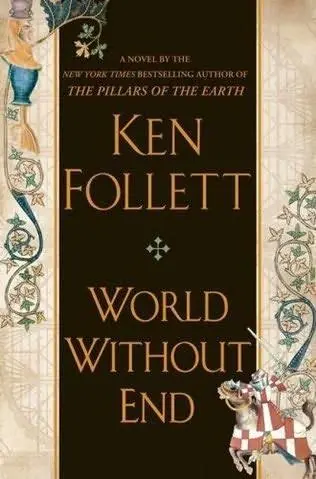
- Название:World Without End
- Автор:
- Жанр:
- Год:неизвестен
- ISBN:нет данных
- Рейтинг книги:5 / 5. Голосов: 1
-
Избранное:Добавить в избранное
- Отзывы:
-
Ваша оценка:
World Without End: краткое содержание, описание и аннотация
Предлагаем к чтению аннотацию, описание, краткое содержание или предисловие (зависит от того, что написал сам автор книги «World Without End»). Если вы не нашли необходимую информацию о книге — напишите в комментариях, мы постараемся отыскать её.
Ken Follett has 90 million readers worldwide. The Pillars of the Earth is his bestselling book of all time. Now, eighteen years after the publication of The Pillars of the Earth, Ken Follett has written the most-anticipated sequel of the year, World Without End.
In 1989 Ken Follett astonished the literary world with The Pillars of the Earth, a sweeping epic novel set in twelfth-century England centered on the building of a cathedral and many of the hundreds of lives it affected. Critics were overwhelmed-"it will hold you, fascinate you, surround you" (Chicago Tribune)-and readers everywhere hoped for a sequel.
World Without End takes place in the same town of Kingsbridge, two centuries after the townspeople finished building the exquisite Gothic cathedral that was at the heart of The Pillars of the Earth. The cathedral and the priory are again at the center of a web of love and hate, greed and pride, ambition and revenge, but this sequel stands on its own. This time the men and women of an extraordinary cast of characters find themselves at a crossroad of new ideas-about medicine, commerce, architecture, and justice. In a world where proponents of the old ways fiercely battle those with progressive minds, the intrigue and tension quickly reach a boiling point against the devastating backdrop of the greatest natural disaster ever to strike the human race-the Black Death.
Three years in the writing, and nearly eighteen years since its predecessor, World Without End breathes new life into the epic historical novel and once again shows that Ken Follett is a masterful author writing at the top of his craft.
World Without End — читать онлайн бесплатно полную книгу (весь текст) целиком
Ниже представлен текст книги, разбитый по страницам. Система сохранения места последней прочитанной страницы, позволяет с удобством читать онлайн бесплатно книгу «World Without End», без необходимости каждый раз заново искать на чём Вы остановились. Поставьте закладку, и сможете в любой момент перейти на страницу, на которой закончили чтение.
Интервал:
Закладка:
“Now you can kiss me, Tilly.”
He was seated, and she was standing in front of him. She leaned forward and offered her cheek. He put his wounded hand at the back of her head and turned her face, then he kissed her lips. He sensed her uncertainty and guessed that she had not been kissed by a man before. He let his mouth linger on hers, partly because it was so sweet, and partly to enrage those watching. Then, with slow deliberation, he pressed his good hand against her chest, and felt her breasts. They were full and round. She was no child.
He released her and sighed with satisfaction. “We must get married soon,” he said. He turned to Caris, who was visibly suppressing anger. “In Kingsbridge Cathedral, four weeks from Sunday,” he said. He looked at Philippa but addressed William. “As we’re getting married by the express wish of His Majesty King Edward, I would be honoured if you would attend, Earl William.”
William nodded curtly.
Caris spoke for the first time. “Sir Ralph, the prior of Kingsbridge sends you greetings, and says he will be honoured to perform the ceremony, unless of course the new bishop wishes to do so.”
Ralph nodded graciously.
She then added: “But those of us who have had charge of this child believe she is still too young to live with her husband conjugally.”
Philippa said: “I concur.”
Ralph’s father spoke. “You know, son, I waited years to marry your mother.”
Ralph did not want to hear that story all over again. “Unlike you, Father, I have been ordered by the king to marry Lady Matilda.”
His mother said: “Perhaps you should wait, son.”
“I have waited more than a year! She was twelve when the king gave her to me.”
Caris said: “Marry the child, yes, with all due ceremony – but then let her return to the nunnery for a year. Let her grow folly into her womanhood. Then bring her to your home.”
Ralph snorted scornfully. “I could be dead in a year, especially if the king decides to go back to France. Meanwhile, the Fitzgeralds need an heir.”
“She is a child-”
Ralph interrupted, raising his voice. “She is no child – look at her! That stupid nun’s habit can’t disguise her breasts.”
“Puppy fat-”
“Does she have a woman’s hair?” Ralph demanded.
Tilly gasped at his crude frankness, and her cheeks reddened with shame.
Caris hesitated.
Ralph said: “Perhaps my mother should examine her on my behalf and tell me.”
Caris shook her head. “That won’t be necessary. Tilly has hair where a woman has it and a child does not.”
“I knew as much. I have seen-” Ralph stopped, realizing that he did not want everyone here to know in what circumstances he had seen the naked bodies of girls of Tilly’s age. “I guessed, from her figure,” he amended, avoiding his mother’s eye.
A rarely heard pleading tone entered Caris’s voice. “But, Ralph, in her mind she is still a child.”
I don’t care about her mind, Ralph thought, but he did not say so. “She has four weeks to learn what she does not know,” he said. He gave Caris a knowing look. “I’m sure you can teach her everything.”
Caris flushed. Nuns were not supposed to know about marital intimacy, of course, but she had been his brother’s girlfriend.
His mother said: “Perhaps a compromise-”
“You just don’t understand, Mother, do you?” he said, rudely interrupting her. “No one is really concerned about her age. If I were going to marry the daughter of a Kingsbridge butcher they wouldn’t care if she was nine. It’s because Tilly is noble-born, don’t you see that? They think they’re superior to us!” He knew he was shouting, and he could see the amazed expressions of everyone around him, but he did not care. “They don’t want a cousin of the earl of Shiring to marry the son of an impoverished knight. They want to put off the marriage in the hope that I’ll be killed in battle before it’s consummated.” He wiped his mouth. “But this son of an impoverished knight fought at the battle of Crécy, and saved the life of the prince of Wales. That’s what matters to the king.” He looked at each of them in turn: haughty William, scornful Philippa, furious Caris and his astonished parents. “So you might as well accept the facts. Ralph Fitzgerald is a knight and a lord, and a comrade-in-arms of the king. And he’s going to marry Lady Matilda, the cousin of the earl – whether you like it or not!”
There was a shocked silence for several moments.
At last Ralph turned to Daniel. “You can serve dinner now,” he said.
53
In the spring of 1348, Merthin woke up as if from a nightmare he could not quite remember. He felt frightened and weak. He opened his eyes to a room lit by bars of bright sunshine coming through half-open shutters. He saw a high ceiling, white walls, red tiles. The air was mild. Reality returned slowly. He was in his bedroom, in his house, in Florence. He had been ill.
The illness came back to him first. It had begun with a skin rash, purplish-black blotches on his chest, then his arms, then everywhere. Soon afterwards he developed a painful lump or bubo in his armpit. He had a fever, sweating in his bed, tangling the sheets as he writhed. He had vomited and coughed blood. He had thought he would die. Worst of all was a terrible, unquenchable thirst that had made him want to throw himself into the river Arno with his mouth open.
He was not the only sufferer. Thousands of Italians had fallen ill with this plague, tens of thousands. Half the workmen on his building sites had disappeared, as had most of his household servants. Almost everyone who caught it died within five days. They called it la moria grande, the big death.
But he was alive.
He had a nagging feeling that while ill he had reached a momentous decision, but he could not remember it. He concentrated for a moment. The harder he thought, the more elusive the memory became, until it vanished.
He sat up in bed. His limbs felt feeble and his head spun for a moment. He was wearing a clean linen nightshirt, and he wondered who had put it on him. After a pause, he stood.
He had a four-storey house with a courtyard. He had designed and built it himself, with a flat façade instead of the traditional overhanging floors, and architectural features such as round window arches and classical columns. The neighbours had called it a palagetto, a mini-palace. That was seven years ago. Several prosperous Florentine merchants had asked him to build palagetti for them, and that had got his career here started.
Florence was a republic, with no ruling prince or duke, dominated by an elite of squabbling merchant families. The city was populated by thousands of weavers, but it was the merchants who made fortunes. They spent their money building grand houses, which made the city a perfect place for a talented young architect to prosper.
He went to the bedroom door and called his wife. “Silvia! Where are you?” It came naturally to him to speak the Tuscan dialect now, after nine years.
Then he remembered. Silvia had been ill, too. So had their daughter, who was three years old. Her name was Laura, but they had adopted her childish pronunciation, Lolla. His heart was gripped by a terrible fear. Was Silvia alive? Was Lolla?
The house was quiet. So was the city, he realized suddenly. The angle of the sunlight slanting into the rooms told him it was mid-morning. He should have been hearing the cries of street hawkers, the clop of horses and the rumble of wooden cartwheels, the background murmur of a thousand conversations – but there was nothing.
He went up the stairs. In his weakness, the effort made him breathless. He pushed open the door to the nursery. The room looked empty. He broke out in a sweat of fear. There was Lolla’s cot, a small chest for her clothes, a box of toys, a miniature table with two tiny chairs. Then he heard a noise. There in the corner was Lolla, sitting on the floor in a clean dress, playing with a small wooden horse with articulated legs. Merthin gave a strangled cry of relief. She heard him and looked up. “Papa,” she observed in a matter-of-fact tone.
Читать дальшеИнтервал:
Закладка:
Похожие книги на «World Without End»
Представляем Вашему вниманию похожие книги на «World Without End» списком для выбора. Мы отобрали схожую по названию и смыслу литературу в надежде предоставить читателям больше вариантов отыскать новые, интересные, ещё непрочитанные произведения.

Обсуждение, отзывы о книге «World Without End» и просто собственные мнения читателей. Оставьте ваши комментарии, напишите, что Вы думаете о произведении, его смысле или главных героях. Укажите что конкретно понравилось, а что нет, и почему Вы так считаете.