Jasper Kent - Thirteen Years Later
Здесь есть возможность читать онлайн «Jasper Kent - Thirteen Years Later» весь текст электронной книги совершенно бесплатно (целиком полную версию без сокращений). В некоторых случаях можно слушать аудио, скачать через торрент в формате fb2 и присутствует краткое содержание. Жанр: Историческая проза, Ужасы и Мистика, на английском языке. Описание произведения, (предисловие) а так же отзывы посетителей доступны на портале библиотеки ЛибКат.
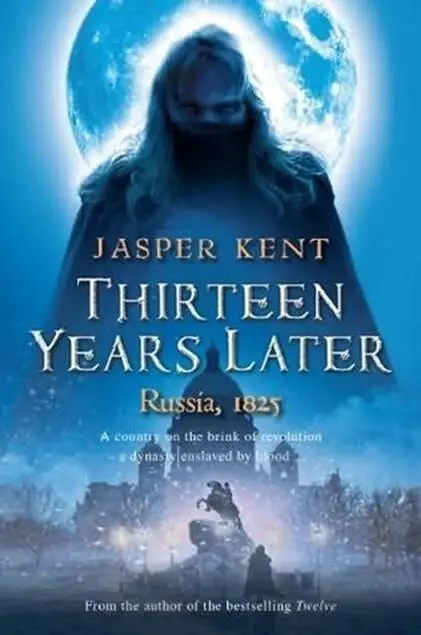
- Название:Thirteen Years Later
- Автор:
- Жанр:
- Год:неизвестен
- ISBN:нет данных
- Рейтинг книги:5 / 5. Голосов: 1
-
Избранное:Добавить в избранное
- Отзывы:
-
Ваша оценка:
Thirteen Years Later: краткое содержание, описание и аннотация
Предлагаем к чтению аннотацию, описание, краткое содержание или предисловие (зависит от того, что написал сам автор книги «Thirteen Years Later»). Если вы не нашли необходимую информацию о книге — напишите в комментариях, мы постараемся отыскать её.
Thirteen Years Later — читать онлайн бесплатно полную книгу (весь текст) целиком
Ниже представлен текст книги, разбитый по страницам. Система сохранения места последней прочитанной страницы, позволяет с удобством читать онлайн бесплатно книгу «Thirteen Years Later», без необходимости каждый раз заново искать на чём Вы остановились. Поставьте закладку, и сможете в любой момент перейти на страницу, на которой закончили чтение.
Интервал:
Закладка:
Of course, it had not been Valentin Valentinovich’s decision alone that they should take in Domnikiia and, when she entered the world, Tamara. Yelena Vadimovna had also to be persuaded. On the one hand she would do almost anything for Aleksei, who had been her father’s most trusted comrade but, as was the nature of women, she had become somewhat close to Marfa in Petersburg, even though they only knew one another through Aleksei. Thus to support one friend in his hour of need would be to betray another. In the end, Aleksei liked to think that it was Yelena’s love for her father that had won the day, but there were other factors. Yelena herself had had a lover when she lived in Petersburg. This had been some while after Rodion’s birth, so there was no doubt as to his paternity, and Aleksei could easily understand why an intelligent and vibrant woman like Yelena might seek attention from a man other than Valentin Valentinovich.
But Aleksei had not used his knowledge to blackmail Yelena; he doubted she was even aware he knew. Even so, her guilt made her less willing to judge others. She was unprepared to go to Marfa and reveal Aleksei as unfaithful, not because she feared he would do the same for her, but because she feared God would.
And from that came the third reason why Valentin would do what Aleksei asked, and retreat from the very idea of discussing it with Yelena. Valentin suspected that Aleksei and his wife had at one time been lovers. Thus he both believed she would side with him now and feared that any disagreement between them would result in him being publicly branded a cuckold. It was all fantasy. There had never been any physical relationship between Yelena and Aleksei, just an intense friendship born out of their mutual love for Vadim. But for a man of Valentin’s limited imagination, such closeness could have only one explanation. A younger Aleksei would have despised him for ever allowing his wife’s lover into the house, but as he had grown to know him, Aleksei had seen something more and more noble in every one of Valentin’s actions. It was a desire to do the right thing which Aleksei knew he could never achieve and so did not even attempt. Nor did he attempt to avoid exploiting Valentin’s fears when it served his purpose.
It took only moments for all these concepts, or at least his perceptions of them, to mollify Valentin’s position. ‘I’m sorry, Aleksei,’ he said quietly, ‘but I’m afraid I can’t help you. As I say, I don’t speak English.’
‘Do you have a dictionary?’
‘I’m sure I could find you a copy of Johnson somewhere in the city, or even Webster, but I don’t see how that would help you.’
‘I meant a bilingual dictionary,’ said Aleksei.
‘Between English and Russian?’ There was greater passion in Valentin’s voice at this ridiculous suggestion than there had been in any other part of their conversation. ‘I don’t think anyone’s attempted such a thing.’ He paused for a moment in thought, tapping his lips with his pen. ‘Wait a minute though…’ He turned to the bookshelf behind him and brought down a sheaf of papers, clearly not a published work but some notes of his own. ‘Yes. Louis Chambaud produced a lexicon of English and French in 1805. That would do you.’
‘Absolutely,’ agreed Aleksei. ‘Do you have a copy?’
‘No, no, no. But I know a man who does.’
‘Excellent. Tell me his name and I’ll go see him.’
Valentin looked at him coldly. ‘I think not. There’s no need for you even to know the name of the gentleman. I shall ask him for it when I next see him.’ He sat down at the desk and resumed his work. Aleksei remained seated. Valentin pretended to ignore him and, much as Aleksei enjoyed the tension that his presence created, he was eager to make use of the dictionary.
‘It is rather urgent,’ he said unassumingly.
Valentin stood up swiftly and flung his pen down on his desk, or at least began to fling it, but he regained his self-control and by the time the object made contact with the desktop, its movement could be described as no more than a gentle placement.
‘Very well, I’ll go and see if I can borrow it,’ huffed Valentin. ‘Wait here.’
The wait was less than half an hour. That would have been time for Valentin to make it some way across the city and back, but Aleksei knew he would not have been able to make a brief call. He would have spent at least ten minutes in polite conversation before putting so direct a question. That put the library from where the dictionary had come very close. Aleksei could easily formulate a list of five likely candidates, with five more who were reasonable possibilities.
In the end, such calculations were unnecessary. A glance inside the front cover as soon as he had returned to the privacy of his rooms revealed an ornate Ex Libris, bearing the name of a celebrated prince and government minister whose library (so the best inside information that Aleksei could obtain had it) was more notable for its erotica than for its lexicography.
With so simple an identification of the book’s owner in mind, Aleksei turned to the mysterious volume Kyesha had given him the previous night. Had he missed something so utterly obvious? He opened it and looked at the inside. There it was – no decorative bookplate, but the simple, functional name of the author:
Richard L. Cain F.R.S.
It certainly sounded like an English name. The ‘F.R.S.’, Aleksei presumed, did not signify further initials, but some kind of qualification or decoration. He had no idea of its precise nature.
He set about translating the text. Whilst the dictionary could give him the meaning of words, their formation into sentences was a more difficult issue. He learned as he went. He was immediately reminded of what he had already heard about English – the fact that it was almost totally lacking in inflection. Aleksei knew that in such languages word order took on greater significance. By following roughly the same rules as French, he generally came up with a sensible translation. Even so, the first few sentences took him over an hour. Many others had words that were not listed in the dictionary at all, presumably scientific terms which had not been deemed necessary for general conversation – or perhaps even terms coined since the dictionary had been published. Who could tell? If Richard Cain really was at the cutting edge of science, he might be inventing new words as he went along.
‘What’s that, Papa?’
He looked up. Tamara had come in. She and Domnikiia had been out most of the day. He could hear Domnikiia’s movements in the next room.
‘It’s a book,’ he said, hoisting his daughter up on to his knee.
‘Can I read it?’
‘You can try.’ She was a keen reader already, in French more so than in Russian, though she spoke Russian better. She looked at the book lying open on the desk in front of Aleksei for some time and then frowned.
‘It’s silly,’ she said confidently.
‘It’s English,’ said Aleksei.
She gave a look of concentration and then spoke. ‘The king of England is King George IV.’
‘Very good.’
‘The king of France is King Charles X.’
‘Excellent,’ he smiled. ‘Any more?’
‘America does not have a king. It is a republic.’ It seemed her long-dead Uncle Maks was having an influence on her. ‘A republic is an affront against God,’ Tamara added. That sounded less like Maks – or perhaps not; Maks was quite fond of affronting God.
‘Who told you that?’ he asked.
‘Uncle Valentin.’
‘And do you believe everything Uncle Valentin tells you?’
Before she could answer, Domnikiia shouted from the other room. ‘Toma!’ The little girl ran out, leaving Aleksei with a sudden understanding of the Latin phrase on the front of the book. Nullius in Verba. On the words of no one. Take nobody’s word for it. Certainly not Uncle Valentin’s, nor that of any adult. The phrase should be written above the gates of every school in the country.
Читать дальшеИнтервал:
Закладка:
Похожие книги на «Thirteen Years Later»
Представляем Вашему вниманию похожие книги на «Thirteen Years Later» списком для выбора. Мы отобрали схожую по названию и смыслу литературу в надежде предоставить читателям больше вариантов отыскать новые, интересные, ещё непрочитанные произведения.








Обсуждение, отзывы о книге «Thirteen Years Later» и просто собственные мнения читателей. Оставьте ваши комментарии, напишите, что Вы думаете о произведении, его смысле или главных героях. Укажите что конкретно понравилось, а что нет, и почему Вы так считаете.