Jasper Kent - Thirteen Years Later
Здесь есть возможность читать онлайн «Jasper Kent - Thirteen Years Later» весь текст электронной книги совершенно бесплатно (целиком полную версию без сокращений). В некоторых случаях можно слушать аудио, скачать через торрент в формате fb2 и присутствует краткое содержание. Жанр: Историческая проза, Ужасы и Мистика, на английском языке. Описание произведения, (предисловие) а так же отзывы посетителей доступны на портале библиотеки ЛибКат.
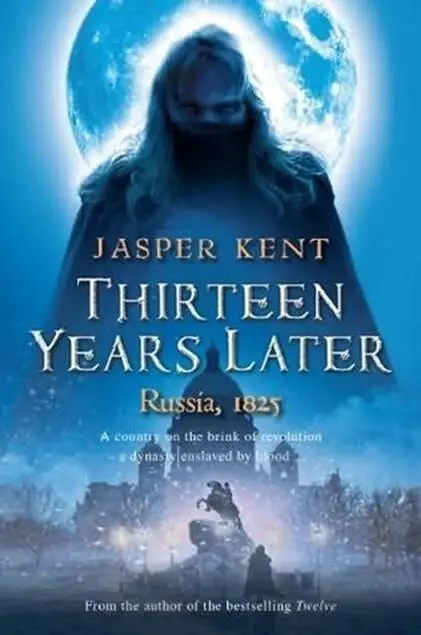
- Название:Thirteen Years Later
- Автор:
- Жанр:
- Год:неизвестен
- ISBN:нет данных
- Рейтинг книги:5 / 5. Голосов: 1
-
Избранное:Добавить в избранное
- Отзывы:
-
Ваша оценка:
Thirteen Years Later: краткое содержание, описание и аннотация
Предлагаем к чтению аннотацию, описание, краткое содержание или предисловие (зависит от того, что написал сам автор книги «Thirteen Years Later»). Если вы не нашли необходимую информацию о книге — напишите в комментариях, мы постараемся отыскать её.
Thirteen Years Later — читать онлайн бесплатно полную книгу (весь текст) целиком
Ниже представлен текст книги, разбитый по страницам. Система сохранения места последней прочитанной страницы, позволяет с удобством читать онлайн бесплатно книгу «Thirteen Years Later», без необходимости каждый раз заново искать на чём Вы остановились. Поставьте закладку, и сможете в любой момент перейти на страницу, на которой закончили чтение.
Интервал:
Закладка:
His understanding of the text might have been helped by the fact that much of it was accompanied by hand-drawn illustrations, but with so little knowledge of the language, it was impossible to understand their context. Many of them appeared to be studies of human anatomy, whilst others were less clear, perhaps relating to optics. There were also several tables of numbers, but again, without understanding the text at the top of each column, they offered little enlightenment.
There was one deduction Aleksei felt he could confidently draw. The six characters heading each new section of the book were dates. The formation of two digits, followed by one, two, three or four letters and then another two digits had confused him for a moment, until he had noticed that the letters were limited to a very small set: ‘x’, ‘v’ and ‘i’. The author was expressing the month in roman numerals. The first entry was dated 9.xii.24 and the last 24.viii.25. Given that the text was English, it was a reasonable assumption that these dates were in the New Style calendar, not the Old. On the other hand, wouldn’t even an Englishman, if he was located in Russia, use the local calendar? The difference was only twelve days anyway. After the final date and its corresponding entry, there were several blank pages. This was a work in progress.
The only other thing that could be deduced from the dates was that Kyesha was most likely not the author. If he had been, then why had he kept it in his possession for almost six weeks without writing anything new in it? The final entry was dated a little while before that scrawled message had been left in Aleksei’s study in Petersburg. The implication was that Kyesha had acquired the book from its author soon before. It was speculation of course, but it seemed reasonable.
The English text began to dance before his eyes in the dim lamplight. There was nothing more he would be able to discern that night. He wrapped the book back up in the paper and placed it in a drawer of the desk. He took off his spectacles and rubbed the sides of his head above his ears where they had dug in. Maks might have had a greater intellect than Aleksei, but he most certainly had a smaller skull.
Aleksei extinguished the lamp and went back into the bedroom. He undressed quickly and slipped into bed beside Domnikiia, wondering if she was still awake. He ran his fingers down her side, lightly brushing her smooth, cool skin and pushing from his mind the strange texture of the book’s covering. When his hand was as far down her leg as he could reach, he ran it back up her body, this time along the inside of her thigh.
She was awake, but she spoke only briefly before rolling over and turning her back on him. ‘Some hope,’ she said.

The Kerch Strait was not wide; less than five versts across at its narrowest, to use the local measurement. That was a huge gap compared with the Bosphorus, but narrow enough to see the coast on either side from the deck of R zbunarea. The hills sloped steeply upwards on the Crimean shore, the buildings of the town of Kerch itself clinging to them.
Ahead lay the Sea of Azov. This was still the familiar route of thirteen years before, but it would be over much sooner – perhaps in less than a day, according to the captain. Already, they were sailing against the outflow from the river Don, at the other end of the small, isolated stretch of water, but on this occasion, he would not be making the tiresome journey upriver into the heart of Russia. On his next visit, he would make that journey and be hailed as a king, but for now, this outpost of the great empire would suffice. Once they had dropped anchor, then all he needed to do was wait. Others would do the work for him.
A journey taking in all the bookshops of Moscow would be unlikely to yield what Aleksei was looking for. He had never heard of such a thing as a dictionary to assist with translations between English and Russian, and doubted whether anyone else had. Fortunately, he happened to be living under the same roof as one of the greatest bibliophiles in the city, the master of the house himself, Valentin Valentinovich. Not only did he possess an impressive library of his own, but his knowledge of what was in the city’s other libraries was unsurpassed.
Aleksei knocked on the door of Valentin Valentinovich’s study, and entered when called. He sat down in the chair opposite the desk. After a few cool pleasantries, he asked the most obvious question:
‘How’s your English, Valentin?’ He was ambivalent about the response. If Valentin was able to translate the text directly for him, then it might save hours, or even days, of work. But it would be a bold move to ask anyone for a translation of a text whose contents could reveal anything. On the other hand, perhaps just a summary of the first page might send Aleksei on the right track. He could always claim it was a work of fiction – apparently the principal use for the English language.
‘Not a word, I’m afraid,’ replied Valentin. ‘Why?’
‘I have a letter I need to translate.’
‘A letter? Why on earth would anyone write to you in English?’ He wasn’t stupid, and was able to answer his own question almost immediately. ‘It’s not your letter, is it?’
He stood up from his desk and slammed his hand against the bookshelves. ‘This is really too much, Aleksei.’ Other men would have shouted, but Valentin Valentinovich spoke as if he had never known true anger. He persisted in using French, even though its popularity had been in decline – certainly amongst men of his class – for a decade. ‘I look after your whore, I pretend your bastard is my own, I let you treat my home as though it were a hotel, and now you want to involve me in your… your… underhand profession.’ He spat the word ‘underhand’ as though it were the foulest profanity he could think of.
Aleksei remained calm. Valentin was speaking with complete accuracy. Tamara was a bastard – the most adorable bastard in the whole wide world. Domnikiia was, or at least had been, a whore – though Aleksei guessed that Valentin was unaware of the literal truth of his words. It was his attitude to espionage that really riled Aleksei. The man thought himself a gentleman, and thought no spy ever could be. It was an insult to so many of Aleksei’s friends.
‘Shall we go and ask Yelena Vadimovna what she thinks of my profession?’ said Aleksei, with a certain sense of pride. It was an obvious enough question for a blackmailer to ask his mark, but in reality it was a three-pronged attack in which blackmail was far from Aleksei’s intent; far, but not completely absent.
It was almost possible to see Valentin wilt step by step as each aspect washed over him. The use of Yelena’s patronymic, and with it the reminder of her father Vadim, hit him first. Vadim Fyodorovich had practised that same underhand profession. Yelena loved her father without question. To insult Aleksei for that would be to insult her father, and that would be unwise.
The second problem for Valentin was what Aleksei knew about him. It wasn’t much, but for a man as honourable as Valentin, it was monumental. It had been a minor embezzlement, and Valentin had been unaware of it, but he had trusted flattering colleagues who had promised him the rank of Actual State Counsellor in exchange for help in what they assured him was an entirely legal set of transactions. One of them had been siphoning funds to Polish activists, and that’s how Aleksei had come across the fraud. He’d looked at the books and found that Valentin was guilty of nothing more than allowing others to use his bank account. He made sure Valentin’s name was kept out of the ensuing trial, and even found a way to let him keep half the money. When he revealed what he had done, Valentin had misread him. He’d seen it as an attempt at blackmail and had capitulated in an instant, even though at the time (back in 1818), there was nothing Aleksei had wanted from him. It was that which had precipitated Valentin’s move from government into commerce, and from Petersburg to Moscow. Aleksei had stored the incident away, until Domnikiia had fallen pregnant, and then called in the marker. Valentin saw it as coercion, Aleksei as one good deed being repaid with another. It made no practical difference to the outcome.
Читать дальшеИнтервал:
Закладка:
Похожие книги на «Thirteen Years Later»
Представляем Вашему вниманию похожие книги на «Thirteen Years Later» списком для выбора. Мы отобрали схожую по названию и смыслу литературу в надежде предоставить читателям больше вариантов отыскать новые, интересные, ещё непрочитанные произведения.







Обсуждение, отзывы о книге «Thirteen Years Later» и просто собственные мнения читателей. Оставьте ваши комментарии, напишите, что Вы думаете о произведении, его смысле или главных героях. Укажите что конкретно понравилось, а что нет, и почему Вы так считаете.