Jasper Kent - Thirteen Years Later
Здесь есть возможность читать онлайн «Jasper Kent - Thirteen Years Later» весь текст электронной книги совершенно бесплатно (целиком полную версию без сокращений). В некоторых случаях можно слушать аудио, скачать через торрент в формате fb2 и присутствует краткое содержание. Жанр: Историческая проза, Ужасы и Мистика, на английском языке. Описание произведения, (предисловие) а так же отзывы посетителей доступны на портале библиотеки ЛибКат.
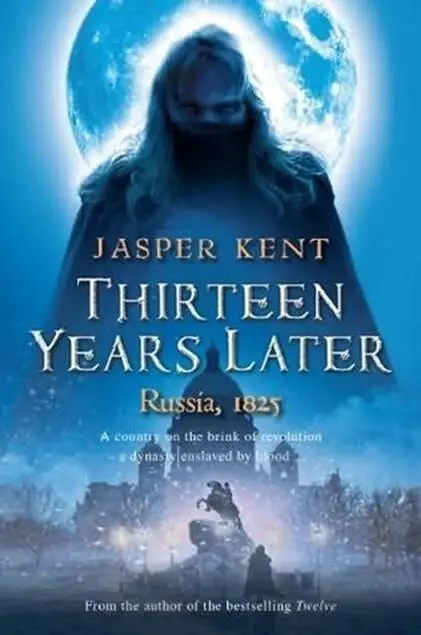
- Название:Thirteen Years Later
- Автор:
- Жанр:
- Год:неизвестен
- ISBN:нет данных
- Рейтинг книги:5 / 5. Голосов: 1
-
Избранное:Добавить в избранное
- Отзывы:
-
Ваша оценка:
Thirteen Years Later: краткое содержание, описание и аннотация
Предлагаем к чтению аннотацию, описание, краткое содержание или предисловие (зависит от того, что написал сам автор книги «Thirteen Years Later»). Если вы не нашли необходимую информацию о книге — напишите в комментариях, мы постараемся отыскать её.
Thirteen Years Later — читать онлайн бесплатно полную книгу (весь текст) целиком
Ниже представлен текст книги, разбитый по страницам. Система сохранения места последней прочитанной страницы, позволяет с удобством читать онлайн бесплатно книгу «Thirteen Years Later», без необходимости каждый раз заново искать на чём Вы остановились. Поставьте закладку, и сможете в любой момент перейти на страницу, на которой закончили чтение.
Интервал:
Закладка:
‘Let your father work,’ said Domnikiia from outside. A moment later, Aleksei felt her arms around his neck and her chin on his shoulder.
‘So this is what it was all for?’ she asked. He had told her about the book that morning.
‘Seems so. A step along the way, at least.’
‘Why couldn’t he have just given it to you the first time you met?’
‘Or just delivered it to my house in Petersburg,’ suggested Aleksei. ‘Perhaps he’s in league with someone who wants to bring me to Moscow and keep me here. Now who could that be?’
He felt a tight little punch to his shoulderblade. ‘Can you decipher it?’ she asked.
‘I haven’t yet. If only Toma would stop pestering me.’
‘But she’s… Oh, I see.’ She kissed him on the cheek and he felt her arms uncoil from around him. He heard the door close.
In truth he had made some headway, but he had found nothing that could explain why Kyesha should have wanted him to read the document. It was, as he had suspected, some sort of scientific journal, listing a series of ongoing experiments, many of which were related, to use a term repeated frequently in the text, to ‘biology’. It was not a word listed in the dictionary, but Aleksei knew enough Greek to guess its meaning. Many of the experiments were conducted on animals, of a species that was not made clear. Individuals were referred to simply by a number. The image that formed in Aleksei’s mind was of rats, but there was nothing concrete to suggest that. Other experiments were of a more chemical nature, many referring to a substance called lapis lunaris, which Aleksei this time had to resort to Latin to translate, unenlighteningly, as ‘moonstone’.
It was clear that this was simply the latest volume in an ongoing work. The text began abruptly on 9 December the previous year, with a reference to work from the day before. It would be a slow process to translate page by page, though ultimately necessary, but for now it seemed there was a better chance of gaining some clue as to what was really going on by flicking through the book and diving in at random. In doing so, Aleksei stumbled on one further fact. One entry referred to the day of the week. The section was pondering, as well as Aleksei could make out, whether any of the animals changed their behaviour on a weekly cycle. Seemingly they did not, but the text made the comment ‘today being Sunday’ and therefore placed that entry’s date, 8 March 1825, as a Sunday.
Aleksei searched his desk and found an almanac. 8 March was the feast day of Saint Theophylaktos, but more importantly, it was indeed a Sunday. That meant that the book’s author was definitely using the Old Style calendar, and probably working in Russia, or at least in the east of Europe.
Aleksei raised his head and rubbed his face with his hands, pushing his spectacles up on to his forehead. It was dark outside. He glanced at the clock. It was half past eight. He’d been sitting there for hours, and he was in danger of missing his appointment – if indeed he had one.
As he passed Tamara’s room, he glanced inside. She was in bed. Her mother was singing gently to her. Aleksei could not make out the words. He paused to watch and to listen. It was another twenty minutes before he left the house.
Aleksei had run across the city. As he went, he questioned what he was doing. Kyesha had killed a man the previous night, and had to be well aware that Aleksei had planned the action against him. And yet Aleksei felt no fear. Kyesha had made no move to attack him all week. His ultimate goal had been to deliver the book, and now that was achieved, it seemed even more pointless to do anything to harm Aleksei until he had actually managed to read it.
The greater worry was that Kyesha wouldn’t be there. It seemed more than likely – he had said himself on Friday that there would only be one more meeting in Moscow. On the other hand, they hadn’t actually met at the theatre the previous night. Aleksei might be taking things too literally, but there was no benefit in ignoring the possibility.
He was only a few minutes late when he arrived at the church. He glanced inside, and inside Menshikov’s Tower, but there was no sign of Kyesha. It was raining, and Aleksei didn’t feel inclined to wait outside. He returned to the tavern where he had taken Kyesha a week before. There was still no sign of him, but Aleksei ordered vodka and sat down to wait. He was at the same table where they had sat before, where Kyesha had first brought out the bones Aleksei now knew to be his own.
Knew? That was a stretch of faith. Kyesha was, in many ways, like Iuda. Iuda would lie and toy with Aleksei, mixing truth and falsehood, leaving him to doubt any certainty he’d had over either. Even today, Iuda’s legacy continued. Aleksei still did not know the truth of what he had seen at Domnikiia’s window, all those years before. His joke earlier that evening about her plotting with Kyesha to keep him in Moscow had started as just that, but he had never felt that depth of certainty with Domnikiia that he did with Marfa. He knew it was one of the things that made their relationship so exciting.
But what would have been easier for Kyesha? To sneak back, as he had described, and retrieve Aleksei’s fingers, to keep them for a decade and a half, and finally reveal them to their original owner? Or simply to steal a few bones from a peasant’s grave and pass them off as Aleksei’s own? How could Aleksei tell the difference? Perhaps they were even Kyesha’s fingers – he seemed happy enough to harvest them as he thought necessary. Could he have cut them off some months before and waited until, just as the flesh grew back on his own hand, it decayed from those severed fingers and they became no more than dry bones?
Aleksei reached into his pocket. Inside, Kyesha’s two fingers still lay where Aleksei had put them. He made sure no one else in the room saw as he drew them out and placed them on the table. They looked and felt just as they had done before, still in that strange state that was both unliving and undead. That was remarkable in itself. It had been three days since Aleksei saw with his own eyes that ragged piece of metal separate those fingers from the body that sustained them. And yet there was not a hint of decay. He raised one to his face, cupping it inside his hand so no one would see, and sniffed it. There was no noticeable odour. It was conceivable that it was still too early, but Aleksei had other ideas.
He had observed putrefaction in the body of more than one vampire in his time. Usually it came on very quickly after death – if the body had not been destroyed anyway, by sunlight or fire. But when he had killed a vampire using a wooden blade to the heart, or by decapitation, the collapse of its bodily integrity had been almost immediate. There had been one exception: a young soldier who had become a vampire only weeks before he met his final end. His decay had been slower and less pronounced. Indeed, as far as Aleksei had been able to tell, the body had decayed, but only to the extent that it would have done if nature had taken her usual course from the point of the soldier’s actual death – the moment at which he became a voordalak. Ultimately, what Aleksei had seen in front of him had been exactly what he would expect to see in a corpse that had lain in the open, unattended to, for several weeks.
Thus his conclusion was that the state of being a vampire somehow suspended the normal process of decomposition expected in a dead body. In reality, that was all that Kyesha and any of his kin were: lifeless cadavers given the semblance of existence by some foul spirit. That same force which animated the limbs fended off the processes of decay. When it had lost control of the body, nature rapidly reasserted herself.
Читать дальшеИнтервал:
Закладка:
Похожие книги на «Thirteen Years Later»
Представляем Вашему вниманию похожие книги на «Thirteen Years Later» списком для выбора. Мы отобрали схожую по названию и смыслу литературу в надежде предоставить читателям больше вариантов отыскать новые, интересные, ещё непрочитанные произведения.







Обсуждение, отзывы о книге «Thirteen Years Later» и просто собственные мнения читателей. Оставьте ваши комментарии, напишите, что Вы думаете о произведении, его смысле или главных героях. Укажите что конкретно понравилось, а что нет, и почему Вы так считаете.