Jasper Kent - Thirteen Years Later
Здесь есть возможность читать онлайн «Jasper Kent - Thirteen Years Later» весь текст электронной книги совершенно бесплатно (целиком полную версию без сокращений). В некоторых случаях можно слушать аудио, скачать через торрент в формате fb2 и присутствует краткое содержание. Жанр: Историческая проза, Ужасы и Мистика, на английском языке. Описание произведения, (предисловие) а так же отзывы посетителей доступны на портале библиотеки ЛибКат.
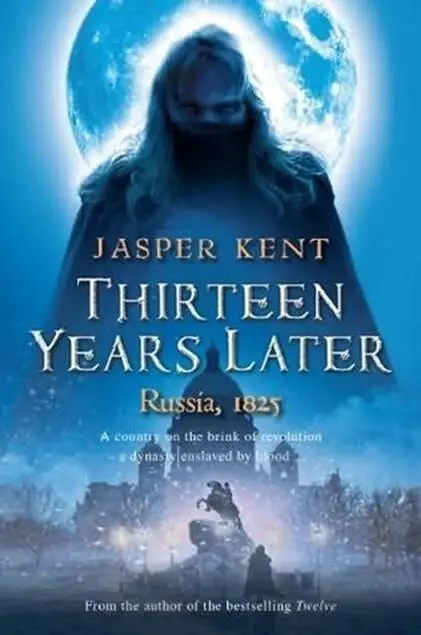
- Название:Thirteen Years Later
- Автор:
- Жанр:
- Год:неизвестен
- ISBN:нет данных
- Рейтинг книги:5 / 5. Голосов: 1
-
Избранное:Добавить в избранное
- Отзывы:
-
Ваша оценка:
Thirteen Years Later: краткое содержание, описание и аннотация
Предлагаем к чтению аннотацию, описание, краткое содержание или предисловие (зависит от того, что написал сам автор книги «Thirteen Years Later»). Если вы не нашли необходимую информацию о книге — напишите в комментариях, мы постараемся отыскать её.
Thirteen Years Later — читать онлайн бесплатно полную книгу (весь текст) целиком
Ниже представлен текст книги, разбитый по страницам. Система сохранения места последней прочитанной страницы, позволяет с удобством читать онлайн бесплатно книгу «Thirteen Years Later», без необходимости каждый раз заново искать на чём Вы остановились. Поставьте закладку, и сможете в любой момент перейти на страницу, на которой закончили чтение.
Интервал:
Закладка:
Those fingers would not decay until Kyesha himself was dead.
Aleksei slammed his fist down on to the table, crushing the little finger beneath it. He smiled to himself, wondering if Kyesha, wherever he might be, could still feel pain in that detached part of his body. The sound of the impact made a few heads turn, but none could see what Aleksei was doing. He ignored them and took a gulp of vodka.
Once again, he placed his hand on the table so that the two fingers lay precisely where his own fingers should have. The skin that had grown over the tops of his shattered knuckles had little feeling in it, but he could see that it was just touching the still-raw ends of Kyesha’s fingers. There was no blood in them now, and no healing had taken place, so blood vessels, bones and other structures, of whose nature Aleksei knew little, were clearly visible. It was an anatomist’s dream; a body-part that could be studied slowly and over a long period, without ever worrying about losing the sample through decay.
Those two fingers answered another question which Aleksei had asked himself years ago. The Oprichnik Andrei had suffered a similar but far more serious injury than Kyesha. In that case, Andrei had lost an entire arm, severed by a blow from Maks’ sword during a desperate fight for self-preservation. Aleksei had seen Andrei not long after with the arm fully restored. The question that had briefly crossed his mind was, if a voordalak could grow back a severed arm, could not the arm grow back the body of a voordalak? Would such an intersection result in two copies of the original?
It seemed not. There was no sign of a new Kyesha, growing out of his own fingers. Perhaps though, even if they could not grow a body anew, they might be able to reattach themselves to an existing body if the chance arose. For a second time, Aleksei pulled his hand away in revulsion. He had almost felt the sensation of new tendrils growing out of those moribund cylinders of flesh and feeling their way towards his own hand, which lacked what they could so readily provide, making him whole once again – part human, part monster. It was all in his mind, but the thought sickened him. He rammed the fingers back into his pocket and downed more vodka.
He looked up at the clock. It was past eleven. Kyesha would not come tonight.
CHAPTER XII
‘I THINK I KNOW HOW TO HANDLE THE TSAR.’
Aleksandr smiled to himself as he heard the words in his head, spoken in Clemens von Metternich’s refined Austrian accent. It had not been his own ears that had heard Metternich speak, but he knew what had been said. He knew much of what people said.
He gazed out of his study window, across the garden and out to the sea. It was peaceful here in Taganrog, and that gave him the chance to contemplate; not merely to think – though he had done enough quick-thinking in his time – but to look back on how things were, and how they might have been.
They had all presumed to understand him: Metternich, Castlereagh, Bonaparte. The last two were dead, and Bonaparte’s fall could be attributed almost entirely to Russia. And Russia was the tsar. That’s what Aleksandr’s babushka had always told him. She, of course, had said ‘tsaritsa’, but he had chosen to take the more general interpretation of her words – the role, not the individual.
Castlereagh was British, and the British were always more astute in war than in peace. They maintained their own peace by allowing Europe to be at war. Aleksandr had beaten him – beaten Britain – on that. There had been peace now in Europe for ten years, and there was no prospect of it breaking down – all thanks to Aleksandr’s Holy Alliance. Metternich had played his role, but only as a broker. To make peace one had to be capable of war, and Austria, even with Metternich as her chancellor, had little strength in that direction when compared with Russia.
For it was war that had proved Aleksandr to be the only man capable of bringing peace. It was Russia that had turned the tide of Bonaparte’s domination; Russia that had proved he was not invincible; Russia that had pursued him all the way back to France. Other armies had played their part, Aleksandr would happily concede that, but it was Russia – Aleksandr – that had led the way.
And yet they still belittled him. Years before Metternich had spoken, Aleksandr’s friend and advisor Speransky had expressed much the same sentiments. ‘Too feeble to reign and too strong to be governed.’ That had been the real reason Speransky had had to go. The most laughable thing was, they thought he would never hear. Scientia potentia est – knowledge is itself power. It was another thing Yekaterina had taught him. He had spies everywhere, who could report to him what anyone said – be they enemies or friends, foreigners or compatriots.
But Yekaterina had lacked one thing a truly great leader required – a devotion to God. Sure enough she worshipped Him, acted in His name, but she believed that the Lord was simply a judge within whose rules – at the boundaries of whose rules – she must operate. Aleksandr knew that God did not exist simply to be feared, but to be loved. It was Castlereagh, again overheard by an ear friendly to the tsar, who had noted it, though he meant it as a criticism: ‘The tsar’s mind has of late taken on a deeply religious tinge.’
It was an accurate observation – and one in which Aleksandr revelled. He had been mistaken in his youth. He had had a zeal to do right, but it had been misdirected. God’s will was not to overthrow the old order – to make serfs into princes – but to protect it; to make serfs prosper as serfs and princes thrive as princes, each knowing his place and doing good for the other. And peace was the foundation for that – an end to ‘the destruction that wasteth at noonday’, as the psalm put it. Aleksandr had achieved peace in a way his babushka never had, and that was what made him greater than she.
But would he yet prove himself to be greater than Tsar Pyotr, his great-great-grandfather? Time would tell – perhaps very little time. He had come to Taganrog to find it out, to face ‘the pestilence that walketh in darkness’. And yet he had been in Taganrog now for three weeks, with no sign of how the question was to be answered – with little sign of anything happening at all.
He glanced out to sea again. At least there there was some change. A new sail could be seen on the horizon. She was too small to be a barque – little more really than a large yacht. She was too far to see the name, or even the flag.
It was pleasant to have something to break the smooth horizon, and a single vessel sailing into harbour could do no harm – not to a man who could outsmart Metternich.
Even now, Aleksei felt a thrill as their eyes locked and did not separate for four, five, six seconds. As ever, it was he who looked away first, despite the pleasure he derived from the sensation of his heart beating faster and the flush of blood he felt to his face, and elsewhere. Why did he break away from her gaze? Was it simply out of some sense of gentlemanly etiquette – the idea he had been brought up with since birth that any woman of good breeding would feel ashamed to sense the eyes of a man on her for so prolonged a period of time? Possibly, but Aleksei knew Domnikiia well enough to understand that no such sense of shame would ever cross her mind in those circumstances.
And therein lay the attraction. To stare into Domnikiia’s eyes was to see no semblance of resistance, to see no veil of diffidence that said, ‘That part of me is not for you,’ or even ‘You must wait.’ Her eyes would yield and allow the gaze of a man to fall upon them almost as though at the same time she had stood up and slipped out of her gown, allowing those same eyes to meander over every curve of her still delectable body. Not that there was anything wrong with that, had they been in the privacy of their own bedroom, where he would have happily gawped at the reality of her nakedness for minutes on end and yet still returned his attention with inescapable frequency to her eyes.
Читать дальшеИнтервал:
Закладка:
Похожие книги на «Thirteen Years Later»
Представляем Вашему вниманию похожие книги на «Thirteen Years Later» списком для выбора. Мы отобрали схожую по названию и смыслу литературу в надежде предоставить читателям больше вариантов отыскать новые, интересные, ещё непрочитанные произведения.








Обсуждение, отзывы о книге «Thirteen Years Later» и просто собственные мнения читателей. Оставьте ваши комментарии, напишите, что Вы думаете о произведении, его смысле или главных героях. Укажите что конкретно понравилось, а что нет, и почему Вы так считаете.