Jasper Kent - Thirteen Years Later
Здесь есть возможность читать онлайн «Jasper Kent - Thirteen Years Later» весь текст электронной книги совершенно бесплатно (целиком полную версию без сокращений). В некоторых случаях можно слушать аудио, скачать через торрент в формате fb2 и присутствует краткое содержание. Жанр: Историческая проза, Ужасы и Мистика, на английском языке. Описание произведения, (предисловие) а так же отзывы посетителей доступны на портале библиотеки ЛибКат.
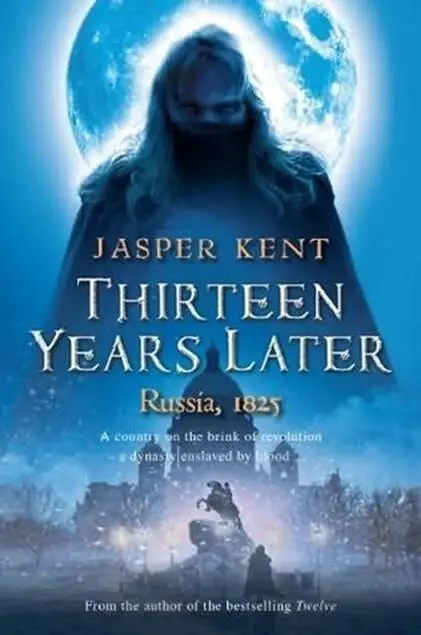
- Название:Thirteen Years Later
- Автор:
- Жанр:
- Год:неизвестен
- ISBN:нет данных
- Рейтинг книги:5 / 5. Голосов: 1
-
Избранное:Добавить в избранное
- Отзывы:
-
Ваша оценка:
Thirteen Years Later: краткое содержание, описание и аннотация
Предлагаем к чтению аннотацию, описание, краткое содержание или предисловие (зависит от того, что написал сам автор книги «Thirteen Years Later»). Если вы не нашли необходимую информацию о книге — напишите в комментариях, мы постараемся отыскать её.
Thirteen Years Later — читать онлайн бесплатно полную книгу (весь текст) целиком
Ниже представлен текст книги, разбитый по страницам. Система сохранения места последней прочитанной страницы, позволяет с удобством читать онлайн бесплатно книгу «Thirteen Years Later», без необходимости каждый раз заново искать на чём Вы остановились. Поставьте закладку, и сможете в любой момент перейти на страницу, на которой закончили чтение.
Интервал:
Закладка:
Even so, she had been enchanting – that glint in her eyes. Could Dmitry have mistaken the way she looked at him? He didn’t think so. And that was the worst of it. He felt ashamed at any subconscious response he might have given her that could suggest there was any prospect of something happening between them. At her age, she flattered herself. That his father should betray his mother was one thing, but that the woman could even think of betraying Aleksei with his own son was madness.
Dmitry realized he had raised himself to his feet. His father did not appear to have noticed. He stepped back into the shadows and continued to watch. Did it matter that his father was fooling his mother, and was himself being taken for a ride? Until last Thursday – when what he had witnessed inside the cathedral had changed his view of the entire world – it had. But now Dmitry’s concerns for Aleksei were far more substantial. And his esteem for his father, which had been at such a low stock for so many years, had risen.
He sat and watched for another hour, during which Aleksei hardly moved, except to take the pipe to and from his lips, and once to refill it. Then, when it was almost half past ten, he dropped back inside the Lobnoye Mesto, and moments later could be seen emerging from it to head north. The shortest route to his hotel was in the opposite direction, but Dmitry had not expected him to go there. He had given up on Kyesha, and Dmitry suspected he was right to. As promised, the voordalak had departed the city.
Dmitry waited until his father had disappeared from view, then made his own way home.
Today, Aleksei knew, he must stick to his work. The notebook and dictionary sat in front of him on his desk – the former open, the latter closed. It was early, scarcely nine o’clock, but Tamara had woken them long before. To sleep late was one of the benefits of his other home in Petersburg, but one which he gladly forwent.
He continued his random approach to the text, although he kept notes to make sure he did not go over the same section twice. It was an infuriating procedure. He had uncovered a number of consecutive sections on what the author – Cain – described as ‘the healing process’, which was a term Aleksei understood well enough, but the details of which made no sense. By Aleksei’s translation, one rat (he had settled, for now, on those being the poor creatures in question) that had the most minor of wounds would succumb to them, while another would struggle through and survive the most terrible ordeals. He doubted his own translation, and in many cases hoped he was wrong.
It was when he looked at the text for 22 August, only two days before the final entry, that the tone moved away from the scientific. Before that, there had been a gap of a week without anything being written. Aleksei felt comfortable in his translation of these more mundane matters.
I have contacted APR. He will prevaricate, but he will come. It may take time. I have returned to the peninsula and will wait. Word will be sent when APR departs.
The text then dissolved into another tract of scientific gibberish, which Aleksei shied away from. He moved to the following day’s entry.
I have looked over APR’s residence. It seems humble for him, but regardless of that, Taganrog is not the place to act against him.
Aleksei went back over the word again. There was no possibility of mistranslation, it was mere transliteration. Whatever alphabet was used, the word was the same.
Taganrog

It was the town where the tsar and tsaritsa were spending the winter. The letters APR suddenly made sense as well. Aleksandr Pavlovich Romanov – the tsar himself. Whatever the meaning of the text, it was clear that Cain had some intention to act against the tsar. The words in English could have unknown subtleties, but there was no doubt that something underhand was intended.
Aleksei grabbed the notebook, forgetting about the paper in which he usually wrapped it. He needed help. Dmitry was an obvious choice, but what interest would Dmitry have in the safety of the tsar? Most likely, this book revealed some sort of plot by the Southern Society. No member of the Northern Society was going to act against it. Perhaps they even knew already.
Who in Moscow could Aleksei trust? He couldn’t think, but he had to do something. He raced through the house, leaving each door open behind him. In the distance, he heard Valentin Valentinovich shouting at him, but he paid no heed. The next moment he was out on the street. In his mind he ran through the list of generals he knew in the city – men who would trust him, and whom he could trust.
As he stood there in the sunny street, he felt bile rising in his throat. At first he could not account for it, but he understood the cause moments after the sensation came over him. It wasn’t fear for the safety of the tsar that brought on that sense of nausea, but a smell – a devastatingly familiar smell, recalled from long ago. Burning hair. Mould. A scent of decay. He had experienced it only once before, as he stamped down on the wrist of the Oprichnik Pyetr and forced his hand into a beam of sunlight, watching with pleasure as it blistered and burned to nothing, but horrified to see it regrow, as Kyesha’s fingers had regrown, before his eyes.
He looked around. The sun was not high but above the buildings and shining bright on this crisp autumn day. Any voordalak outside in these conditions would not simply burn, he would be obliterated. There was no sign of any such occurrence, yet still the smell persisted, strengthened.
Suddenly, Aleksei noticed a dampness against his arms, through his shirtsleeves. He was holding the notebook against his chest, with his arms crossed over it. He now pulled them away, and saw that the leather cover of the book had split open, and was curling at the edges, degrading to a yellow pus which blackened as it soaked into the linen of his clothes.
He stepped back inside the house.
‘What in Heaven are you doing, Aleksei?’ he heard Valentin Valentinovich’s voice say behind him. ‘What is that awful stench?’
‘Get back!’ shouted Aleksei, raising his hand and again clutching the book to him. He must have given off the aura of some mad starets – a preacher foretelling the end of the world. It did the job. Valentin disappeared back into the house.
Now that he was out of the sunlight, Aleksei looked again at the book. The leather was not completely destroyed; two wide stripes were missing across the front of it, plus most of the top edge of both front and back. The central strip of the front, where the Latin text was written, had been protected by Aleksei’s arms.
Even as he watched, and as he had expected, the leather began to repair itself. In parts, it was like a wave riding up a shallow beach in an advancing line which never receded. In other places, a thin tendril of the material would shoot across the cover, like the stem of a climbing plant accelerated a thousand times, and bind to a dangling fragment of leather on the other side. Then those two slivers, reinvigorated by one another, would spread outwards in a thickening band, until, within less than a minute, the cover was as it had always been.
The stench was now no more than a forgotten hint on the breeze.
Aleksei took a step towards the door, holding a corner of the book in front of him. The smell returned, and he saw what he had known he would see. The shadow of the doorframe cut off the sun in a clear line. One small corner of the book was in light, the rest in relative darkness. The corner burned, briefly bursting into flame, and then subsiding as the same noxious fluid as before dribbled from it to the floor emitting its putrid scent. The remainder of the book was unaffected; the same light-brown leather it had been when he first looked at it. The line between what had survived and what had been destroyed was exact – it was the line along which sunlight had been cut off by shadow.
Читать дальшеИнтервал:
Закладка:
Похожие книги на «Thirteen Years Later»
Представляем Вашему вниманию похожие книги на «Thirteen Years Later» списком для выбора. Мы отобрали схожую по названию и смыслу литературу в надежде предоставить читателям больше вариантов отыскать новые, интересные, ещё непрочитанные произведения.







Обсуждение, отзывы о книге «Thirteen Years Later» и просто собственные мнения читателей. Оставьте ваши комментарии, напишите, что Вы думаете о произведении, его смысле или главных героях. Укажите что конкретно понравилось, а что нет, и почему Вы так считаете.