Jasper Kent - Thirteen Years Later
Здесь есть возможность читать онлайн «Jasper Kent - Thirteen Years Later» весь текст электронной книги совершенно бесплатно (целиком полную версию без сокращений). В некоторых случаях можно слушать аудио, скачать через торрент в формате fb2 и присутствует краткое содержание. Жанр: Историческая проза, Ужасы и Мистика, на английском языке. Описание произведения, (предисловие) а так же отзывы посетителей доступны на портале библиотеки ЛибКат.
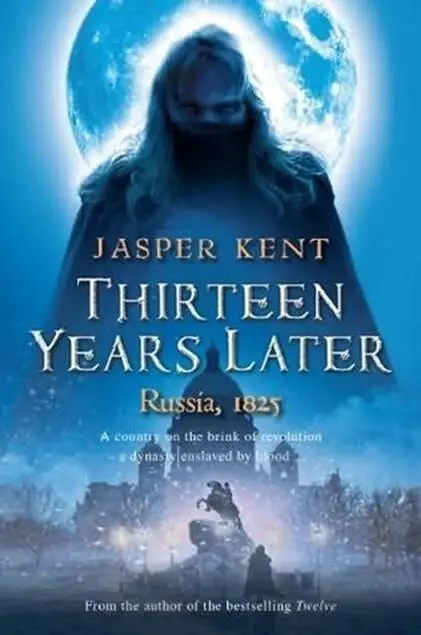
- Название:Thirteen Years Later
- Автор:
- Жанр:
- Год:неизвестен
- ISBN:нет данных
- Рейтинг книги:5 / 5. Голосов: 1
-
Избранное:Добавить в избранное
- Отзывы:
-
Ваша оценка:
Thirteen Years Later: краткое содержание, описание и аннотация
Предлагаем к чтению аннотацию, описание, краткое содержание или предисловие (зависит от того, что написал сам автор книги «Thirteen Years Later»). Если вы не нашли необходимую информацию о книге — напишите в комментариях, мы постараемся отыскать её.
Thirteen Years Later — читать онлайн бесплатно полную книгу (весь текст) целиком
Ниже представлен текст книги, разбитый по страницам. Система сохранения места последней прочитанной страницы, позволяет с удобством читать онлайн бесплатно книгу «Thirteen Years Later», без необходимости каждый раз заново искать на чём Вы остановились. Поставьте закладку, и сможете в любой момент перейти на страницу, на которой закончили чтение.
Интервал:
Закладка:
His journey down the Don had reminded him of the journey the Oprichniki had taken in the opposite direction in order to ‘save’ Moscow thirteen years before. Was there a link there? Had they put down roots in the region which somehow connected to the experiments Cain was performing? In the various hostelries he had stayed at along the way, he had asked if anyone remembered the autumn of 1812. Stories had reached Moscow of a plague travelling up the Don, which Aleksei had realized to be the echoes of the revolting feeding habits of voordalaki. But as with all such tales, details, even years, became merged. Locals disagreed as to what had happened and when it had happened. More recent outbreaks of pestilence were far more pressing on the memory than what had happened thirteen years before.
And so Aleksei had spent most of his evenings continuing his translation of Cain’s writings. It was still difficult, but at least Valentin had not asked for the dictionary back. Much of what Aleksei uncovered was what he already knew, though with a precise, scientific gloss to it. He worried that his prior knowledge might be biasing his translation, forcing it to tell him what he expected it to tell him. But he had no way of avoiding such prejudice.
Several sections discussed what happened when a vampire was injured. Measurements were made concerning the speed of regrowth and the degree to which an individual could resist that regrowth. A table of figures showed how a well-fed voordalak could regenerate its flesh far more quickly than one which had been starved. Cain also referred to reported evidence of a voordalak who had fended off the regrowth of his missing fingers for four hours in order not to be discovered by humans, and of another who had had an arm hacked off with a sword, and grown it back without the slightest sign of a scar. The first was clearly Kyesha’s story. It seemed that Kyesha had been at one time the subject of Cain’s experiments. Presumably he had escaped, stealing the notebook and taking it with him. But why had he brought it to Aleksei?
Cain also wrote of the methods by which a vampire could die. There was little new. Fire could kill them, freezing cold could not but would paralyse them, as would starvation and suffocation. Cain had conducted his own experiment with fire – his description of the death of the creature was brutally detached – but of the attempted freezing there was no detail. Aleksei wondered if the winters would be cold enough this far south to conduct such an experiment successfully. His own experience of a voordalak being frozen had been much further north.
What seemed to interest Cain most was his investigation of the actual mechanism by which a man could be turned into a vampire. Aleksei was familiar enough with the process, having had it described to him by Iuda back in 1812. Iuda, of course, could not be trusted on any matter, and was not even a vampire, so might not know the truth. However, Cain’s studies concurred. The victim had first to have his blood drunk by the vampire and then, close to the moment of his death, had in turn to drink the vampire’s blood.
Aleksei had shuddered as he finished translating that section. It was exactly what he had witnessed – believed he had witnessed – at the window of the brothel on Degtyarny Lane, except that, in truth, he had seen Iuda lower his lips on to the woman’s neck and pretend to suck the life-giving fluid from her using fangs he did not possess. He had seen the woman lick at the blood that seeped from a self-inflicted wound in Iuda’s breast, but it was not vampire’s blood. And still today, Aleksei did not know whether that woman had been Margarita or Domnikiia.
Again, Cain’s concern was with precise measurement. He was convinced that consumption of the vampire’s blood had to occur within a certain time period leading up to the actual moment of death of the victim, but he had been unable to pin down the duration; in some cases it was hours, in others many weeks. Beyond that, the death of the victim did not have to be caused by the original bite of the vampire and subsequent loss of blood. Any cause of death would be effective, as long as blood had been exchanged both ways. In nature, as Cain had put it, the vampire’s bite was almost always the cause of death as well, but he had demonstrated that it was not uniquely effective. He went on, somewhat unnecessarily, to list mechanisms of death he had found to work: stabbing, shooting, drowning, poisoning.
Aleksei stopped reading at that point. Evidently Cain was not only using voordalaki for his experiments. Humans were involved as well; human, at least, when the experiments began.
That was about as much as Aleksei had discovered by the time he reached Taganrog. There was much he could make neither head nor tail of, and few translations in which he felt entirely confident.
He quickly found a tavern that had rooms available. He had expected the town to be busy, as social climbers hoping to gain favour at court – and social decliners, desperate to hang on to what slight favour they had left – hovered round the tsar like flies. But Aleksandr’s presence had caused remarkably little stir. Aleksei had arrived in time for lunch. The last leg of his journey, from Rostov, had been short – only about seventy versts – and he had set out early. After eating, he wrote letters to Marfa, Dmitry, Domnikiia and Tamara – the last of those he wrote mostly in Russian, with occasional hints in French to help her understand.
Then he set out on a simple quest – an audience with the tsar.
The adopted royal palace was unassuming. It was a low building, with no upper floors. It must have helped in keeping the crowds at bay. Although there was no overt secrecy, few passing the house would have guessed the majesty of the personage dwelling therein. It had a garden and a view of the sea, neither of which Aleksei paid much attention to. There was one piece of comfort he took from seeing the house at last with his own eyes: everything was in order. Whatever Cain was planning against Aleksandr, he had not yet acted.
Aleksei’s credentials got him past the guards at the gate and the household staff, but none felt audacious enough to allow him access to the tsar. Instead he was asked to sit in a small anteroom, overlooking the beach, and wait until he could be dealt with by the tsar’s personal secretary, Prince Volkonsky. He waited for a quarter of an hour before the door opened and three men entered the room.
Volkonsky was easy to recognize. He was the only one of the three in uniform, but beyond that he had the bearing that only a man raised with the title of prince could carry. He was almost fifty now, and his square face had a benevolence to it which belied his history. Aleksei well knew – though it was not the sort of thing that was ever spoken of publicly – that Volkonsky was one of those who had organized the death of Aleksandr’s father, Tsar Pavel I. Just how closely Aleksandr himself had been involved was a matter of wide, if hushed, debate. Few who held him responsible thought less of him for it. The whole empire had benefited. Pavel had been a hopeless monarch. Aleksandr had been a hopeful one, but twenty-four years on, that promise remained to be fulfilled.
‘Colonel Danilov?’ said Volkonsky somewhat haughtily.
‘Yes, Your High Excellency,’ said Aleksei, standing.
‘You have a message for His Majesty?’
‘Yes, sir.’ Aleksei felt no sense of awe in the presence of the prince, but he knew his business would be achieved a lot more simply if he appeared to.
Volkonsky held out his hand. ‘Give it to me, I’ll take it to him.’
‘I don’t have it written down.’
‘Then tell me,’ Volkonsky snapped.
‘I think the tsar would prefer it if I told him personally,’ said Aleksei.
Читать дальшеИнтервал:
Закладка:
Похожие книги на «Thirteen Years Later»
Представляем Вашему вниманию похожие книги на «Thirteen Years Later» списком для выбора. Мы отобрали схожую по названию и смыслу литературу в надежде предоставить читателям больше вариантов отыскать новые, интересные, ещё непрочитанные произведения.







Обсуждение, отзывы о книге «Thirteen Years Later» и просто собственные мнения читателей. Оставьте ваши комментарии, напишите, что Вы думаете о произведении, его смысле или главных героях. Укажите что конкретно понравилось, а что нет, и почему Вы так считаете.