Jasper Kent - Thirteen Years Later
Здесь есть возможность читать онлайн «Jasper Kent - Thirteen Years Later» весь текст электронной книги совершенно бесплатно (целиком полную версию без сокращений). В некоторых случаях можно слушать аудио, скачать через торрент в формате fb2 и присутствует краткое содержание. Жанр: Историческая проза, Ужасы и Мистика, на английском языке. Описание произведения, (предисловие) а так же отзывы посетителей доступны на портале библиотеки ЛибКат.
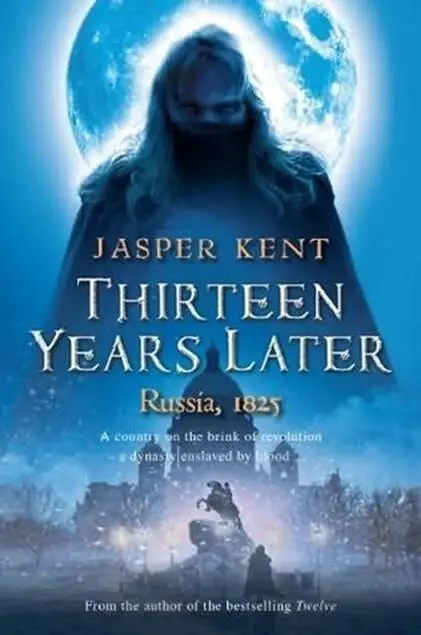
- Название:Thirteen Years Later
- Автор:
- Жанр:
- Год:неизвестен
- ISBN:нет данных
- Рейтинг книги:5 / 5. Голосов: 1
-
Избранное:Добавить в избранное
- Отзывы:
-
Ваша оценка:
Thirteen Years Later: краткое содержание, описание и аннотация
Предлагаем к чтению аннотацию, описание, краткое содержание или предисловие (зависит от того, что написал сам автор книги «Thirteen Years Later»). Если вы не нашли необходимую информацию о книге — напишите в комментариях, мы постараемся отыскать её.
Thirteen Years Later — читать онлайн бесплатно полную книгу (весь текст) целиком
Ниже представлен текст книги, разбитый по страницам. Система сохранения места последней прочитанной страницы, позволяет с удобством читать онлайн бесплатно книгу «Thirteen Years Later», без необходимости каждый раз заново искать на чём Вы остановились. Поставьте закладку, и сможете в любой момент перейти на страницу, на которой закончили чтение.
Интервал:
Закладка:
The colonel seemed to pause just momentarily, as if tripping over an unseen paving stone, before replying. ‘I should hope so. I wouldn’t be much use to you if I wasn’t a member.’
‘Even so – not a pleasant list to be named on, should things not go the way you hope.’
‘I’m sure I’ll have you to vouch for me, Your Majesty.’
‘Oh, absolutely,’ said Aleksandr. ‘Absolutely.’
‘Could we discuss my other business?’ asked Aleksei.
Was this the moment? If it was, Aleksandr would be foolish to ignore it. Even so, he felt afraid. He nodded. ‘Go ahead.’
Aleksei paused, considering how to start. ‘Why did you come here, to Taganrog?’
‘Why do you ask?’ replied Aleksandr.
‘Let’s just accept that I did ask.’
It was more the statement of an interrogator to his captive than of a subject to his tsar, though Aleksandr knew he needed a man of such effrontery. But it was still too early to reveal his hand.
‘Many reasons,’ he replied, ‘but chiefly to do with the climate; partly for my own benefit – but mostly for my dear Yelizaveta Alekseevna.’
‘The climate? Doesn’t the sea here freeze over in November?’
‘Later than it does in Petersburg.’
‘Why not Greece or Italy?’
Aleksandr longed to confide in someone, but his anger and pride won through. ‘I am tsar of all the Russias,’ he asserted. ‘I may go where I please. And Russia is the place where I should and do wish to go.’
Aleksei nodded. ‘Very well,’ he said. He clearly did not accept the answer, but accepted it was all he was going to get.
‘Is there anything more you need to discuss?’ asked Aleksandr. He avoided making it sound like the plea it was. He knew he had to be open with Danilov, but could conceive of no effective way to breach the barrier between monarch and subject.
‘Not at the moment, Your Majesty.’
‘Then you may go. But don’t go far. I may need you.’
That would be better. It was Danilov who had instigated this meeting – he could not be allowed to come away the beneficiary. Next time, Aleksandr would be in charge. The colonel stood and walked to the door, but before exiting, he turned.
‘Just one last question, Your Majesty.’
‘Yes?’
‘Did you ever hear of a man named Cain – Richard Cain? An Englishman.’
The tsar felt a coldness, as though the blood had suddenly vanished from his body, but he pulled an expression of thoughtful puzzlement before replying. ‘No. No, I can’t say I have. Is it important?’
‘I don’t know.’ With that, Aleksei was gone.
Aleksandr stood and walked over to the window. He gazed out to sea, but still the only thing that broke the shallow curve of the horizon was that one yacht. He heard the door open behind him and feared for a moment that Danilov had returned, but on looking he saw that it was only Volkonsky, who said nothing, waiting first to be spoken to. Aleksandr looked back out across the water.
It was an odd combination of trust and fear that Aleksandr felt for Danilov – and not just Danilov; there were others of his profession who produced the same feeling. The trust was in the absolute sense that such men would neither harm him nor let him be harmed. The fear was in the risk that they would perceive too much; would catch out the tsar in one of his petty misdemeanours. It was the same ambiguity a son might feel towards his father – though not so much in Aleksandr’s case. For him, it was a little more like the way he had felt about his grandmother.
It was a comparison he did not want to take too far; the old empress had always been able to catch Aleksandr out in a lie, and he felt that Colonel Danilov shared exactly the same perceptive skills.
Which was unfortunate, because that afternoon Aleksandr had prevaricated with him once and twice told outright lies.
It was dark by the time Aleksei returned to his lodgings. He had wandered around the town a little, asked a few questions, but there was not much to be discovered. Cain’s book had implied he was not actually resident in Taganrog, but in the ‘peninsula’. That could only mean the Crimea, almost four hundred versts away. As Aleksei walked, he had been considering what the tsar had said to him. Aleksandr was a difficult man to fathom. Aleksei had met him perhaps ten times in his life, the first being in 1814, in Paris. On each occasion, he had deliberately tried to reduce the usual formality of such an encounter, and had achieved it to some extent. But the tsar was used to hiding behind the mask of his office, and ultimately could not be browbeaten into revealing information he didn’t want to. The tsar always knew best.
Moreover, the tsar was used to filtering every statement he uttered, preparing it for the consumption of advisors, ambassadors and the general public. He delivered the truth with exactly the same lack of conviction with which he did a lie. Aleksei was reminded of Iuda, who had found a way to make his every statement equally valueless. Aleksandr had taken a different approach, but had arrived at a similar result.
Even so, Aleksei was pretty certain the tsar had lied about not knowing Cain.
He asked for a meal to be sent up to his rooms, and then ascended the stairs. His door was on the right. He had only put one foot inside the room when he realized there was someone else in there. Initially the knowledge was instinctive, but he knew that instincts were based on senses, and he quickly honed the source of his intuition down to a smell. It was a familiar smell – the closest thing he could describe it as was raw sheep’s kidneys, but even that was a poor comparison. It was a smell he had not noticed the first time he encountered it, or not distinguished, but now, he could associate it with its source.
‘Kyesha?’ he asked.
‘You see almost as well as I do, Aleksei,’ said a voice from the darkness, over towards the bed. Aleksei lit the lamp and saw Kyesha lying there on one side, his chin resting on his fist. Aleksei did not disabuse him of the idea that he had seen him, even if it had been said in jest. He was well aware that the smell was not unique to Kyesha – it was the scent of the voordalak. That the voordalak in question was Kyesha was an obvious guess.
Aleksei sat down on a chair near the door and fixed his eyes warily on Kyesha, saying nothing.
‘You came then,’ said the vampire.
‘You could have offered a more direct invitation.’
‘Would you have responded to that?’
Aleksei considered, then shook his head. He glanced over to the drawer where he had left both the dictionary and Cain’s notebook. Kyesha saw his concern. ‘Don’t worry, it’s still there,’ he said. ‘It makes no sense to me.’
‘So how did you know it would bring me here?’
‘Richard Cain is a talkative man, at times. He’d told me enough of what was in there.’
‘He experimented on you?’ asked Aleksei.
Kyesha sat up and unbuttoned his shirt cuff. He rolled up his sleeve to reveal his forearm. ‘He…’ Kyesha interrupted himself with a smile. ‘But of course, there are no scars.’ He pulled his sleeve back down again. ‘One sometimes forgets.’
‘You’ve not been a voordalak long then?’ said Aleksei.
‘Only a few years before we first met. And the word round these parts is “oopir”.’
It was not a new word to Aleksei. ‘Voordalak, oopir. You all die the same way.’ He regretted his harshness immediately. He was filled with the hateful realization that he’d grown to like Kyesha.
‘Round here, I’m afraid not. Some die, but many live for years in torment, thanks to Cain.’
‘And what have I got to do with it?’
‘You will stop him,’ said Kyesha confidently.
Читать дальшеИнтервал:
Закладка:
Похожие книги на «Thirteen Years Later»
Представляем Вашему вниманию похожие книги на «Thirteen Years Later» списком для выбора. Мы отобрали схожую по названию и смыслу литературу в надежде предоставить читателям больше вариантов отыскать новые, интересные, ещё непрочитанные произведения.










Обсуждение, отзывы о книге «Thirteen Years Later» и просто собственные мнения читателей. Оставьте ваши комментарии, напишите, что Вы думаете о произведении, его смысле или главных героях. Укажите что конкретно понравилось, а что нет, и почему Вы так считаете.