Jasper Kent - Thirteen Years Later
Здесь есть возможность читать онлайн «Jasper Kent - Thirteen Years Later» весь текст электронной книги совершенно бесплатно (целиком полную версию без сокращений). В некоторых случаях можно слушать аудио, скачать через торрент в формате fb2 и присутствует краткое содержание. Жанр: Историческая проза, Ужасы и Мистика, на английском языке. Описание произведения, (предисловие) а так же отзывы посетителей доступны на портале библиотеки ЛибКат.
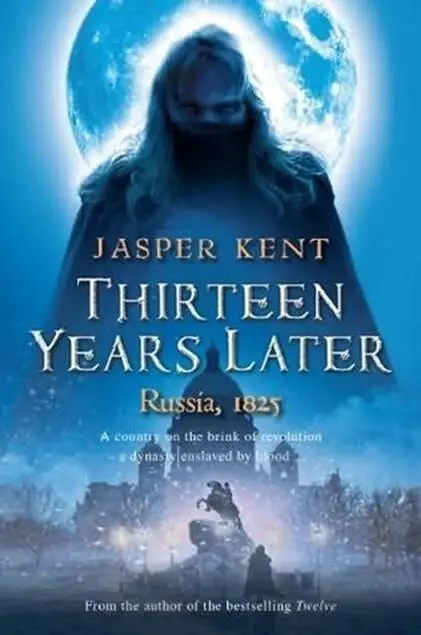
- Название:Thirteen Years Later
- Автор:
- Жанр:
- Год:неизвестен
- ISBN:нет данных
- Рейтинг книги:5 / 5. Голосов: 1
-
Избранное:Добавить в избранное
- Отзывы:
-
Ваша оценка:
Thirteen Years Later: краткое содержание, описание и аннотация
Предлагаем к чтению аннотацию, описание, краткое содержание или предисловие (зависит от того, что написал сам автор книги «Thirteen Years Later»). Если вы не нашли необходимую информацию о книге — напишите в комментариях, мы постараемся отыскать её.
Thirteen Years Later — читать онлайн бесплатно полную книгу (весь текст) целиком
Ниже представлен текст книги, разбитый по страницам. Система сохранения места последней прочитанной страницы, позволяет с удобством читать онлайн бесплатно книгу «Thirteen Years Later», без необходимости каждый раз заново искать на чём Вы остановились. Поставьте закладку, и сможете в любой момент перейти на страницу, на которой закончили чтение.
Интервал:
Закладка:
‘We saw him speaking to Lieutenant Danilov, sir,’ he said. ‘The lieutenant gave the signal.’
‘And then?’
‘They headed east, over there.’
‘Together?’
‘Yes, sir.’
‘And where’s Lieutenant Danilov now?’
‘I don’t know.’
Aleksei raced down the theatre steps and diagonally across the square. Batenkov ran to keep up with him.
‘Did you see what happened next?’ asked Aleksei as they hurtled through the crowds.
‘No. One of the men must have; he gave a shout. Then everyone started running.’
They crossed the street, dodging the slow-moving carriages, and turned past the Maly Theatre. Quite a crowd had gathered – passers-by as well as the soldiers – but it opened up as Aleksei approached, walking now. Aleksei saw the soles of a pair of boots first, then the body, laid flat on its back, and finally the face, covered in blood. There was only a small wound to the neck, but it had been instantly fatal. More blood oozed around the head in a slowly growing halo, which caused the circling crowd likewise to expand as people stepped back to avoid sullying their boots.
It must have been a wrench for Kyesha to leave so much blood unconsumed, but his motivation that night had not been hunger, but flight. And in that he had succeeded.
CHAPTER XI
‘IT’S NOT LIEUTENANT DANILOV, COLONEL.’ BATENKOV HAD KNELT down to examine the body.
‘I know that,’ snapped Aleksei. ‘Don’t you think I’d recognize my own son?’ He stepped forward and looked more closely at the bloody face. It was Obukhov. Aleksei knew he should have sent him home earlier when he had seemed so keen for a fight. He should have sent them all home.
He heard the sound of footsteps trotting down the street and looked up to see Dmitry. Aleksei walked quietly away from the crowd, and Dmitry changed his course to join him. They spoke in low voices.
‘I saw him coming out of the theatre,’ said Dmitry.
‘Did he see you?’
‘I thought so, but he didn’t come over to me. Had you already spoken to him inside?’
‘Later,’ said Aleksei. ‘Tell me your story first.’
‘Well, I went after him, and once I was close, just about where we are now, it was impossible for him to avoid me. I told him where you were.’
‘And?’
‘He said he knew. He seemed in a hurry to leave, so I gave the signal.’ Dmitry repeated the sign. It seemed undetectable to anyone unprepared for it. It wasn’t even right to call it a kiss; Dmitry merely touched his curled index finger to his lips, as if in thought. ‘He can’t have known what it meant, but perhaps he saw one of them react to it. He just turned and ran. Obukhov was further down the street. He threw himself at Kyesha; I didn’t quite see what happened, but Kyesha hardly seemed to pause before running on. I tried to follow, but I lost him.’
Aleksei said nothing. The whole plan had been foolhardy. A good, if disobedient soldier was dead and Kyesha was no longer going to trust either him or Dmitry. The worst part was how little concern Aleksei really felt for Obukhov.
‘What did he say to you in there?’ asked Dmitry.
Aleksei briefly looked up at his son, not understanding the question for a moment. ‘Oh, I never spoke to him,’ he replied.
‘So why did he come here at all?’
Aleksei held up the package he had discovered on the theatre seat. ‘To give me this.’
Aleksei’s credentials had proved to be almost too impressive when he showed them to the police. His intention had merely been to get them off his back, but the officer had been all too keen to leave Aleksei in charge of the whole investigation. Whether this was the result of deference or indolence, Aleksei could not tell, but it had taken some persuasion before he had finally been able to leave, with the promise that he would make himself available for any further enquiries. Only himself and Batenkov had been there when the gendarmerie arrived. The others – including Dmitry – had followed orders and dispersed. There would be many unanswered questions for the police, but with luck they would remain unanswered.
As he walked back home, Aleksei wondered how long the Moscow police kept records for, and how thorough they were in referring to them. Would they go back all the way to 1812? There would be nothing for them to find during the French occupation itself, but there had been deaths after the city had returned to Russian control, one of which – that of Margarita Kirillovna, Domnikiia’s colleague – Aleksei had reported himself. To anyone who cared to look, the similarities between that crime and this would become immediately apparent.
‘He got away, didn’t he?’ Domnikiia spoke within seconds of Aleksei’s coming through the door. Even though there was barely enough light to see even his outline, she knew him well enough to perceive his mood. He sat on the bed beside her.
‘Yes, he got away.’ He didn’t mention the death of Obukhov. He hoped her intuition might detect that too, but if it did, she said nothing. She stroked his back.
‘Perhaps you’ve at least scared him away.’
‘Perhaps,’ said Aleksei. But he had little doubt that Kyesha had been planning to leave Moscow anyway.
‘Come to bed,’ she said, moving her hand on to his thigh. He looked towards her, just able to make out the glint of her eyes.
‘No, there’s something I’ve got to do.’ He leaned forward and kissed her, but in the darkness missed her mouth, his lips falling somewhere close to the side of her nose.
‘Do me,’ she whispered, but he stood up and walked to the door.
‘I won’t be long,’ he said.
In the adjoining room he lit the lamp and sat down at the desk. He laid the parcel down in front of him and slipped on his spectacles. There was no string or other fastening – the crumpled paper had simply been wrapped around the contents. The three letters were the only noticeable marks.

He turned the parcel over and pulled the paper gently aside, drawing the lamp closer to see what it was that he had revealed.
It was a book.
A large book, almost the size of a church Bible, but not nearly so thick. It was bound in a pale-brown leather. Aleksei put his fingers out to touch it. It felt extraordinarily delicate, like chamois, but also highly ridged, as though it had not been properly stretched. The leather could be easily deformed and would return to its original shape. It seemed like the work of an amateur. There was nothing written on it. He turned the book over. He had evidently been looking at the back. On the cover were three words:
Nullius in Verba
The ink was a greenish-blue and the style ornate. Both the script and the language were Latin. ‘On the words of no one,’ was a rough translation. It meant little to Aleksei. He opened the book.
The handwritten text inside also used the Latin alphabet, but not the Latin language. Aleksei was fluent enough in French and Italian to have no trouble reading the script, despite the tight cursive handwriting, but the language itself was neither of those. Nor was it German, of which he had some knowledge. The use of words such as ‘the’, ‘a’ and ‘is’, repeated beyond any necessity, gave it away as English. It was easier to come up with corresponding words in either French or Italian than it was in Russian itself.
Aleksei’s understanding of English was woefully poor. He glanced through the book, flicking page after page, but could understand little beyond the structural essentials of the language and the occasional word or phrase that had been lifted wholesale from French or Latin, of which English had so many.
Читать дальшеИнтервал:
Закладка:
Похожие книги на «Thirteen Years Later»
Представляем Вашему вниманию похожие книги на «Thirteen Years Later» списком для выбора. Мы отобрали схожую по названию и смыслу литературу в надежде предоставить читателям больше вариантов отыскать новые, интересные, ещё непрочитанные произведения.







Обсуждение, отзывы о книге «Thirteen Years Later» и просто собственные мнения читателей. Оставьте ваши комментарии, напишите, что Вы думаете о произведении, его смысле или главных героях. Укажите что конкретно понравилось, а что нет, и почему Вы так считаете.