Jasper Kent - Thirteen Years Later
Здесь есть возможность читать онлайн «Jasper Kent - Thirteen Years Later» весь текст электронной книги совершенно бесплатно (целиком полную версию без сокращений). В некоторых случаях можно слушать аудио, скачать через торрент в формате fb2 и присутствует краткое содержание. Жанр: Историческая проза, Ужасы и Мистика, на английском языке. Описание произведения, (предисловие) а так же отзывы посетителей доступны на портале библиотеки ЛибКат.
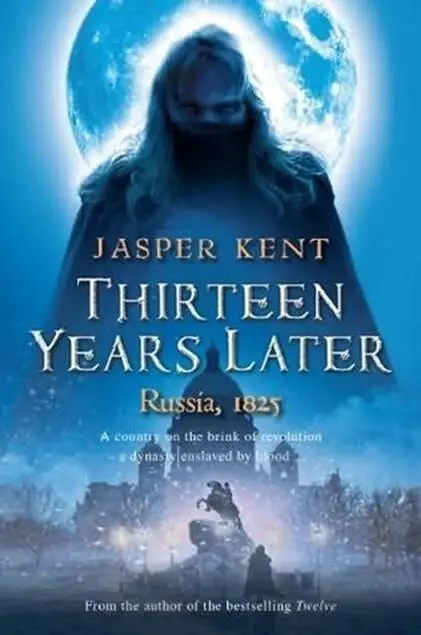
- Название:Thirteen Years Later
- Автор:
- Жанр:
- Год:неизвестен
- ISBN:нет данных
- Рейтинг книги:5 / 5. Голосов: 1
-
Избранное:Добавить в избранное
- Отзывы:
-
Ваша оценка:
Thirteen Years Later: краткое содержание, описание и аннотация
Предлагаем к чтению аннотацию, описание, краткое содержание или предисловие (зависит от того, что написал сам автор книги «Thirteen Years Later»). Если вы не нашли необходимую информацию о книге — напишите в комментариях, мы постараемся отыскать её.
Thirteen Years Later — читать онлайн бесплатно полную книгу (весь текст) целиком
Ниже представлен текст книги, разбитый по страницам. Система сохранения места последней прочитанной страницы, позволяет с удобством читать онлайн бесплатно книгу «Thirteen Years Later», без необходимости каждый раз заново искать на чём Вы остановились. Поставьте закладку, и сможете в любой момент перейти на страницу, на которой закончили чтение.
Интервал:
Закладка:
He smiled as he cast his mind back to earlier that day, as he sat there, carving away at the wood. Domnikiia had been across the room, sewing, aware of what he was planning, but repressing her concerns. Tamara had dashed in and seen the sword. The look on Domnikiia’s face expressed both their fears that their daughter would ask what it was for, but in her childish self-interest she had immediately assumed it was a toy for her. ‘I don’t want a sword,’ she had said. ‘Swords are for boys.’ With that, she had raced out again. On a different occasion, Aleksei would have chided her for her rudeness, but instead he and Domnikiia had laughed, a little of the tension between them released. Years earlier, Dmitry had been far happier to receive a wooden sword as a gift from his father. It had only been broken two nights before.
Kyesha had not provided a ticket for tonight’s performance as he had the previous week, but Aleksei had had no trouble in purchasing one – or rather two, so that there would be an empty space beside him for Kyesha to sit. Tonight’s performance was of Flore et Zéphire, a revival of Didelot’s production of Bossi’s score. Aleksei had already seen it in Petersburg, and while he had enjoyed plenty of ballet in his time, Didelot’s over-staged trickery somehow bored him beyond all measure. Artistic appreciation was not, however, the purpose of tonight’s visit. Aleksei and Dmitry stood for a while in the square outside the theatre, their eyes darting in all directions in search of Kyesha as the audience made its way between the columns of the theatre’s façade to take their seats within.
‘I should go in,’ said Aleksei.
‘You’re sure he’ll be inside?’
‘He was last time.’
‘Last time he knew where you’d be sitting.’
Aleksei nodded, but he already had an answer to that. ‘Last time, he didn’t know what I looked like.’ Now it was Dmitry’s turn to nod. ‘Anyway,’ continued Aleksei, ‘he’s either going to be inside or outside. It’s either you or I that will meet him.’ And I hope to God it’s me, he thought.
‘You’re certain he’ll come.’ Dmitry spoke it as a statement, not a question.
‘He wants something,’ was Aleksei’s simple reply.
Aleksei glanced around the square again. To anyone who knew the faces, the whole area screamed out that it was a trap. Even if Aleksei had never seen a single one of them before, he would have felt uneasy. Too many pairs of men, evenly distributed, each in his own way trying to look as if he had a reason for being there. Considering the assumed trade that Kyesha had used to lure some of his victims, he might well guess that there was an embarrassment of competition for him here tonight.
Dmitry took his father’s hand. ‘Good luck,’ he said sincerely, before adding with a smirk, ‘Colonel.’
‘You too, Lieutenant,’ replied Aleksei. Then he turned and went into the theatre.
His seat was again in the stalls, but further back this time, in row nine. As before, he was close to the aisle. He wanted to make it easy for Kyesha to approach him, and just as easy for him to get away. The main plot of the evening would not be unfolding in the theatre. Looking around, he could see three pairs of men he knew to be members of the Northern Society. No – more than that. Three pairs were members of the inner circle which had embarked upon tonight’s adventure, but there were almost a dozen other faces Aleksei knew to house the same political point of view. He hoped none of them would interfere with his plans by trying to engage him or his colleagues in any kind of conversation.
The ballet began. Aleksei paid little attention. He glanced around the auditorium. It was almost full. He was pleased to see that the eyes of his comrades were all fixed on him, rather than on the stage. That was an important part of the plan. None of them had seen Kyesha before, and his contact with Aleksei might last only moments. They could not simply follow the man who took the seat next to Aleksei. Kyesha might not sit down – or some innocent, noticing a vacant space, might occupy it instead. It was vital that there be no confusion, and so all knew the prearranged sign Aleksei would make to indicate that this was the man. Aleksei clenched his fist in preparation. It was only after he had described the signal he would give that he understood its irony, though he felt sure that some deeper part of his mind, or some mischievous God, had suggested the idea to him in full knowledge of its implications.
The sign was to be a kiss – an inconspicuous kiss to the side of his own forefinger when he was in the presence of the man they should follow. It was not a kiss to the man he would betray, but it amounted to the same. The words of Saint Matthew came to him: ‘Now he that betrayed him gave them a sign, saying, whomsoever I shall kiss, that same is he: hold him fast.’ And there was another difference. Aleksei’s instructions were explicitly not to hold him fast, but to let him go. Even so, Aleksei hoped he would not have to endure the same fate as Judas. The icy cold of winter was his Hell on earth. He did not need to experience that same cold for eternity, down with the traitors in Hell’s ninth circle.
Despite having seen it before, Aleksei found the ballet just about incomprehensible. He had, he believed, worked out who was playing Zephyr, the west wind, and who was Flora, the goddess of flowers and spring. Even before he’d entered the theatre he’d questioned why a Greek god should be attempting to seduce a Roman goddess when her Greek equivalent, Chloris, would at least be more likely to speak his language. But looking at the woman who was dancing the part of Flora, he couldn’t help but wonder why any god or mortal, Greek or Roman, would want to seduce her, even if she offered him every one of the flowers that she caused to bloom in the spring. It was surprise enough that the rope by which she was all too frequently suspended – an innovation by Didelot in his original production – could hold her in the air long enough for her to fly across the stage and join her lover. Aleksei could only imagine the two, perhaps three, stagehands off in the wings, valiantly straining to keep the nymph aloft.
But he remembered that, just as he was not here to enjoy the ballet, he was equally not here to despise it. He glanced around the auditorium again and then down at the empty seat beside him. It was too late. The seat was no longer empty. On it lay a package, wrapped in paper, with three letters scrawled on its front:

Aleksei Ivanovich Danilov. Kyesha had slipped in to deliver it without Aleksei even noticing. Perhaps Kyesha himself had not come at all – he could have asked anyone to place the parcel on the seat. And it could have happened at any time within the last ten minutes. But there was no benefit in speculating. Aleksei grabbed the package and rushed out of the auditorium. The tunnel took him quickly out to the foyer and then he headed straight on, out of the theatre and into the square.
At first, he saw nothing. The square was not bustling, but as busy as one would expect on a Saturday evening. It was only after a few moments that he perceived a consensus of motion amongst a significant fraction of the people. Most walked in their own direction, or stood still, but all around, a number of individuals and often pairs were cutting through the crowd at a run, converging on a point just out of Aleksei’s view – around the corner of the Maly Theatre. They were like ants, rushing home and converging on a single entrance to their nest. All were men he had deployed to track Kyesha. He felt a presence at his shoulder and turned. It was one of them – Lieutenant Batenkov, if he remembered correctly.
Читать дальшеИнтервал:
Закладка:
Похожие книги на «Thirteen Years Later»
Представляем Вашему вниманию похожие книги на «Thirteen Years Later» списком для выбора. Мы отобрали схожую по названию и смыслу литературу в надежде предоставить читателям больше вариантов отыскать новые, интересные, ещё непрочитанные произведения.










Обсуждение, отзывы о книге «Thirteen Years Later» и просто собственные мнения читателей. Оставьте ваши комментарии, напишите, что Вы думаете о произведении, его смысле или главных героях. Укажите что конкретно понравилось, а что нет, и почему Вы так считаете.