Jasper Kent - Thirteen Years Later
Здесь есть возможность читать онлайн «Jasper Kent - Thirteen Years Later» весь текст электронной книги совершенно бесплатно (целиком полную версию без сокращений). В некоторых случаях можно слушать аудио, скачать через торрент в формате fb2 и присутствует краткое содержание. Жанр: Историческая проза, Ужасы и Мистика, на английском языке. Описание произведения, (предисловие) а так же отзывы посетителей доступны на портале библиотеки ЛибКат.
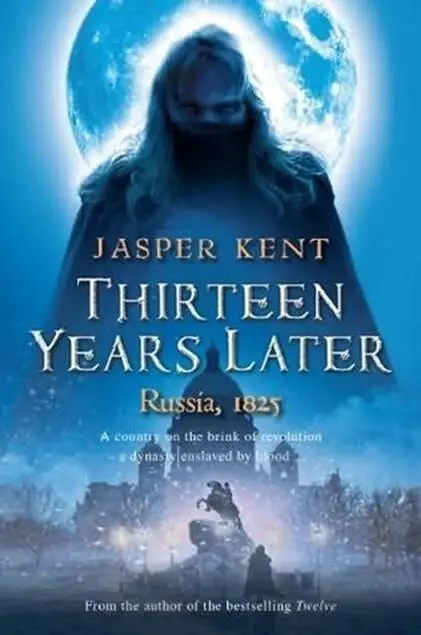
- Название:Thirteen Years Later
- Автор:
- Жанр:
- Год:неизвестен
- ISBN:нет данных
- Рейтинг книги:5 / 5. Голосов: 1
-
Избранное:Добавить в избранное
- Отзывы:
-
Ваша оценка:
Thirteen Years Later: краткое содержание, описание и аннотация
Предлагаем к чтению аннотацию, описание, краткое содержание или предисловие (зависит от того, что написал сам автор книги «Thirteen Years Later»). Если вы не нашли необходимую информацию о книге — напишите в комментариях, мы постараемся отыскать её.
Thirteen Years Later — читать онлайн бесплатно полную книгу (весь текст) целиком
Ниже представлен текст книги, разбитый по страницам. Система сохранения места последней прочитанной страницы, позволяет с удобством читать онлайн бесплатно книгу «Thirteen Years Later», без необходимости каждый раз заново искать на чём Вы остановились. Поставьте закладку, и сможете в любой момент перейти на страницу, на которой закончили чтение.
Интервал:
Закладка:
The venue at which they had chosen to meet – chosen before the fires had wreaked their destruction – had been a tavern on the north-west side of the street which had vanished along with everything else. By chance, the rebuilt street also had a tavern, but on the other side and a little further away from Tverskaya Street itself. Aleksei glanced at his watch, and then up and down the street in either direction. It was a quarter past nine and there was still no sign of Kyesha.
‘Perhaps he’s not coming,’ said Dmitry.
Aleksei turned and looked at his son. Everything between them still seemed so normal. Had their conversation earlier that day really taken place? Had Dmitry completely misunderstood what Aleksei had told him? It was impossible. Aleksei tried to recall the exact words he had used. He could not have put it more plainly – and yet it was also impossible that, having learned that the voordalak was a real creature, not some inhabiter of dreams, having learned that his own father had done battle with them in his youth, he could remain the same person he had been that morning. But Aleksei had seen the reaction many times before. The turmoil of his own mind at the discovery of the existence of vampires had not manifested itself in any obvious way. He had seen the reactions of Vadim, Maks, Dmitry Fetyukovich and even Domnikiia, and although they had all taken it differently, none of them had been reduced to the jabbering wrecks of humanity such knowledge should surely inspire in any sane person.
Perhaps the strangeness was not the ease with which Dmitry had come to terms with the concept, but the fact that he believed it at all. Dmitry’s was the first truly modern generation of Russians, unable to remember the turmoil the French Revolution had brought to Russia, but familiar with the new age that had been ushered in across Europe. But still the old beliefs lurked within his mind, waiting to be given substance. It was not something that was learned – it was in the Russian blood. And how could Dmitry not believe? What he had seen in Saint Vasiliy’s the previous night had been beyond any human experience. It had needed an explanation, and the single word – voordalak – uttered from his father’s lips brought together a belief based both on filial respect and that great mass of Russian folklore. Maks would have pointed out the flaw: vampires may have regrowing fingers, but that does not mean that regrowing fingers necessitate a vampire. His reasoning would have been right, but his conclusion wrong, or at least unhelpfully ambiguous. Maks himself had come to believe in the voordalak.
‘He’ll come,’ said Aleksei in response to his son’s suggestion. ‘There’s something he wants.’
‘What?’
Aleksei shrugged. ‘Let’s have a drink.’
They went into the tavern. It hadn’t changed much since Aleksei’s only previous visit. That had been in 1818. Domnikiia had become happily settled in her shop – truly happy for the first time in her life – and had decided that now was perhaps the time to be reconciled with her estranged family. Her father had thrown her out because she’d slept with one of his customers. Then the distinction between a lover and a customer had dwindled to nothing; at least they had been her own customers. But in 1818, that was all behind her, and she had decided to make amends. She had asked Aleksei to find her mother and father.
Her mother was dead; dead since 1812. At least that was what everyone assumed. She had not been seen after the five weeks of the French occupation. She might have fled, starved, been killed by the invaders or have died in the fires. There was no clue as to which. There was one other possibility – a cause of death of which few were aware – but it would have been an unthinkable coincidence for Domnikiia’s mother to have become a victim of the Oprichniki. Even so, Aleksei knew that Domnikiia would want certainty, and so he had told a story of how her mother had been crushed under the walls of a collapsing building ravaged by the conflagration. It was a cruel invention to convey to a daughter, but kinder than allowing her imagination free rein.
News of her father had been more difficult to come by, but eventually Aleksei had found him. His business had evaporated before the war, and his home life had collapsed with the loss of his wife. Aleksei discovered that he spent most of his life slumped against the bar of the tavern near Tverskaya Street. Domnikiia had gone to speak to him, but Aleksei had sat in a corner and kept an eye on them.
Semyon Arkadievich Beketov was a little over fifty, of average height and corpulent build. Greying hair surrounded a large bald patch. His face was bloated, presumably from his continual drinking, and was of a yellow – almost green – complexion. The red slits of his eyes emerged from between his swollen eyelids. Even so, Domnikiia recognized him at once. She had spoken to him, but Aleksei had not been able to make out clearly what was said. He could not even be sure that her father knew who she was. Towards the end of the conversation, he had heard Beketov call her a whore and watched him slide a handful of money across the bar to her – mere copecks. Perhaps he had recognized her and remembered the reason he had thrown her out – perhaps he hadn’t, and was genuinely trying to hire her services. Then Beketov had stood and grabbed Domnikiia by the wrist, as if about to drag her to the door. Aleksei was instantly on his feet, but Domnikiia had no trouble freeing herself from the pathetically feeble old man. She hadn’t even needed to push him; he had fallen to the floor, unable to maintain his own balance. She had rushed out, and Aleksei had followed.
Domnikiia never told him the details of the conversation, and he didn’t really care to hear. He suggested that he continue looking for the rest of the family – her sister and three brothers – but she said she wasn’t interested. Three years later he repeated the offer when he told her the news he had heard, that Beketov was dead. He had stumbled out of a public house and under the wheels of a carriage. Domnikiia said she wanted to forget them all, and the topic had never been raised again. Three months after that, Tamara was born.
And this was the first time Aleksei had been back to the street, or to the tavern, since. As they entered, he glanced at the spot at the bar where Domnikiia and her father had spoken. Today, it was occupied by a similar drunk, who somewhere in the city might have a similar family. That was not Aleksei’s concern. Kyesha was sitting alone in a corner. He was not to know that this was not the actual tavern of the meeting place arranged in 1812. Whoever he had heard of the meetings from had never been here – the alliance between Oprichnik and Russian had fallen apart long before seven consecutive meetings could be achieved.
In truth it was a surprise to find Kyesha there at all, after the events of the previous night. But then again, Kyesha had proved himself quite capable of resisting the attacks of both Aleksei and his son, so he would feel he had little to fear. That would change – but not tonight. The more logical question was why Aleksei had come. He was the one who had been defeated, so why was Kyesha sitting here, confident that his opponent would come back for more? He knew how well he had set his lure.
Or perhaps he had just come in for a drink. Beside him was a bottle of Bordeaux and three glasses. All were full, including Kyesha’s own.
Aleksei and Dmitry sat down.
‘I remember you now,’ said Aleksei.
‘From last night?’ asked Kyesha, with a smile that Aleksei had to force himself not to reciprocate.
‘From Silistria.’
‘Ah!’
‘I thought you were either a fool or a hero,’ said Aleksei.
‘And now?’
Читать дальшеИнтервал:
Закладка:
Похожие книги на «Thirteen Years Later»
Представляем Вашему вниманию похожие книги на «Thirteen Years Later» списком для выбора. Мы отобрали схожую по названию и смыслу литературу в надежде предоставить читателям больше вариантов отыскать новые, интересные, ещё непрочитанные произведения.









Обсуждение, отзывы о книге «Thirteen Years Later» и просто собственные мнения читателей. Оставьте ваши комментарии, напишите, что Вы думаете о произведении, его смысле или главных героях. Укажите что конкретно понравилось, а что нет, и почему Вы так считаете.