Bernard Cornwell - Excalibur
Здесь есть возможность читать онлайн «Bernard Cornwell - Excalibur» весь текст электронной книги совершенно бесплатно (целиком полную версию без сокращений). В некоторых случаях можно слушать аудио, скачать через торрент в формате fb2 и присутствует краткое содержание. Год выпуска: 1999, Издательство: MacMillan Publishers, Жанр: Историческая проза, на английском языке. Описание произведения, (предисловие) а так же отзывы посетителей доступны на портале библиотеки ЛибКат.
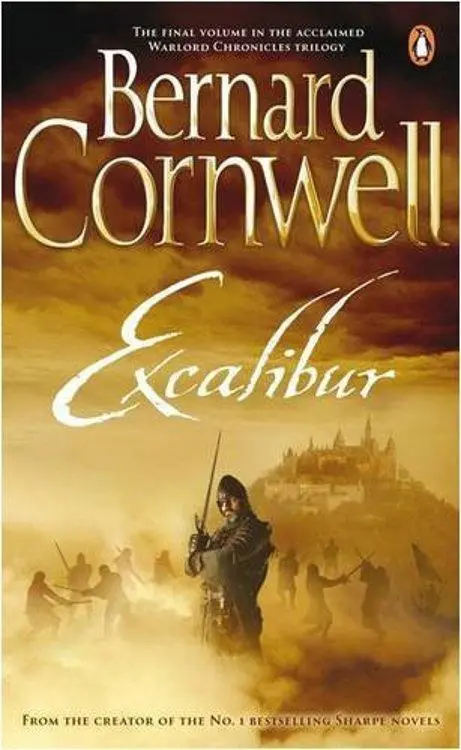
- Название:Excalibur
- Автор:
- Издательство:MacMillan Publishers
- Жанр:
- Год:1999
- ISBN:нет данных
- Рейтинг книги:4 / 5. Голосов: 2
-
Избранное:Добавить в избранное
- Отзывы:
-
Ваша оценка:
Excalibur: краткое содержание, описание и аннотация
Предлагаем к чтению аннотацию, описание, краткое содержание или предисловие (зависит от того, что написал сам автор книги «Excalibur»). Если вы не нашли необходимую информацию о книге — напишите в комментариях, мы постараемся отыскать её.
to Marion Zimmer Bradley's
, the legend of King Arthur has haunted and inspired generations of writers to reinvent the ancient story. In
and
, Bernard Cornwell demonstrated his astonishing ability to make the oft-told legend of King Arthur fresh and new for our time. Now, in this riveting final volume of the
, Cornwell tells the story of Arthur's desperate attempt to triumph over a ruined marriage and the Saxons' determination to destroy him.
Set against the backdrop of the Dark Ages, this brilliant saga continues as seen through the eyes of Derfel, an orphan brought up by Merlin and one of Arthur's warriors. In this book, the aging Arthur has been betrayed by, among others, his beloved Guinevere; but although he is alone and deeply saddened, he still embraces his dreams of a world in which civilization triumphs over brute force. Arthur and his warriors must face the dreaded Saxons — now allied with Arthur's betrayer Lancelot — for the throne of Britain.
This is the tale not only of a broken love remade but also of enemies more subtle than any Saxon spearman — of forces both earthly and unearthly that threaten everything Arthur stands for. When Merlin and Nimue embark on a dangerous quest to summon the Gods back to Britain, they unleash forces that will lead to a last desperate battle on the sands of Camlann, where it seems that Arthur must fail unless Merlin's final enchantment can avert the horror.
Peopled by princesses and bards, warriors and magicians, Excalibur is a story of love, war, loyalty, and betrayal, the unforgettable conclusion to a brilliant retelling of one of the most powerful legends of all time.
Excalibur — читать онлайн бесплатно полную книгу (весь текст) целиком
Ниже представлен текст книги, разбитый по страницам. Система сохранения места последней прочитанной страницы, позволяет с удобством читать онлайн бесплатно книгу «Excalibur», без необходимости каждый раз заново искать на чём Вы остановились. Поставьте закладку, и сможете в любой момент перейти на страницу, на которой закончили чтение.
Интервал:
Закладка:
By then Gwydre and Morwenna were married and had produced their first child, and that child was a boy whom they named Arthur and who was ever afterwards known as Arthur-bach, Arthur the Little. The child was baptized by Bishop Emrys, and Argante saw the ceremony as a provocation. She knew that neither Arthur nor Guinevere had any great love for Christianity, and that by baptizing their grandson they were merely currying favour with the Christians in Dumnonia whose support would be needed if Gwydre were to take the throne. Besides, Arthur-bach’s very existence was a reproach to Mordred. A King should be fecund, it was his duty, and Mordred was failing in that duty. It did not matter that he had whelped bastards the length and breadth of Dumnonia and Armorica, he was not whelping an heir on Argante and the Queen spoke darkly of his crippled foot, she remembered the evil omens of his birth and she looked sourly towards Siluria where her rival, my daughter, was proving capable of breeding new Princes. The Queen became more desperate, even dipping into her treasury to pay in gold any fraudster who promised her a swollen womb, but not all the sorceresses of Britain could help her conceive and, if rumour spoke true, not half the spearmen in her palace guard either. And all the while Gwydre waited in Siluria and Argante knew that if Mordred died then Gwydre would rule in Dumnonia unless she produced an heir of her own.
I did my best to preserve Dumnonia’s peace in those early years of Mordred’s rule and, for a time, my efforts were helped by the King’s absence. I appointed the magistrates and so made sure that Arthur’s justice continued. Arthur had always loved good laws, claiming they bound a country together like the willow-boards of a shield are gripped by their leather cover, and he had taken immense trouble to appoint magistrates whom he could trust to be impartial. They were, for the most part, landowners, merchants and priests, and almost all were wealthy enough to resist the corrosive effects of gold. If men can buy the law, Arthur had always said, then the law becomes worthless, and his magistrates were famous for their honesty, but it did not take long for folk in Dumnonia to discover that the magistrates could be outflanked. By paying money to Sansum or Argante they guaranteed that Mordred would write from Armorica ordering a decision changed and so, year after year, I found myself fighting a rising sea of small injustices. The honest magistrates resigned rather than have their rulings constantly reversed, while men who might have submitted their grievances to a court preferred to settle them with spears. That erosion of the law was a slow process, but I could not halt it. I was supposed to be a bridle on Mordred’s capriciousness. but Argante and Sansum were twin spurs, and the spurs were overcoming the bridle.
Yet, on the whole, that was a happy time. Few folk lived as long as forty years, yet both Ceinwyn and I did and both of us were given good health by the Gods. Morwenna’s marriage gave us joy, and the birth of Arthur-bach even more, and a year later our daughter Seren was married to Ederyn, the Edling of Elmet. It was a dynastic marriage, for Seren was first cousin to Perddel, King of Powys, and the marriage was not contracted for love, but to strengthen the alliance between Elmet and Powys and though Ceinwyn opposed the marriage for she saw no evidence of affection between Seren and Ederyn, Seren had set her heart on being a Queen and so she married her Edling and moved far away from us. Poor Seren, she never did become a Queen, for she died giving birth to her first child, a daughter who lived only half a day longer than her mother. Thus did the second of my three daughters cross to the Otherworld.
We wept for Seren, though the tears were not so bitter as those we had shed at Dian’s death, for Dian had died so cruelly young, but just a month after Seren died Morwenna gave birth to a second child, a daughter whom she and Gwydre named Seren, and those grandchildren were a growing brightness in our lives. They did not come to Dumnonia because there they would have been in danger from Argante’s jealousy, but Ceinwyn and I went often enough to Siluria. Indeed, our visits became so frequent that Guinevere kept rooms in her palace just for our use and, after a while, we spent more time in Isca than we did in Dun Caric. My head and beard were going grey and I was content to let Issa struggle with Argante while I played with my grandchildren. I built my mother a house on Siluria’s coast, but by then she was so mad that she did not know what was happening and kept trying to return to her tidewood hovel on its bluff above the sea. She died in one of the winter plagues and, as I had promised Aelle, I buried her like a Saxon with her feet to the north.
Dumnonia decayed, and there seemed little I could do to prevent the decay for Mordred had just enough power to outflank me, but Issa preserved what order and justice he could while Ceinwyn and I spent more and more of our time in Siluria. What sweet memories I keep of Isca; memories of sunny days with Taliesin singing lullabies and Guinevere gently mocking my happiness as I towed Arthur-bach and Seren in an upturned shield across the grass. Arthur would join the games, for he had ever adored children, and sometimes Galahad would be there for he had joined Arthur and Guinevere in their comfortable exile.
Galahad had still not married, though now he had a child. It was his nephew, Prince Peredur, Lancelot’s son, who had been found wandering in tears among the dead of Mynydd Baddon. As Peredur grew he came more and more to resemble his father; he had the same dark skin, the same lean and handsome face, and the same black hair, but in his character he was Galahad, not Lancelot. He was a clever, grave and earnest boy, and anxious to be a good Christian. I do not know how much of his father’s history he knew, but Peredur was always nervous of Arthur and Guinevere, and they, I think, found him unsettling. That was not his fault, but rather because his face reminded them of what we would all have preferred to forget, and both were grateful when, at twelve years old, Peredur was sent to Meurig’s court in Gwent to learn a warrior’s skills. He was a good boy, yet with his departure it was as though a shadow had gone from Isca. In later years, long after Arthur’s story was done, I came to know Peredur well and to value him as highly as I have valued any man.
Peredur might have unsettled Arthur, but there were few other shadows to trouble him. In these dark days, when folk look back and remember what they lost when Arthur went, they usually speak of Dumnonia, but others also mourn Siluria, for in those years he gave that unregarded kingdom a time of peace and justice. There was still disease, and still poverty, and men did not cease from getting drunk and killing each other just because Arthur governed, but widows knew that his courts would give redress, and the hungry knew that his granaries held food to last a winter. No enemy raided across Siluria’s border, and though the Christian religion spread fast through the valleys, Arthur would not let its priests defile the pagan shrines, nor allow the pagans to attack the Christian churches. In those years he made Siluria into what he had dreamed he could make all Britain: a haven. Children were not enslaved, crops were not burned and warlords did not ravage homesteads.
Yet beyond the haven’s borders, dark things loomed. Merlin’s absence was one. Year after year passed, and still there was no news, and after a while folk assumed the Druid must have died for surely no man, not even Merlin, could live so long. Meurig was a nagging and irritable neighbour, forever demanding higher taxes or a purge of the Druids who lived in Siluria’s valleys, though Tewdric, his father, was a moderating influence when he could be stirred from his self-imposed life of near starvation. Powys stayed weak, and Dumnonia became increasingly lawless, though it was spared the worst of Mordred’s rule by his absence. In Siluria alone, it seemed, there was happiness, and Ceinwyn and I began to think that we would live the rest of our days in Isca. We had wealth, we had friends, we had family and we were happy.
Читать дальшеИнтервал:
Закладка:
Похожие книги на «Excalibur»
Представляем Вашему вниманию похожие книги на «Excalibur» списком для выбора. Мы отобрали схожую по названию и смыслу литературу в надежде предоставить читателям больше вариантов отыскать новые, интересные, ещё непрочитанные произведения.









Обсуждение, отзывы о книге «Excalibur» и просто собственные мнения читателей. Оставьте ваши комментарии, напишите, что Вы думаете о произведении, его смысле или главных героях. Укажите что конкретно понравилось, а что нет, и почему Вы так считаете.