Bernard Cornwell - Excalibur
Здесь есть возможность читать онлайн «Bernard Cornwell - Excalibur» весь текст электронной книги совершенно бесплатно (целиком полную версию без сокращений). В некоторых случаях можно слушать аудио, скачать через торрент в формате fb2 и присутствует краткое содержание. Год выпуска: 1999, Издательство: MacMillan Publishers, Жанр: Историческая проза, на английском языке. Описание произведения, (предисловие) а так же отзывы посетителей доступны на портале библиотеки ЛибКат.
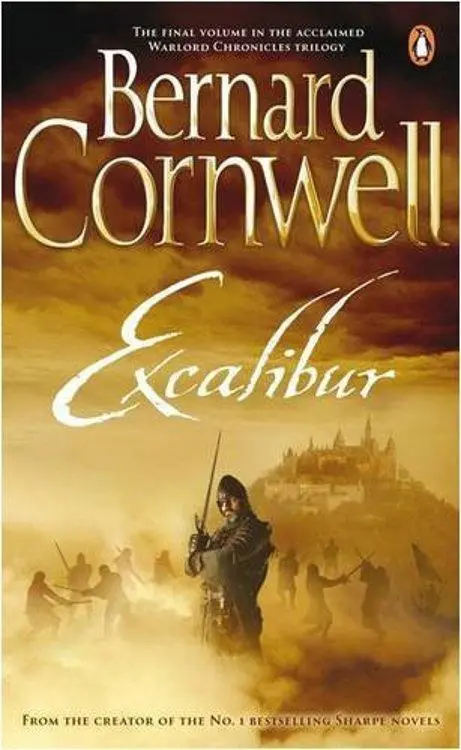
- Название:Excalibur
- Автор:
- Издательство:MacMillan Publishers
- Жанр:
- Год:1999
- ISBN:нет данных
- Рейтинг книги:4 / 5. Голосов: 2
-
Избранное:Добавить в избранное
- Отзывы:
-
Ваша оценка:
Excalibur: краткое содержание, описание и аннотация
Предлагаем к чтению аннотацию, описание, краткое содержание или предисловие (зависит от того, что написал сам автор книги «Excalibur»). Если вы не нашли необходимую информацию о книге — напишите в комментариях, мы постараемся отыскать её.
to Marion Zimmer Bradley's
, the legend of King Arthur has haunted and inspired generations of writers to reinvent the ancient story. In
and
, Bernard Cornwell demonstrated his astonishing ability to make the oft-told legend of King Arthur fresh and new for our time. Now, in this riveting final volume of the
, Cornwell tells the story of Arthur's desperate attempt to triumph over a ruined marriage and the Saxons' determination to destroy him.
Set against the backdrop of the Dark Ages, this brilliant saga continues as seen through the eyes of Derfel, an orphan brought up by Merlin and one of Arthur's warriors. In this book, the aging Arthur has been betrayed by, among others, his beloved Guinevere; but although he is alone and deeply saddened, he still embraces his dreams of a world in which civilization triumphs over brute force. Arthur and his warriors must face the dreaded Saxons — now allied with Arthur's betrayer Lancelot — for the throne of Britain.
This is the tale not only of a broken love remade but also of enemies more subtle than any Saxon spearman — of forces both earthly and unearthly that threaten everything Arthur stands for. When Merlin and Nimue embark on a dangerous quest to summon the Gods back to Britain, they unleash forces that will lead to a last desperate battle on the sands of Camlann, where it seems that Arthur must fail unless Merlin's final enchantment can avert the horror.
Peopled by princesses and bards, warriors and magicians, Excalibur is a story of love, war, loyalty, and betrayal, the unforgettable conclusion to a brilliant retelling of one of the most powerful legends of all time.
Excalibur — читать онлайн бесплатно полную книгу (весь текст) целиком
Ниже представлен текст книги, разбитый по страницам. Система сохранения места последней прочитанной страницы, позволяет с удобством читать онлайн бесплатно книгу «Excalibur», без необходимости каждый раз заново искать на чём Вы остановились. Поставьте закладку, и сможете в любой момент перейти на страницу, на которой закончили чтение.
Интервал:
Закладка:
‘There can be no peace, Lord King,’ I said directly, ‘while two men want the same kingdom. What would you have me tell my son-in-law?’
Again Meurig was unsettled by my directness. He fiddled with an oyster shell while he considered his answer, then shrugged. ‘You may assure Gwydre that he will have land, honour, rank and my protection,’ he said, blinking rapidly, ‘but I will not see him made King of Dumnonia.’ He actually blushed as he spoke the last words. He was a clever man, Meurig, but a coward at heart and it must have taken a great effort for him to have expressed himself so bluntly. Maybe he feared my anger, but I gave him a courteous reply. ‘I shall tell him, Lord King,’ I said, though in truth the message was not for Gwydre, but for Arthur. Meurig was not only declaring his own bid to rule Dumnonia, but warning Arthur that Gwent’s formidable army would oppose Gwydre’s candidacy.
Bishop Lladarn leaned towards Meurig and spoke in an urgent whisper. He used Latin, confident that neither Galahad nor I would understand him, but Galahad spoke the language and half heard what was being said. ‘You’re planning to keep Arthur penned inside Siluria?’ he accused Lladarn in British. Lladarn blushed. As well as being the Bishop of Burrium, Lladarn was the King’s chief counsellor and thus a man of power. ‘My King,’ he said, bowing his head in Meurig’s direction, ‘cannot allow Arthur to move spearmen through Gwent’s territory.’
‘Is that true, Lord King?’ Galahad asked politely.
‘I am a man of peace,’ Meurig blustered, ‘and one way to secure peace is to keep spearmen at home.’
I said nothing, fearing that my anger would only make me blurt out some insult that would make things worse. If Meurig insisted that we could not move spearmen across his roads then he would have succeeded in dividing the forces that would support Gwydre. It meant that Arthur could not march to join Sagramor, nor Sagramor to join Arthur, and if Meurig could keep their forces divided then he would most likely be the next King of Dumnonia.
‘But Meurig won’t fight,’ Galahad said scornfully as we rode down the river towards Isca the next day. The willows were hazed with their first hint of spring leaves, but the day itself was a reminder of winter with a cold wind and drifting mists.
‘He might,’ I said, ‘if the prize is large enough.’ And the prize was huge, for if Meurig ruled both Gwent and Dumnonia then he would control the richest part of Britain. ‘It will depend,’ I said, ‘on how many spears oppose him.’
‘Yours, Issa’s, Arthur’s, Sagramor’s,’ Galahad said.
‘Maybe five hundred men?’ I said, ‘and Sagramor’s are a long way away, and Arthur’s would have to cross Gwent’s territory to reach Dumnonia. And how many men does Meurig command? A thousand?’
‘He won’t risk war,’ Galahad insisted. ‘He wants the prize, but he’s terrified of the risk.’ He had stopped his horse to watch a man fishing from a coracle in the centre of the river. The fisherman cast his hand net with a careless skill and, while Galahad was admiring the fisherman’s dexterity, I was weighting each cast with an omen. If this throw yields a salmon, I told myself, then Mordred will die. The throw did bring up a big struggling fish, and then I thought that the augury was a nonsense, for all of us would die, and so I told myself that the next cast must net a fish if Mordred was to die before Beltain. The net came up empty and I touched the iron of Hywelbane’s hilt. The fisherman sold us a part of his catch and we pushed the salmon into our saddlebags and rode on. I prayed to Mithras that my foolish omen was misleading, then prayed that Galahad was right, and that Meurig would never dare commit his troops. But for Dumnonia? Rich Dumnonia? That was worth a risk, even for a cautious man like Meurig. Weak kings are a curse on the earth, yet our oaths are made to kings, and if we had no oaths we would have no law, and if we had no law we would have mere anarchy, and so we must bind ourselves with the law, and keep the law by oaths, and if a man could change kings at whim then he could abandon his oaths with his inconvenient king, and so we need kings because we must have an immutable law. All that is true, yet as Galahad and I rode home through the wintry mists I could have wept that the one man who should have been a king would not be one, and that those who should never have been kings all were.
We found Arthur in his blacksmith’s shed. He had built the shed himself, made a hooded furnace from Roman bricks, then purchased an anvil and a set of blacksmith’s tools. He had always declared he wanted to be a blacksmith, though as Guinevere frequently remarked, wanting and being were not at all the same thing. But Arthur tried, how he tried! He employed a proper blacksmith, a gaunt and taciturn man named Morridig, whose task was to teach Arthur the skills of the trade, but Morridig had long despaired of teaching Arthur anything except enthusiasm. All of us, nevertheless, possessed items Arthur had made; iron candle-stands that had kinked shafts, misshapen cooking pots with ill-fitting handles or fire-spits that bowed over the flame. Yet the smithy made him happy, and he spent hours beside its hissing furnace, ever certain that a little more practice would make him as carelessly proficient as Morridig.
He was alone in the smithy when Galahad and I returned from Burrium. He grunted a distracted welcome, then went on hammering a shapeless piece of iron that he claimed was a shoe-plate for one of his horses. He reluctantly dropped the hammer when we presented him with one of the salmon we had bought, then interrupted our news by saying that he had already heard that Mordred was close to death.
‘A bard arrived from Armorica yesterday,’ he told us, ‘and says the King’s leg is rotting at the hip. The bard says he stinks like a dead toad.’
‘How does the bard know?’ I asked, for I had thought Mordred was surrounded and cut off from all the other Britons in Armorica.
‘He says it’s common knowledge in Broceliande,’ Arthur said, then happily added that he expected Dumnonia’s throne to be vacant in a matter of days, but we spoiled his cheerfulness by telling him of Meurig’s refusal to allow any of our spearmen to cross Gwent’s land and I furthered his gloom by adding my suspicions of Sansum. I thought for a second that Arthur was going to curse, something he did rarely, but he controlled the impulse, and instead moved the salmon away from the furnace. ‘Don’t want it to cook,’ he said. ‘So Meurig’s closed all the roads to us?’
‘He says he wants peace, Lord,’ I explained.
Arthur laughed sourly. ‘He wants to prove himself, that’s what he wants. His father’s dead and he’s eager to show that he’s a better man than Tewdric. The best way is to become a hero in battle and the second best is to steal a kingdom without a battle.’ He sneezed violently, then shook his head angrily. ‘I hate having a cold.’
‘You should be resting, Lord,’ I said, ‘not working.’
‘This isn’t work, this is pleasure.’
‘You should take coltsfoot in mead,’ Galahad said.
‘I’ve drunk nothing else for a week. Only two things cure colds: death or time.’ He picked up the hammer and gave the cooling lump of iron a ringing blow, then pumped the leather-jacketed bellows that fed air into the furnace. The winter had ended, but despite Arthur’s insistence that the weather was ever kind in Isca, it was a freezing day. ‘What’s your mouse lord up to?’ he asked me as he pumped the furnace into a shimmering heat.
‘He isn’t my mouse lord,’ I said of Sansum.
‘But he’s scheming, isn’t he? Wants his own candidate on the throne.’
‘But Meurig has no right to the throne!’ Galahad protested.
Читать дальшеИнтервал:
Закладка:
Похожие книги на «Excalibur»
Представляем Вашему вниманию похожие книги на «Excalibur» списком для выбора. Мы отобрали схожую по названию и смыслу литературу в надежде предоставить читателям больше вариантов отыскать новые, интересные, ещё непрочитанные произведения.






Обсуждение, отзывы о книге «Excalibur» и просто собственные мнения читателей. Оставьте ваши комментарии, напишите, что Вы думаете о произведении, его смысле или главных героях. Укажите что конкретно понравилось, а что нет, и почему Вы так считаете.