Bernard Cornwell - Excalibur
Здесь есть возможность читать онлайн «Bernard Cornwell - Excalibur» весь текст электронной книги совершенно бесплатно (целиком полную версию без сокращений). В некоторых случаях можно слушать аудио, скачать через торрент в формате fb2 и присутствует краткое содержание. Год выпуска: 1999, Издательство: MacMillan Publishers, Жанр: Историческая проза, на английском языке. Описание произведения, (предисловие) а так же отзывы посетителей доступны на портале библиотеки ЛибКат.
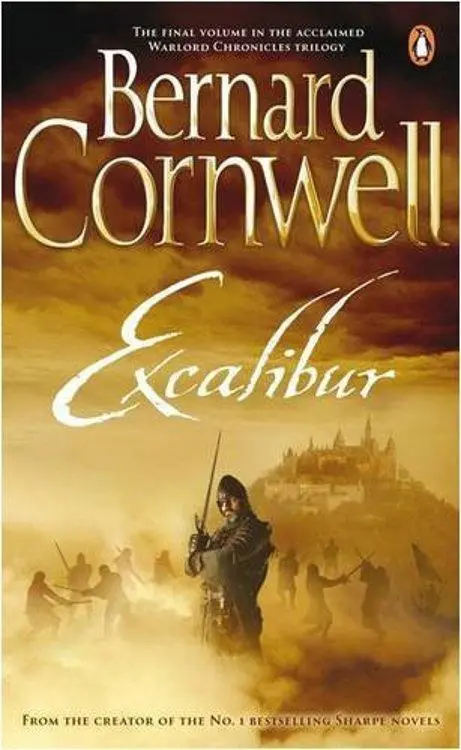
- Название:Excalibur
- Автор:
- Издательство:MacMillan Publishers
- Жанр:
- Год:1999
- ISBN:нет данных
- Рейтинг книги:4 / 5. Голосов: 2
-
Избранное:Добавить в избранное
- Отзывы:
-
Ваша оценка:
Excalibur: краткое содержание, описание и аннотация
Предлагаем к чтению аннотацию, описание, краткое содержание или предисловие (зависит от того, что написал сам автор книги «Excalibur»). Если вы не нашли необходимую информацию о книге — напишите в комментариях, мы постараемся отыскать её.
to Marion Zimmer Bradley's
, the legend of King Arthur has haunted and inspired generations of writers to reinvent the ancient story. In
and
, Bernard Cornwell demonstrated his astonishing ability to make the oft-told legend of King Arthur fresh and new for our time. Now, in this riveting final volume of the
, Cornwell tells the story of Arthur's desperate attempt to triumph over a ruined marriage and the Saxons' determination to destroy him.
Set against the backdrop of the Dark Ages, this brilliant saga continues as seen through the eyes of Derfel, an orphan brought up by Merlin and one of Arthur's warriors. In this book, the aging Arthur has been betrayed by, among others, his beloved Guinevere; but although he is alone and deeply saddened, he still embraces his dreams of a world in which civilization triumphs over brute force. Arthur and his warriors must face the dreaded Saxons — now allied with Arthur's betrayer Lancelot — for the throne of Britain.
This is the tale not only of a broken love remade but also of enemies more subtle than any Saxon spearman — of forces both earthly and unearthly that threaten everything Arthur stands for. When Merlin and Nimue embark on a dangerous quest to summon the Gods back to Britain, they unleash forces that will lead to a last desperate battle on the sands of Camlann, where it seems that Arthur must fail unless Merlin's final enchantment can avert the horror.
Peopled by princesses and bards, warriors and magicians, Excalibur is a story of love, war, loyalty, and betrayal, the unforgettable conclusion to a brilliant retelling of one of the most powerful legends of all time.
Excalibur — читать онлайн бесплатно полную книгу (весь текст) целиком
Ниже представлен текст книги, разбитый по страницам. Система сохранения места последней прочитанной страницы, позволяет с удобством читать онлайн бесплатно книгу «Excalibur», без необходимости каждый раз заново искать на чём Вы остановились. Поставьте закладку, и сможете в любой момент перейти на страницу, на которой закончили чтение.
Интервал:
Закладка:
We were, in short, complacent, and fate has ever been the enemy of complacency, and fate, as Merlin always told me, is inexorable.
I was hunting with Guinevere in the hills north of Isca when I first heard of Mordred’s calamity. It was winter, the trees were bare, and Guinevere’s prized deerhounds had just run down a great red stag when a messenger from Dumnonia found me. The man handed me a letter, then watched wide-eyed as Guinevere waded among the snarling dogs to put the beast out of its misery with one merciful stab of her short spear. Her huntsmen whipped the hounds off the corpse, then drew their knives to gralloch the stag. I pulled open the parchment, read the brief message, then looked at the messenger. ‘Did you show this to Arthur?’ ‘No, Lord,’ the man said. ‘The letter was addressed to you.’ ‘Take it to him now,’ I said, handing him the sheet of parchment.
Guinevere, happily blood-streaked, stepped out of the carnage. ‘You look as if it was bad news, Derfel.’
‘On the contrary,’ I said, ‘it’s good news. Mordred has been wounded.’
‘Good!’ Guinevere exulted. ‘Badly, I hope?’
‘It seems so. An axe blow to the leg.’
‘Pity it wasn’t to the heart. Where is he?’
‘Still in Armorica,’ I said. The message had been dictated by Sansum and it said that Mordred had been surprised and defeated by an army led by Clovis, High King of the Franks, and that in the battle our King had been badly wounded in the leg. He had escaped, and was now besieged by Clovis in one of the ancient hilltop forts of old Benoic. I surmised that Mordred must have been wintering in the territory that he had conquered from the Franks and which he doubtless thought would make him a second kingdom across the sea, but Clovis had led his Frankish army westwards in a surprise winter campaign. Mordred had been defeated and, though he was still alive, he was trapped.
‘How reliable is the news?’ Guinevere asked.
‘Reliable enough,’ I said. ‘King Budic sent Argante a messenger.’
‘Good!’ Guinevere said. ‘Good! Let’s hope the Franks kill him.’ She stepped back into the growing pile of steaming offal to find a scrap for one of her beloved hounds. ‘They will kill him, won’t they?’ she asked me.
‘Franks aren’t noted for their mercy,’ I said.
‘I hope they dance on his bones,’ she said. ‘Calling himself a second Uther!’
‘He fought well for a time, Lady.’
‘It isn’t how well you fight that matters, Derfel, it’s whether or not you win the last battle.’ She threw scraps of the stag’s guts to her dogs, wiped her knife blade on her tunic, then thrust it back into its sheath. ‘So what does Argante want of you?’ she asked me. ‘A rescue?’ Argante was demanding exactly that, and so was Sansum which is why he had written to me. His message ordered me to march all my men to the south coast, find ships and go to Mordred’s relief. I told Guinevere as much and she gave me a mocking glance. ‘And you’re going to tell me that your oath to the little bastard will force you to obey?’
‘I have no oath to Argante,’ I said, ‘and certainly none to Sansum.’ The mouse lord could order me as much as he liked, but I had no need to obey him nor any wish to rescue Mordred. Besides, I doubted that an army could be shipped to Armorica in winter, and even if my spearmen did survive the rough crossing they would be too few to fight the Franks. The only help Mordred might expect would be from old King Budic of Broceliande, who was married to Arthur’s elder sister, Anna, but while Budic might have been happy to have Mordred killing Franks in the land that used to be Benoic, he would have no wish to attract Clovis’s attention by sending spearmen to Mordred’s rescue. Mordred, I thought, was doomed. If his wound did not kill him, Clovis would.
For the rest of that winter Argante harried me with messages demanding that I take my men across the sea, but I stayed in Siluria and ignored her. Issa received the same demands, but he flatly refused to obey, while Sagramor simply threw Argante’s messages into the flames. Argante, seeing her power slip with her husband’s waning life, became more desperate and offered gold to spearmen who would sail to Armorica. Though many spearmen took the gold, they preferred to sail westwards to Kernow or hurry north into Gwent rather than sail south to where Clovis’s grim army waited. And as Argante despaired, our hopes grew. Mordred was trapped and sick, and sooner or later news must come of his death and when that news came we planned to ride into Dumnonia under Arthur’s banner with Gwydre as our candidate for the kingship. Sagramor would come from the Saxon frontier to support us and no man in Dumnonia would have the power to oppose us.
But other men were also thinking of Dummonia’s kingship. I learned that early in the spring when Saint Tewdric died. Arthur was sneezing and shivering with the last of the winter’s colds and he asked Galahad to go to the old King’s funeral rites in Burrium, the capital of Gwent which lay just a short journey up river from Isca, and Galahad pleaded with me to accompany him. I mourned for Tewdric, who had proved himself a good friend to us, yet I had no wish to attend his funeral and thus be forced to endure the interminable droning of the Christian rites, but Arthur added his pleas to Galahad’s. ‘We live here at Meurig’s pleasure,’ he reminded me, ‘and we’d do well to show him respect. I would go if I could,’ he paused to sneeze, ‘but Guinevere says it will be the death of me.’
So Galahad and I went in Arthur’s place and the funeral service did indeed seem never ending. It took place in a great barn-like church that Meurig had built in the year marking the supposed five hundredth anniversary of the appearance of the Lord Jesus Christ on this sinful earth, and once the prayers inside the church were all said or chanted, we had to endure still more prayers at Tewdric’s graveside. There was no balefire, no singing spearmen, just a cold pit in the ground, a score of bobbing priests and an undignified rush to get back to the town and its taverns when Tewdric was at last buried. Meurig commanded Galahad and me to take supper with him. Peredur, Galahad’s nephew, joined us, as did Burrium’s bishop, a gloomy soul named Lladarn who had been responsible for the most tedious of the day’s prayers, and he began supper with yet another long-winded prayer after which he made an earnest enquiry about the state of my soul and was grieved when I assured him that it was safe in Mithras’s keeping. Such an answer would normally have irritated Meurig, but he was too distracted to notice the provocation. I know he was not unduly upset by his father’s death, for Meurig was still resentful that Tewdric had taken back his power at the time of Mynydd Baddon, but at least he affected to be distressed and bored us with insincere praise of his father’s saintliness and sagacity. I expressed the hope that Tewdric’s death had been merciful and Meurig told me that his father had starved to death in his attempt to imitate the angels.
‘There was nothing of him at the end,’ Bishop Lladarn elaborated, ‘just skin and bone, he was, skin and bone! But the monks say that his skin was suffused with a heavenly light, praise God!’
‘And now the saint is on God’s right hand,’ Meurig said, crossing himself, ‘where one day I shall be with him. Try an oyster, Lord.’ He pushed a silver dish towards me, then poured himself wine. He was a pale young man with protuberant eyes, a thin beard and an irritably pedantic manner. Like his father he aped Roman manners. He wore a bronze wreath on his thinning hair, dressed in a toga and ate while lying on a couch. The couches were deeply uncomfortable. He had married a sad and ox-like Princess from Rheged who had arrived in Gwent a pagan, produced male twins and then had Christianity whipped into her stubborn soul. She appeared in the dimly lit supper room for a few moments, ogled us, said and ate nothing, then disappeared as mysteriously as she had arrived.
Читать дальшеИнтервал:
Закладка:
Похожие книги на «Excalibur»
Представляем Вашему вниманию похожие книги на «Excalibur» списком для выбора. Мы отобрали схожую по названию и смыслу литературу в надежде предоставить читателям больше вариантов отыскать новые, интересные, ещё непрочитанные произведения.










Обсуждение, отзывы о книге «Excalibur» и просто собственные мнения читателей. Оставьте ваши комментарии, напишите, что Вы думаете о произведении, его смысле или главных героях. Укажите что конкретно понравилось, а что нет, и почему Вы так считаете.