Bernard Cornwell - Excalibur
Здесь есть возможность читать онлайн «Bernard Cornwell - Excalibur» весь текст электронной книги совершенно бесплатно (целиком полную версию без сокращений). В некоторых случаях можно слушать аудио, скачать через торрент в формате fb2 и присутствует краткое содержание. Год выпуска: 1999, Издательство: MacMillan Publishers, Жанр: Историческая проза, на английском языке. Описание произведения, (предисловие) а так же отзывы посетителей доступны на портале библиотеки ЛибКат.
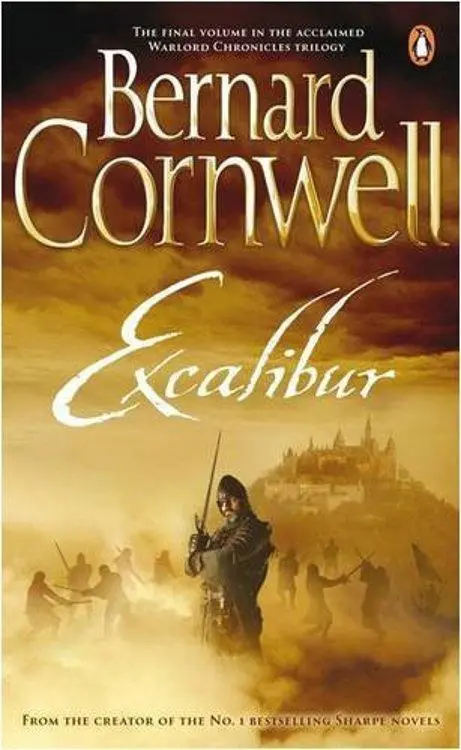
- Название:Excalibur
- Автор:
- Издательство:MacMillan Publishers
- Жанр:
- Год:1999
- ISBN:нет данных
- Рейтинг книги:4 / 5. Голосов: 2
-
Избранное:Добавить в избранное
- Отзывы:
-
Ваша оценка:
Excalibur: краткое содержание, описание и аннотация
Предлагаем к чтению аннотацию, описание, краткое содержание или предисловие (зависит от того, что написал сам автор книги «Excalibur»). Если вы не нашли необходимую информацию о книге — напишите в комментариях, мы постараемся отыскать её.
to Marion Zimmer Bradley's
, the legend of King Arthur has haunted and inspired generations of writers to reinvent the ancient story. In
and
, Bernard Cornwell demonstrated his astonishing ability to make the oft-told legend of King Arthur fresh and new for our time. Now, in this riveting final volume of the
, Cornwell tells the story of Arthur's desperate attempt to triumph over a ruined marriage and the Saxons' determination to destroy him.
Set against the backdrop of the Dark Ages, this brilliant saga continues as seen through the eyes of Derfel, an orphan brought up by Merlin and one of Arthur's warriors. In this book, the aging Arthur has been betrayed by, among others, his beloved Guinevere; but although he is alone and deeply saddened, he still embraces his dreams of a world in which civilization triumphs over brute force. Arthur and his warriors must face the dreaded Saxons — now allied with Arthur's betrayer Lancelot — for the throne of Britain.
This is the tale not only of a broken love remade but also of enemies more subtle than any Saxon spearman — of forces both earthly and unearthly that threaten everything Arthur stands for. When Merlin and Nimue embark on a dangerous quest to summon the Gods back to Britain, they unleash forces that will lead to a last desperate battle on the sands of Camlann, where it seems that Arthur must fail unless Merlin's final enchantment can avert the horror.
Peopled by princesses and bards, warriors and magicians, Excalibur is a story of love, war, loyalty, and betrayal, the unforgettable conclusion to a brilliant retelling of one of the most powerful legends of all time.
Excalibur — читать онлайн бесплатно полную книгу (весь текст) целиком
Ниже представлен текст книги, разбитый по страницам. Система сохранения места последней прочитанной страницы, позволяет с удобством читать онлайн бесплатно книгу «Excalibur», без необходимости каждый раз заново искать на чём Вы остановились. Поставьте закладку, и сможете в любой момент перейти на страницу, на которой закончили чтение.
Интервал:
Закладка:
Mordred was happy in those years after Mynydd Baddon. The battle had given him a taste for warfare, and he pursued it greedily. For a time he was content to fight under Sagramor’s guidance; raiding into shrunken Lloegyr or hunting down Saxon warbands that came to plunder our crops and livestock, but after a while he became frustrated by Sagramor’s caution. The Numidian had no desire to start a full-scale war by conquering the territory Cerdic still possessed and where the Saxons remained strong, but Mordred desperately wanted another clash of shield walls. He once ordered Sagramor’s spearmen to follow him into Cerdic’s territory, but those men refused to march without Sagramor’s orders and Sagramor forbade the invasion. Mordred sulked for a time, but then a plea for help arrived from Broceli-ande, the British kingdom in Armorica, and Mordred led a warband of volunteers to fight against the Franks who were pressing on King Budic’s borders. He stayed in Armorica for over five years and in that time he made a name for himself. In battle, men told me, he was fearless, and his victories attracted yet more men to his dragon banner. They were masterless men; rogues and outlaws who could grow rich on plunder, and Mordred gave them their hearts’ desires. He took back a good part of the old kingdom of Benoic and bards began to sing of him as an Uther reborn, even as a second Arthur, though other tales, never turned into song, also came home across the grey waters, and those tales spoke of rape and murder, and of cruel men given licence.
Arthur himself fought during those years for, just as he had foreseen, some of Meurig’s missionaries were massacred in Powys and Meurig demanded Arthur’s aid in punishing the rebels who had killed the priests, and so Arthur rode north on one of his greatest campaigns. I was not there to help him, for I had responsibilities in Dumnonia, but we all heard the stories. Arthur persuaded Oengus mac Airem to attack the rebels out of Demetia, and while Oengus’s Blackshields attacked from the west, Arthur’s men came from the south and Meurig’s army, marching two days behind Arthur, arrived to find the rebellion quashed and most of the murderers captured, but some of the priests’ killers had taken refuge in Gwynedd, where Byrthig, the King of that mountainous country, refused to hand them over. Byrthig still hoped to use the rebels to gain more land in Powys and so Arthur, ignoring Meurig’s counsel for caution, surged on northwards. He defeated Byrthig at Caer Gei and then, without pause, and still using the excuse that some of the priest-killers had fled further north, he led his warband over the Dark Road into the dread kingdom of Lleyn. Oengus followed him, and at the sands of Foryd where the River Gwyrfair slides to the sea, Oengus and Arthur trapped King Diwrnach between their forces and so broke the Bloodshields of Lleyn. Diwrnach drowned, over a hundred of his spearmen were massacred, and the remainder fled in panic. In two summer months Arthur had ended the rebellion in Powys, cowed Byrthig and destroyed Diwrnach, and by doing the latter he had kept his oath to Guinevere that he would avenge the loss of her father’s kingdom. Leodegan, her father, had been King of Henis-Wyren, but Diwrnach had come from Ireland, taken Henis-Wyren by storm, renamed it Lleyn, and so made Guinevere a penniless exile. Now Diwrnach was dead and I thought Guinevere might insist that his captured kingdom be given to her son, but she made no protest when Arthur handed Lleyn into Oengus’s keeping in the hope that it would keep his Black-shields too busy to raid into Powys. It was better, Arthur later told me, that Lleyn should have an Irish ruler, for the great majority of its people were Irish and Gwydre would ever have been a stranger to them, and so Oengus’s elder son ruled in Lleyn and Arthur carried Diwrnach’s sword back to Isca as a trophy for Guinevere.
I saw none of it, for I was governing Dumnonia where my spearmen collected Mordred’s taxes and enforced Mordred’s justice. Issa did most of the work, for he was now a Lord in his own right and I had given him half my spearmen. He was also a father now, and Scarach his wife was expecting another child. She lived with us in Dun Caric from where Issa rode out to patrol the country, and from where, each month and ever more reluctantly, I went south to attend the Royal Council in Durnova-ria. Argante presided over those meetings, for Mordred had sent orders that his Queen was to take his high place at the council. Not even Guinevere had attended council meetings, but Mordred insisted and so Argante summoned the council and had Bishop Sansum as her chief ally. Sansum had rooms in the palace and was forever whispering in Argante’s ear while Fergal, her Druid, whispered in the other. Sansum proclaimed a hatred of all pagans, but when he saw that he would have no power unless he shared it with Fergal, his hatred dissolved into a sinister alliance. Morgan, Sansum’s wife, had returned to Ynys Wydryn after Mynydd Baddon, but Sansum stayed in Durnovaria, preferring the Queen’s confidences to his wife’s company.
Argante enjoyed exercising the royal power. I do not think she had any great love for Mordred, but she did possess a passion for money, and by staying in Dumnonia she made certain that the greater part of the country’s taxes passed through her hands. She did little with the wealth. She did not build as Arthur and Guinevere had built, she did not care about restoring bridges or forts, she just sold the taxes, whether they were salt, grain or hides, in return for gold. She sent some of the gold to her husband, who was forever demanding more money for his warband, but most she piled up in the palace vaults until the folk of Durnovaria reckoned their town was built on a foundation of gold. Argante had long ago retrieved the treasure I had hidden beside the Fosse Way, and to that she now added more and more, and she was encouraged in her hoarding by Bishop Sansum who, as well as being Bishop of all Dumnonia, was now named Chief Counsellor and Royal Treasurer. I did not doubt that he was using the last office to skim the treasury for his own hoard. I accused him of that one day and he immediately adopted a hurt expression. ‘I do not care for gold, Lord,’ he said piously. ‘Did not our Lord command us not to lay up treasures on earth, but in heaven?’
I grimaced. ‘He could command what he liked,’ I said, ‘but you would still sell your soul for gold, Bishop, and so you should, for it would prove a good bargain.’
He gave me a suspicious look. ‘A good bargain? Why?’ ‘Because you would be exchanging filth for money, of course,’ I said. I could make no pretence of liking Sansum, nor he for liking me. The mouse lord was always accusing me of trimming men’s taxes in return for favours, and as proof of the accusation he cited the fact that each successive year less money came into the treasury, but that shortfall was none of my doing. Sansum had persuaded Mordred to sign a decree which exempted all Christians from taxation and I dare say the church never found a better way of making converts, though Mordred rescinded the law as soon as he realized how many souls and how little gold he was saving; but then Sansum persuaded the King that the church, and only the church, should be responsible for collecting the taxes of Christians. That increased the yield for a year, but it fell thereafter as the Christians discovered that it was cheaper to bribe Sansum than to pay their King. Sansum then proposed doubling the taxes of all pagans, but Argante and Fergal stopped that measure. Instead Argante suggested that all the taxes on the Saxons should be doubled, but Sagramor refused to collect the increase, claiming it would only provoke rebellion in those parts of Lloegyr that we had settled. It was no wonder that I hated attending council meetings, and after a year or two of such fruitless wrangling I abandoned the meetings altogether. Issa went on collecting taxes, but only the honest men paid and there seemed fewer honest men each year, and so Mordred was forever complaining of being penniless while Sansum and Argante grew rich. Argante became rich, but she stayed childless. She sometimes visited Broceliande and, once in a long while, Mordred returned to Dumnonia, but Argante’s belly never swelled after such visits. She prayed, she sacrificed and she visited sacred springs in her attempts to have a child, but she stayed barren. I remember the stink at council meetings when she wore a girdle smeared with the faeces of a newborn child, supposedly a certain remedy for barrenness, but that worked no better than the infusions of bryony and mandrake that she drank daily. Eventually Sansum persuaded her that only Christianity could bring her the miracle and so, two years after Mordred had first gone to Broceliande, Argante threw Fergal, her Druid, out of the palace and was publicly baptized in the River Ffraw that flows around Durnova-ria’s northern margin. For six months she attended daily services in the huge church Sansum had built in the town centre, but at the end of the six months her belly was as flat as it had been before she had waded into the river. So Fergal was summoned back to the palace and brought with him new concoctions of bat dung and weasel blood that were supposed to make Argante fertile.
Читать дальшеИнтервал:
Закладка:
Похожие книги на «Excalibur»
Представляем Вашему вниманию похожие книги на «Excalibur» списком для выбора. Мы отобрали схожую по названию и смыслу литературу в надежде предоставить читателям больше вариантов отыскать новые, интересные, ещё непрочитанные произведения.








Обсуждение, отзывы о книге «Excalibur» и просто собственные мнения читателей. Оставьте ваши комментарии, напишите, что Вы думаете о произведении, его смысле или главных героях. Укажите что конкретно понравилось, а что нет, и почему Вы так считаете.