Bernard Cornwell - Excalibur
Здесь есть возможность читать онлайн «Bernard Cornwell - Excalibur» весь текст электронной книги совершенно бесплатно (целиком полную версию без сокращений). В некоторых случаях можно слушать аудио, скачать через торрент в формате fb2 и присутствует краткое содержание. Год выпуска: 1999, Издательство: MacMillan Publishers, Жанр: Историческая проза, на английском языке. Описание произведения, (предисловие) а так же отзывы посетителей доступны на портале библиотеки ЛибКат.
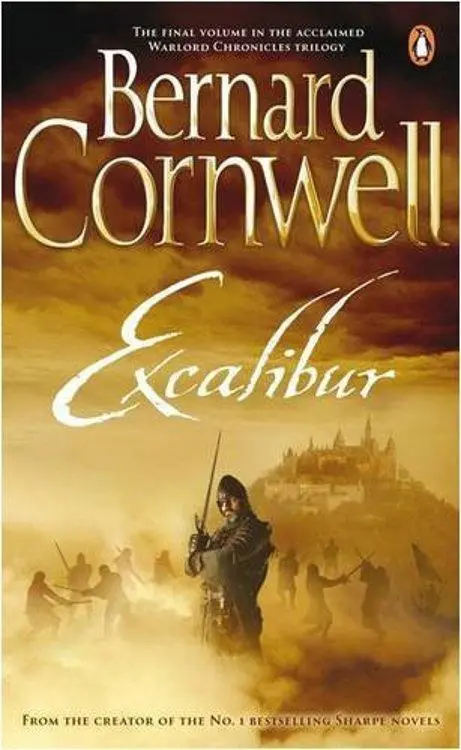
- Название:Excalibur
- Автор:
- Издательство:MacMillan Publishers
- Жанр:
- Год:1999
- ISBN:нет данных
- Рейтинг книги:4 / 5. Голосов: 2
-
Избранное:Добавить в избранное
- Отзывы:
-
Ваша оценка:
Excalibur: краткое содержание, описание и аннотация
Предлагаем к чтению аннотацию, описание, краткое содержание или предисловие (зависит от того, что написал сам автор книги «Excalibur»). Если вы не нашли необходимую информацию о книге — напишите в комментариях, мы постараемся отыскать её.
to Marion Zimmer Bradley's
, the legend of King Arthur has haunted and inspired generations of writers to reinvent the ancient story. In
and
, Bernard Cornwell demonstrated his astonishing ability to make the oft-told legend of King Arthur fresh and new for our time. Now, in this riveting final volume of the
, Cornwell tells the story of Arthur's desperate attempt to triumph over a ruined marriage and the Saxons' determination to destroy him.
Set against the backdrop of the Dark Ages, this brilliant saga continues as seen through the eyes of Derfel, an orphan brought up by Merlin and one of Arthur's warriors. In this book, the aging Arthur has been betrayed by, among others, his beloved Guinevere; but although he is alone and deeply saddened, he still embraces his dreams of a world in which civilization triumphs over brute force. Arthur and his warriors must face the dreaded Saxons — now allied with Arthur's betrayer Lancelot — for the throne of Britain.
This is the tale not only of a broken love remade but also of enemies more subtle than any Saxon spearman — of forces both earthly and unearthly that threaten everything Arthur stands for. When Merlin and Nimue embark on a dangerous quest to summon the Gods back to Britain, they unleash forces that will lead to a last desperate battle on the sands of Camlann, where it seems that Arthur must fail unless Merlin's final enchantment can avert the horror.
Peopled by princesses and bards, warriors and magicians, Excalibur is a story of love, war, loyalty, and betrayal, the unforgettable conclusion to a brilliant retelling of one of the most powerful legends of all time.
Excalibur — читать онлайн бесплатно полную книгу (весь текст) целиком
Ниже представлен текст книги, разбитый по страницам. Система сохранения места последней прочитанной страницы, позволяет с удобством читать онлайн бесплатно книгу «Excalibur», без необходимости каждый раз заново искать на чём Вы остановились. Поставьте закладку, и сможете в любой момент перейти на страницу, на которой закончили чтение.
Интервал:
Закладка:
Siluria was a small, poor and unregarded kingdom. The last King of its old dynasty had been Gundleus, who had died at Lugg Vale, and afterwards Lancelot was acclaimed the King, but he had disliked Siluria and had happily abandoned it for the wealthier throne of the Belgic country. Lacking another King, Siluria had been divided into two client kingdoms subservient to Gwent and Powys. Cuneglas had called himself King of Western Siluria, while Meurig was proclaimed King of Eastern Siluria, but in truth neither monarch had seen much value in its steep, cramped valleys that ran to the sea from its raw northern mountains. Cuneglas had recruited spearmen from the valleys while Meurig of Gwent had done little more than send missionaries into the territory, and the only King who had ever taken any interest in Siluria was Oengus mac Airem who had raided the valleys for food and slaves, but otherwise Siluria had been ignored. Its chieftains squabbled amongst themselves and grudgingly paid their taxes to Gwent or Powys, but the coming of Arthur changed all that. Whether he liked it or not he became Siluria’s most important inhabitant and thus its effective ruler and, despite his declared ambition to be a private man, he could not resist using his spearmen to end the chieftains’ ruinous squabbles. A year after Mynydd Baddon, when we first visited Arthur and Guinevere in Isca, he was wryly calling himself the Governor, a Roman title, and one that pleased him for it had no connotation of kingship. Isca was a beautiful town. The Romans had first made a fort there to guard the river crossing, but as they pushed their legions further west and north their need for the fort diminished and they turned Isca into a place not unlike Aquae Sulis: a town where Romans went to enjoy themselves. It had an amphitheatre and though it lacked hot springs, Isca still boasted six bath-houses, three palaces and as many temples as the Romans had Gods.
The town was much decayed now, but Arthur was repairing the law-courts and the palaces, and such work always made him happy. The largest of the palaces, the one where Lancelot had lived, was given to Culhwch, who had been named the commander of Arthur’s bodyguard and most of those guards shared the big palace with Culhwch. The second largest palace was now home to Emrys, once Bishop of Dumnonia but now the Bishop of Isca. ‘He couldn’t stay in Dumnonia,’ Arthur told me as he showed me the town. It was a year after Mynydd Baddon, and Ceinwyn and I were making our first visit to Arthur’s new home. ‘There isn’t room for both Emrys and Sansum in Dumnonia,’ Arthur explained, ‘so Emrys helps me here. He has an insatiable appetite for administration and, better still, he keeps Meurig’s Christians away.’
‘All of them?’ I asked.
‘Most of them,’ he said with a smile, ‘and it’s a fine place, Derfel,’ he went on, gazing at Isca’s paved streets, ‘a fine place!’ He was absurdly proud of his new home, claiming that the rain fell less hard on Isca than on the surrounding countryside. ‘I’ve seen the hills thick with snow,’ he told me, ‘and the sun has shone on green grass here.’
‘Yes, Lord,’ I said with a smile.
‘It’s true, Derfel! True! When I ride out of the town I take a cloak and there comes a point where the heat suddenly fades and you must pull on the cloak. You’ll see when we go hunting tomorrow.’
‘It sounds like magic,’ I said, gently teasing him, for normally he despised any talk of magic.
‘I think it well may be!’ he said in all seriousness and he led me down an alley that ran beside the big Christian shrine to a curious mound that stood in the town’s centre. A spiralling path climbed to the summit of the mound where the old people had made a shallow pit. The pit held countless small offerings left for the Gods; scraps of ribbon, tufts of fleece, buttons, all of them proof that Meurig’s missionaries, busy as they had been, had not entirely defeated the old religion. ‘If there is magic here,’ Arthur told me when we had climbed to the mound’s top and were staring down into the grassy pit, ‘then this is where it springs from. The local folk say it’s an entrance to the Otherworld.’
‘And you believe them?’
‘I just know this is a blessed place,’ he said happily, and so Isca was on that late summer’s day. The incoming tide had swollen the river so that it flowed deep within green banks, the sun shone on the white-walled buildings and on the leafy trees that grew in their courtyards, while to the north the small hills with their busy farmlands stretched peacefully to the mountains. It was hard to believe that not so many years before a Saxon raiding party had reached those hills and slaughtered farmers, captured slaves and left the crofts burning. That raid had been during Uther’s reign, and Arthur’s achievement had been to thrust the enemy so far back that it seemed, that summer and for many summers to come, that no free Saxon would ever come near Isca again.
The town’s smallest palace lay just to the west of the mound and it was there that Arthur and Guinevere lived. From our high point on the mysterious mound we could look down into the courtyard where Guinevere and Ceinwyn were pacing, and it was plain that it was Guinevere who was doing all the talking. ‘She’s planning Gwydre’s marriage,’ Arthur told me, ‘to Morwenna, of course,’ he added with a quick smile.
‘She’s ready for it,’ I said fervently. Morwenna was a good girl, but of late she had been moody and irritable. Ceinwyn assured me that Morwenna’s behaviour was merely the symptoms of a girl ready for marriage, and I for one would be grateful for the cure.
Arthur sat on the mound’s grassy lip and stared westwards. His hands, I noticed, were flecked with small dark scars, all from the furnace of the smithy he had built for himself in his palace’s stable yard. He had always been intrigued by blacksmithing and could enthuse for hours about its skills. Now, though, he had different matters on his mind. ‘Would you mind,’ he asked diffidently, ‘if Bishop Emrys blesses the marriage?’
‘Why would I mind?’ I asked. I liked Emrys.
‘Only Bishop Emrys,’ Arthur said. ‘No Druids. You must understand, Derfel, that I live here at Meurig’s pleasure. He is, after all, the King of this land.’
‘Lord,’ I began to protest, but he stilled me with a raised hand and I did not pursue my indignation. I knew that the young King Meurig was an uneasy neighbour. He resented the fact that his father had temporarily relieved him of his power, resented that he had not shared in any of Mynydd Baddon’s glory and was sullenly jealous of Arthur. Meurig’s Gwentian territory began only yards from this mound, at the far end of the Roman bridge that crossed the River Usk, and this eastern portion of Siluria was legally another of Meurig’s possessions.
‘It was Meurig who wanted me to live here as his tenant,’ Arthur explained, ‘but it was Tewdric who gave me the rights to all the old royal rents. He, at least, is grateful for what we achieved at Mynydd Baddon, but I very much doubt that young Meurig approves of the arrangement, so I placate him by making a show of allegiance to Christianity.’ He mimicked the sign of the cross and offered me a self-deprecating grimace.
‘You don’t need to placate Meurig,’ I said angrily. ‘Give me one month and I’ll drag the miserable dog back here on his knees.’
Arthur laughed. ‘Another war?’ He shook his head. ‘Meurig might be a fool, but he’s never been a man to seek war, so I cannot dislike him. He will leave me in peace so long as I don’t offend him. Besides, I have enough fighting on my hands without worrying about Gwent.’
His fights were small things. Oengus’s Blackshields still raided across Siluria’s western frontier and Arthur set small garrisons of spearmen to guard against those incursions. He felt no anger against Oengus who, indeed, he regarded as a friend, but Oengus could no more resist harvest raids than a dog could stop itself from scratching at fleas. Siluria’s northern border was more troubling because that joined Powys, and Powys, since Cuneglas’s death, had fallen into chaos. Perddel, Cuneglas’s son, had been acclaimed King, but at least a half-dozen powerful chieftains believed they had more right to the crown than Perddel — or at least the power to take the crown — and so the once mighty kingdom of Powys had degenerated into a squalid killing ground. Gwynedd, the impoverished country to the north of Powys, was raiding at will, warbands fought each other, made temporary alliances, broke them, massacred each other’s families and, whenever they themselves were in danger of massacre, retreated into the mountains. Enough spearmen had stayed loyal to Perddel to ensure that he kept the throne, but they were too few to defeat the rebellious chieftains. ‘I think we shall have to intervene,’ Arthur told me.
Читать дальшеИнтервал:
Закладка:
Похожие книги на «Excalibur»
Представляем Вашему вниманию похожие книги на «Excalibur» списком для выбора. Мы отобрали схожую по названию и смыслу литературу в надежде предоставить читателям больше вариантов отыскать новые, интересные, ещё непрочитанные произведения.






Обсуждение, отзывы о книге «Excalibur» и просто собственные мнения читателей. Оставьте ваши комментарии, напишите, что Вы думаете о произведении, его смысле или главных героях. Укажите что конкретно понравилось, а что нет, и почему Вы так считаете.