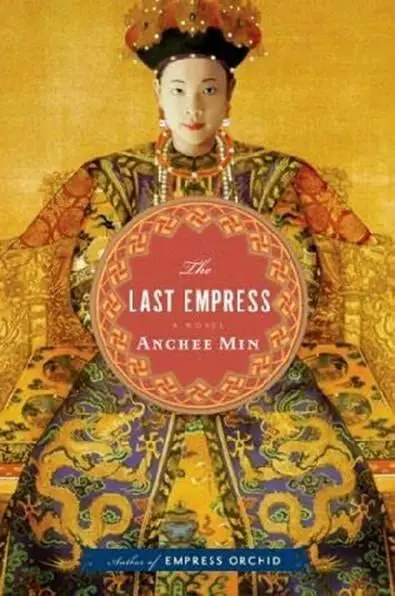
Anchee Min - The Last Empress
Здесь есть возможность читать онлайн «Anchee Min - The Last Empress» весь текст электронной книги совершенно бесплатно (целиком полную версию без сокращений). В некоторых случаях можно слушать аудио, скачать через торрент в формате fb2 и присутствует краткое содержание. Жанр: Историческая проза, на английском языке. Описание произведения, (предисловие) а так же отзывы посетителей доступны на портале библиотеки ЛибКат.
- Название:The Last Empress
- Автор:
- Жанр:
- Год:неизвестен
- ISBN:нет данных
- Рейтинг книги:4 / 5. Голосов: 1
-
Избранное:Добавить в избранное
- Отзывы:
-
Ваша оценка:
The Last Empress: краткое содержание, описание и аннотация
Предлагаем к чтению аннотацию, описание, краткое содержание или предисловие (зависит от того, что написал сам автор книги «The Last Empress»). Если вы не нашли необходимую информацию о книге — напишите в комментариях, мы постараемся отыскать её.
The Last Empress is the story of Orchid"s dramatic transition from a strong-willed, instinctive young woman to a wise and politically savvy leader. Moving from the intimacy of the concubine quarters into the spotlight of the world stage, Orchid must not only face the perilous condition of her empire but also a series of devastating personal losses, as first her son and then her adopted son succumb to early death. Yearning only to step aside, and yet growing constantly into her role, only she-allied with the progressives, but loyal to the conservative Manchu clan of her dynasty-can hold the nation"s rival
factions together.
Anchee Min offers a powerful revisionist portrait based on extensive research of one of the most important figures in Chinese history. Viciously maligned by the western press of the time as the "Dragon Lady," a manipulative, blood-thirsty woman who held onto power at all costs, the woman Min gives us is a compelling, very human leader who assumed power reluctantly, and who sacrificed all she had to protect those she loved and an empire that was doomed to die.
The Last Empress — читать онлайн бесплатно полную книгу (весь текст) целиком
Ниже представлен текст книги, разбитый по страницам. Система сохранения места последней прочитанной страницы, позволяет с удобством читать онлайн бесплатно книгу «The Last Empress», без необходимости каждый раз заново искать на чём Вы остановились. Поставьте закладку, и сможете в любой момент перейти на страницу, на которой закончили чтение.
Интервал:
Закладка:
My eunuch let the wigs speak for him. He never resented my stormy ways. It wasn't until I saw how his wigs saved my appearance that I began to truly trust him. After I turned sixty, it became harder for me to live up to the expectation that I look like the goddess Kuan-yin. Li Lien-ying served my needs in ways that made him the equal of An-te-hai.
When I asked him why he put up with me, he replied, "A eunuch's greatest dream is to be missed by his lady after his death. It comforts me that you have not gotten over An-te-hai. It means that you would miss me too if I should die tomorrow."
"I am afraid that I must go on living in order to display your beautiful wigs," I teased. "I am so poor that the wigs will probably be the only things I can leave you when I die."
"There would be no better fortune, my lady."
By the time the wisteria climbed over the trellis I still wasn't able to retire. Guang-hsu's inability to exert control over the court left him vulnerable. He had made an enemy of every senior member of the old court, and his new advisors had neither the political influence nor the military clout for effective action. No critical reforms had been made, and it seemed that Guang-hsu's whole program for change was petering out.
I would lose everything if Guang-hsu's reforms were to miscarry. I would be forced to replace him, and it would cost me my retirement-I would have to start all over again, choosing and raising another infant boy who would someday rule over China.
What frustrated me equally was that the consequences of Li Hung-chang's dismissal began to show. The hoped-for industrialization of the country had now ground to a halt. Everything awaited Li Hung-chang, the only man with the international and domestic connections necessary to get things done.
Yung Lu continued his duty on the military front, but only because I intervened at the last minute to stop my son from firing him. Under the spell of the reformer, Guang-hsu was becoming even more radical in his actions. It grew more and more difficult for me to comprehend his logic.
The Emperor went on insisting that progress was being impeded by Yung Lu and Li Hung-chang. "But most of all," he said with angry tears in his eyes, "it is because your shadow still sits behind the curtain!"
I quit explaining. I could not make Guang-hsu see why I had to stay engaged. I had given him permission to fire Li Hung-chang but had immediately begun to lay the groundwork for his return. It was only a matter of time before the Emperor would discover that he couldn't function without Li and would need to mend his relationship with him, as well as with Yung Lu. I would serve as the glue, so that neither party would risk the loss of face and reputation. As it turned out, no matter how much my son angered and humiliated them, the two men always came back.
"The failure of a thousand-mile dike starts with an ant colony." So began a message from Li Hung-chang in the fall of 1898 that warned of a foreign conspiracy against me. The goal was to make Guang-hsu a puppet king.
I couldn't say I was surprised. I was aware that my son had been carried away by his vision of a new China, reinvigorated by his own hand. Yet I chose ignorance because I couldn't stand fighting him anymore. I wanted to please him so he would think of nothing but my love.
While I was admiring the lotus flowers swaying in the gentle breeze at Kun Ming Lake, reformer Kang Yu-wei secretly contacted General Yuan Shih-kai, Yung Lu's right-hand man in the military. I had no idea that Guang-hsu's permission for Kang's "unlimited access to the Forbidden City" extended to my bedroom door.
A week after the scurrilous attack on me in the foreign press, I received a formal letter from Guang-hsu. Seeing the familiar seals and opening the envelope, I couldn't believe what I read: a request that the capital be moved to Shanghai.
I was not able to stay calm. I summoned my son and told him that he'd better give me one good reason for such an outrageous idea.
"The feng shui in Peking works against me" was all he could say.
I tried to block a loud "no" from rolling out of my chest.
Guang-hsu stood by the door as if getting ready to escape.
I paced the room, then swung around to look at him. Sunlight hit his robe, making his accessories glitter. He was pale.
"Look me in the eyes, son."
He couldn't. He stared at the floor.
"In history," I said, "only the Emperor of a fallen dynasty, such as the Soong, relocated the capital. And it didn't save the dynasty."
"I have an audience waiting," Guang-hsu said flatly. He no longer wanted to listen. "I must go."
"What are you going to do about the Tientsin military inspection? It has already been scheduled." I chased him to the gate.
"I am not going."
"Why? You can learn what Yung Lu and General Yuan Shih-kai are doing."
Guang-hsu stopped. He pivoted his body at an odd angle, and his hands went to the wall. "You are going, aren't you?" He looked at me nervously, blinking his eyes. "Who else? Prince Ts'eng? Prince Ch'un Junior? Who else?"
"Guang-hsu, what's wrong with you? It was your idea."
"How many people are going?"
"What's the matter?"
"I want to know!"
"Just you and I."
"Why Tientsin? Why a military inspection? Is there something you want to do there?" His face was inches from mine. "It's a setup, isn't it?"
As if suddenly gripped by fear, Guang-hsu's frame began to tremble. He held himself against the wall as if trying to conquer it. The moment took me back to his childhood, when he once stopped breathing while listening to a ghost story.
"Here is the reason I am going," I said. "First, I'd like to find out if the foreign loans we took have indeed been spent on our defenses. Second, I would like to honor our troops. I want the world, especially Japan, to know that China is on its way toward having a modern military."
Guang-hsu remained tense, but he finally let himself breathe.
It took me ten days to get him to explain what had been on his mind. His advisors had told him that I had planned to use the military event to depose him. "They are concerned about my safety."
I laughed. "If I were to dethrone you, it would be much easier to have it done inside the Forbidden City."
Guang-hsu wiped the sweat from his face with both hands. "I didn't want to take a chance."
"As you know, there have been proposals regarding your replacement."
"What do you think of the proposals, Mother?"
"What do I think? Are you still sitting on the Dragon Throne?" Guang-hsu looked down but spoke clearly: "The way you listen to the Ironhats made me worry that you were changing your mind about me."
"Of course I listen. I have to in order to play fair. I must listen or pretend to listen to everybody. That's how I protect you."
"Will Prince Ts'eng's idea become yours?"
"It depends. I will look foolish if it has to happen. I want the world to think that I knew what I was doing when I picked you to be the Emperor of China."
"And moving the capital to Shanghai?"
"Who would be responsible for your safety in Shanghai? After all, it is closer to Japan. Queen Min's assassination and Li Hung-chang's being shot certainly were no accident."
"It will not happen to me, Mother."
"What would I do if it did? I only know what Japan would demand in exchange for your life. Ito would get to collect the architectural splendor of the Forbidden City."
"Kang Yu-wei has assured me of my safety."
"Moving the capital to Shanghai is a bad idea."
"I have given Kang Yu-wei my word to do whatever it takes to achieve reform."
"Let me meet with Kang Yu-wei myself. It's time."
34
Either afraid that Kang Yu-wei would not get a fair hearing from me or unsure about the reformer himself, my son ordered him to move to Shanghai and run a local newspaper. This Imperial edict Kang disobeyed. The reformer would later tell the world that the Emperor was forced to send him away and that he, "despite the danger, remained in Peking in order to rescue the throne."
Читать дальшеИнтервал:
Закладка:
Похожие книги на «The Last Empress»
Представляем Вашему вниманию похожие книги на «The Last Empress» списком для выбора. Мы отобрали схожую по названию и смыслу литературу в надежде предоставить читателям больше вариантов отыскать новые, интересные, ещё непрочитанные произведения.







Обсуждение, отзывы о книге «The Last Empress» и просто собственные мнения читателей. Оставьте ваши комментарии, напишите, что Вы думаете о произведении, его смысле или главных героях. Укажите что конкретно понравилось, а что нет, и почему Вы так считаете.