Thomas Keneally - Schindler's Ark
Здесь есть возможность читать онлайн «Thomas Keneally - Schindler's Ark» весь текст электронной книги совершенно бесплатно (целиком полную версию без сокращений). В некоторых случаях можно слушать аудио, скачать через торрент в формате fb2 и присутствует краткое содержание. Город: London, Год выпуска: 1982, ISBN: 1982, Издательство: Hodder and Stoughton, Жанр: Историческая проза, на английском языке. Описание произведения, (предисловие) а так же отзывы посетителей доступны на портале библиотеки ЛибКат.
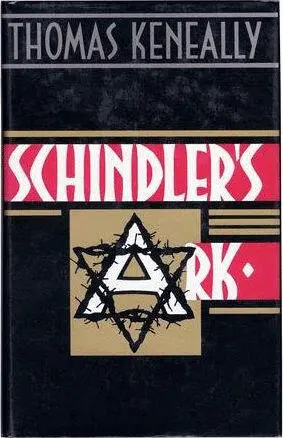
- Название:Schindler's Ark
- Автор:
- Издательство:Hodder and Stoughton
- Жанр:
- Год:1982
- Город:London
- ISBN:0-340-27838-2
- Рейтинг книги:4 / 5. Голосов: 1
-
Избранное:Добавить в избранное
- Отзывы:
-
Ваша оценка:
Schindler's Ark: краткое содержание, описание и аннотация
Предлагаем к чтению аннотацию, описание, краткое содержание или предисловие (зависит от того, что написал сам автор книги «Schindler's Ark»). Если вы не нашли необходимую информацию о книге — напишите в комментариях, мы постараемся отыскать её.
Schindler’s List
Working with the actual testimony of Schindler’s Jews, Thomas Keneally artfully depicts the courage and shrewdness of an unlikely savior, a man who is a flawed mixture of hedonism and decency and who, in the presence of unutterable evil, transcends the limits of his own humanity. From From
A mesmerizing novel based on the true story of Oskar Schindler, a German industralist who saved and succored more than 1000 Jews from the Nazis at enormous financial and emotional expense. How the German Oskar Schindler came to save more than one thousand Polish Jews during the Holocaust is one of the most fascinating stories of the century. Although millions are now learning about Schindler through Steven Spielberg’s recent Academy Award-winning film, his achievement first gained prominence with Keneally’s 1982 “facticious” novel (which is also the basis for the film). Keneally’s account is less melodramatic than the motion picture, and although he does not fully explain how a hedonistic German could have been so altered by the plight of the Jewish workers in his factory, he does make Schindler less enigmatic than the big-screen version. Ben Kingsley, one of the film's stars, reads in a calculatedly matter-of-fact tone, letting the story's power alone convey its complicated emotions. Highly recommended.
Michael Adams, Fairleigh Dickinson Univ. Lib., Madison, N.J.
Schindler's Ark — читать онлайн бесплатно полную книгу (весь текст) целиком
Ниже представлен текст книги, разбитый по страницам. Система сохранения места последней прочитанной страницы, позволяет с удобством читать онлайн бесплатно книгу «Schindler's Ark», без необходимости каждый раз заново искать на чём Вы остановились. Поставьте закладку, и сможете в любой момент перейти на страницу, на которой закончили чтение.
Интервал:
Закладка:
He did not say no, however. He needed time to think about it. Though he couldn’t say it to Oskar, it is likely he was afraid of sharing factory premises with a rash, demonic fellow like Herr Schindler.
Without any clear word from Madritsch, Oskar took to the road. He went to Berlin and bought dinner for Colonel Erich Lange. I can go completely over to the manufacture of shells, Oskar told Lange. I can transfer my heavy machinery.
Lange was crucial. He could guarantee contracts; he could write the hearty recommendations Oskar needed for the Evacuation Board and the German officials in Moravia. Later, Oskar would say of this shadowy staff officer that he had given consistent help. Lange was still in that state of exalted desperation and moral disgust characteristic of many who had worked inside the system but not always for it. We can do it, said Lange but it will take some money. Not for me. For others.
Through Lange, Oskar talked with an officer of the Evacuation Board at OKH on Bendler Street. It was likely, said this officer, that the evacuation would be approved in principle. But there was a major obstacle. The Governor cum Gauleiter of Moravia, ruling from a castle at Liberec, had followed a policy of keeping Jewish labor camps out of his province.
Neither the SS nor the Armaments Inspectorate had so far persuaded him to change his attitude. A good man to discuss this impasse with, said the officer, would be a middle-aged Wehrmacht engineer down in the Troppau office of the Armaments Inspectorate, a man named Sussmuth. Oskar could talk to Sussmuth too about what relocation sites were available in Moravia. Meanwhile, Herr Schindler could count on the support of the Main Evacuation Board. “But you can understand that in view of the pressure they are under, and the inroads the war has made on their personal comforts, they are more likely to give a quick answer if you could be considerate to them in some way. We poor city fellows are short of ham, cigars, liquor, cloth, coffee… that sort of thing.”
The officer seemed to think that Oskar carried around with him half the peacetime produce of Poland. Instead, to get together a gift parcel for the gentlemen of the board, Oskar had to buy luxuries at the Berlin black-market rate.
An old gentleman on the desk at the Hotel Adlon was able to acquire excellent schnapps for Herr Schindler for a discount price of about 80 RM. a bottle. And you couldn’t send the gentlemen of the board less than a dozen. Coffee, however, was like gold, and Havanas were at an insane price. Oskar bought them in quantity and included them in the hamper. The gentlemen might need a head of steam if they were to bring the Governor of Moravia around. In the midst of Oskar’s negotiations, Amon Goeth was arrested.
Someone must have informed on him. Some jealous junior officer, or a concerned citizen who’d visited the villa and been shocked by Amon’s sybaritic style. A senior SS investigator named Eckert began to look at Amon’s financial dealings. The shots Amon had taken from the balcony were not germane to Eckert’s investigation. But the embezzlements and the black-market dealings were, as were complaints from some of his SS inferiors that he had treated them severely.
Amon was on leave in Vienna, staying with his father, the publisher, when the SS arrested him. They also raided an apartment Hauptsturmführer Goeth kept in the city and discovered a cache of money, some 80,000 RM., which Amon could not explain to their satisfaction. They found as well, stacked to the ceiling, close to a million cigarettes. Amon’s Viennese apartment, it seemed, was more warehouse than pied à terre.
It might be at first sight surprising that the SS—OR rather, the officers of Bureau V of the Reich Security Main Office—should want to arrest such an effective servant as Hauptsturmführer Goeth. But they had already investigated irregularities in Buchenwald and tried to pin the Commandant, Koch. They had even attempted to find evidence for the arrest of the renowned Rudolf Hóss, and had questioned a Viennese Jewess who, they suspected, was pregnant by this star of the camp system. So Amon, raging in his apartment while they ransacked it, had no cause to hope for much immunity.
They took him to Breslau and put him in an SS prison to await investigation and trial. They showed their innocence of the way affairs were run in Płaszów by going to the villa and questioning Helen Hirsch on suspicion of her being involved in Amon’s swindles. Twice in coming months she would be taken to the cells beneath the SS barracks of Płaszów for interrogation. They fired questions at her about Amon’s contacts on the black market—who his agents were, how he worked the jewelry shop at Płaszów, the custom-tailoring shop, the upholstery plant. No one hit her or threatened her. But it was their conviction that she was a member of a gang that tormented her. If Helen had ever thought of an unlikely and glorious salvation, she would not have dared dream that Amon would be arrested by his own people. But she felt her sanity going now in the interrogation room, when under their law they tried to shackle her to Amon. Chilowicz might have been able to help you, she told them. But Chilowicz is dead.
They were policemen by trade, and after a time would decide she could give them nothing except a little information about the sumptuous cuisine at the villa Goeth. They could have asked her about her scars, but they knew they couldn’t get Amon on grounds of sadism. Investigating sadism in the camp at Sachsenhausen, they’d been forced off the prem-ises by armed guards. In Buchenwald they had found a material witness, an NCO, to testify against the Commandant, but the informer had been found dead in his cell. The head of that SS investi-gating team ordered that samples of a poison found in the NCO’S stomach be administered to four Russian prisoners. He watched them die, and so had his proof against the Commandant and the camp doctor. Even though he got prosecutions for murder and sadistic practice, it was a strange justice. Above all, it made the camp personnel close ranks and dispose of living evidence. So the men of Bureau V did not question Helen about her injuries. They stuck to embezzlement, and in the end stopped troubling her. They investigated Mietek Pemper too.
He was wise enough not to tell them much about Amon, certainly not about his crimes against humans. He knew little but rumors of Amon’s frauds.
He played the neutral and well-mannered typist of nonclassified material. “The Herr Commandant would never discuss such matters with me,” he pleaded continually. But beneath his performance, he must have suffered the same howling disbelief as Helen Hirsch. If there was one event most likely to guarantee him a chance of life, it was Amon’s arrest. For there had been no more certain limit to his life than this: that when the Russians reached Tarnow, Amon would dictate his last letters and then assassinate the typist. What worried Mietek, therefore, was that they would release Amon too soon.
But they were not interested solely in the question of Amon’s speculations. The SS judge who questioned Pemper had been told by Oberscharführer Lorenz Landsdorfer that Hauptsturmführer Goeth had let his Jewish stenographer type up the directives and plans to be followed by the Płaszów garrison in the case of an assault on the camp by partisans. Amon, in explaining to Pemper how the typing of these plans should be set out, had even shown him copies of similar plans for other concentration camps. The judge was so alarmed by this disclosure of secret documents to a Jewish prisoner that he ordered Pemper’s arrest.
Pemper spent two miserable weeks in a cell beneath the SS barracks. He was not beaten, but was questioned regularly by a series of Bureau V investigators and by two SS judges. He thought he could read in their eyes the conclusion that the safest thing was to shoot him. One day during questioning about Płaszów’s emergency plans, Pemper asked his interrogators, “Why keep me here? A prison is a prison. I have a life sentence anyhow.” It was an argument calculated to bring a resolution, either release from the cells or else a bullet. After the session ended, Pemper spent some hours of anxiety until his cell door opened again. He was marched out and returned to his hut in the camp. It was not the last time, however, that he would be questioned on subjects relating to Commandant Goeth. It seemed that following his arrest, Amon’s juniors did not rush to give him references. They were careful. They waited. Bosch, who’d drunk so much of the Commandant’s liquor, told Untersturmführer John that it was dangerous to try to bribe these determined investigators from Bureau V. As for Amon’s seniors, Scherner was gone, assigned to hunting partisans, and would in the end be killed in an ambush in the forests of Niepolomice. Amon was in the hands of men from Oranienburg who’d never dined at the Goethhaus—or, if they had, had been either shocked or touched by envy. After her release by the SS, Helen Hirsch, now working for the new Commandant, Hauptsturmführer Büscher, received a friendly note from Amon asking her to get together a parcel of clothes, some romances and detective novels, and some liquor to comfort him in his cell. It was, she thought, like a letter from a relative. “Would you kindly gather for me the following,” it said, and ended with “Hoping to see you again soon.” Meanwhile Oskar had been down to the market city of Troppau to see engineer Sussmuth. He’d brought along liquor and diamonds, but they weren’t needed in this case. Sussmuth told Oskar that he had already proposed that some small Jewish work camps be set up in the border towns of Moravia to turn out goods for the Armaments Inspectorate. Such camps would, of course, be under the central control of either Auschwitz or Gróss-Rosen, for the areas of influence of the big concentration camps crossed the Polish-Czechoslovak border. But there was more safety for prisoners in little work camps than could be found in the grand necropolis of Auschwitz itself. Sussmuth had got nowhere, of course. The Castle at Liberec had trampled on the proposal. He had never had a lever. Oskar— the support Oskar had from Colonel Lange and the gentlemen of the Evacuation Board—that could be the lever.
Читать дальшеИнтервал:
Закладка:
Похожие книги на «Schindler's Ark»
Представляем Вашему вниманию похожие книги на «Schindler's Ark» списком для выбора. Мы отобрали схожую по названию и смыслу литературу в надежде предоставить читателям больше вариантов отыскать новые, интересные, ещё непрочитанные произведения.












Обсуждение, отзывы о книге «Schindler's Ark» и просто собственные мнения читателей. Оставьте ваши комментарии, напишите, что Вы думаете о произведении, его смысле или главных героях. Укажите что конкретно понравилось, а что нет, и почему Вы так считаете.