Frances Itani - Requiem
Здесь есть возможность читать онлайн «Frances Itani - Requiem» весь текст электронной книги совершенно бесплатно (целиком полную версию без сокращений). В некоторых случаях можно слушать аудио, скачать через торрент в формате fb2 и присутствует краткое содержание. Город: Toronto, Год выпуска: 2012, ISBN: 2012, Издательство: A Phyllis Bruce Book, Жанр: Историческая проза, на английском языке. Описание произведения, (предисловие) а так же отзывы посетителей доступны на портале библиотеки ЛибКат.
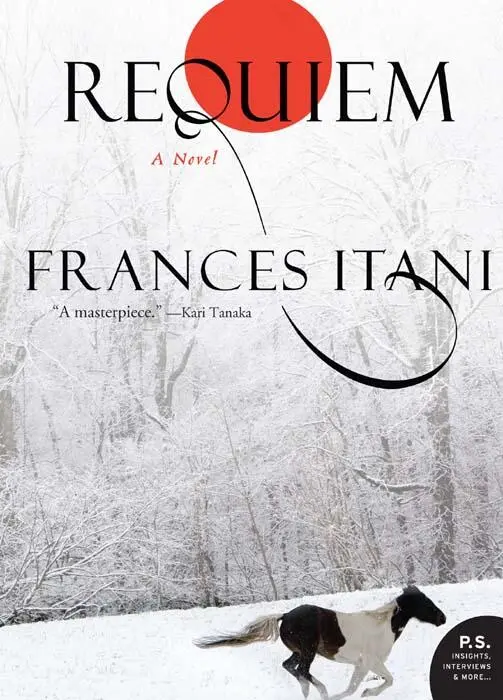
- Название:Requiem
- Автор:
- Издательство:A Phyllis Bruce Book
- Жанр:
- Год:2012
- Город:Toronto
- ISBN:978-1-44340-690-1
- Рейтинг книги:4 / 5. Голосов: 1
-
Избранное:Добавить в избранное
- Отзывы:
-
Ваша оценка:
Requiem: краткое содержание, описание и аннотация
Предлагаем к чтению аннотацию, описание, краткое содержание или предисловие (зависит от того, что написал сам автор книги «Requiem»). Если вы не нашли необходимую информацию о книге — напишите в комментариях, мы постараемся отыскать её.
delicately probes the complex adjustments we make to live with our sorrows…. [A] perfectly modulated novel.”
—
An extraordinary researcher and scholar of detail, Frances Itani—author of the best-selling novel
—excels at weaving breathtaking fiction from true-life events. In her new novel, she traces the lives, loves, and secrets in one Japanese-Canadian family during and after their internment in the 1940s.
In 1942, in retaliation for the attack on Pearl Harbor, the Canadian government removed Bin Okuma’s family from their home on British Columbia’s west coast and forced them into internment camps. They were allowed to take only the possessions they could carry, and Bin, as a young boy, was forced to watch neighbors raid his family’s home before the transport boats even undocked. One hundred miles from the “Protected Zone,” they had to form new makeshift communities without direct access to electricity, plumbing, or food—for five years.
Fifty years later, after his wife’s sudden death, Bin travels across Canada to find the biological father who has been lost to him. Both running from grief and driving straight toward it, Bin must ask himself whether he truly wants to find First Father, the man who made a fateful decision that almost destroyed his family all those years ago. With his wife’s persuasive voice in his head and the echo of their love in his heart, Bin embarks on an unforgettable journey into his past that will throw light on a dark time in history.
Requiem — читать онлайн бесплатно полную книгу (весь текст) целиком
Ниже представлен текст книги, разбитый по страницам. Система сохранения места последней прочитанной страницы, позволяет с удобством читать онлайн бесплатно книгу «Requiem», без необходимости каждый раз заново искать на чём Вы остановились. Поставьте закладку, и сможете в любой момент перейти на страницу, на которой закончили чтение.
Интервал:
Закладка:
I watched children my own age and younger playing on pathways and in the open space beside the schoolhouse. I once saw Hiroshi rolling a large stone down the hill below me, then hiding when it crashed into the roof of one of the outhouses. I saw Auntie Aya sitting dully on the low stool beside her door, her head tilted back as if to trap the sun on her face, her bright, lacquered combs shining as her head moved forward and back. There were days when she banged the back of her skull rhythmically against the tarpaper of the outer wall. I watched Uncle Aki come outside and soothe her, or sit beside her for a few moments and take her hand. I watched him climb a homemade ladder and replace boards on the side of his bathhouse, all the while keeping an eye on Auntie Aya, never letting her out of his sight. When he was working in the garden, he brought her to stay with Mother, who helped her with meals and with the preserving of vegetables for winter.
People greeted one another in the camp and I observed how slowly their bodies moved in the oppressive summer heat. I watched the way they crossed the road, and I watched the angle of their backs as they bent over plants in the garden plots. Voices could be heard in the mountain air: some in laughter, some in argument or irritation. Always, there was a murmur of rising sound.
When I returned home with pictures on cardboard or wood or bark—rarely on paper—Father reminded me again: “Drawing will not put rice in the pot. Drawing will not buy food from the back of Ying’s truck. Everyone in the family must contribute. Everyone must work, no matter how young.”
In fact, earlier on our picnic morning, before breakfast, I had painstakingly drawn two wild horses on a piece of boxboard, but my drawing was yanked from my hand. It disappeared and was probably tossed into the stove. I was sorry Father had taken it away from me, because I’d wanted to make it better. I had drawn the eye of the larger horse to make it look alert and ready to bolt if startled. The head of the smaller horse was tucked under the neck of the larger, but the nose of the small horse had turned out looking like the fat, long beak of a giant goose. I knew everyone would laugh at a horse that looked like a goose; I knew my drawing was a complete failure.
But on this once-a-year day, I was not going to worry about a picture that had been yanked out of my hand. Everyone in the family, including Father, was taking a holiday, and our day at the river was meant to be enjoyed.
Father completed his careful study of water conditions and now pointed downriver to fallen rocks that jutted out near the base of the cliff. These, he said, would provide shelter from the current. He led the three of us away from Mother and showed us a gravel bar where we were permitted to play in the shallows. He chose this place not only for safety; a bit farther along, he planned to throw out a line for sturgeon.
We followed again, and watched in silence while he selected a branch from the bushes and sank it into the sand. He tied a length of fishing line around the tip so it would twitch up and down if a fish was hooked, and then he anchored the line to the trunk of a cotton-wood tree. Two feet from the end, he attached bait to a large hook, and then weighted the line with an oblong-shaped rock. He lobbed it out in a high arc, and the rock sank down into the deepest part of the river.
“Now,” he said, and he was even smiling, “we will attract a big fish. Agreed?”
Hiroshi and Keiko and I nodded agreement, and then we went back to the gravel bar to play while he returned to the picnic site along the bank.
When it was time to cross to the island, Father stood and called out to us. Because I was youngest, I was left behind in care of Mother on the main shore while Father swam breaststroke alongside Hiroshi, eldest and tallest, and helped him across. Mother put her hands on my shoulders from behind, and we watched while Father returned for Keiko and swam with her to the island, where she stood beside Hiroshi. Finally, he came back for me. Because I was small and he was big, he hoisted me onto his back and began to swim through the dark current, out and out to the island and the swiftest part of the river.
But I was already slippery from playing in the shallow water, and because my arms did not reach all the way around to his chest, I was terrified that my fingers would let go. If I put pressure on his neck, he would be sure to make an angry noise. So I hung on and hung on, certain that I could do nothing to save myself if I slipped off. I knew that Father was strong, and I willed the muscles of his arms to push the swirls of treacherous water behind us. At the same time, I knew that I would never forget this moment, and my exhilaration became tangled up with the fear of sliding off my father’s back.
While one part of me believed that the journey to the island would never end, another part of me was watching the colours of the river. Ever since that day, I have been able to describe them as if I were once again in its middle. First, there was a surprising change from muddy brown to marble green. Then from marble green to sparkling turquoise. We neared a second gravel bar and I was relieved to see the river bottom, clear and close. Before I had time to be thankful, I was lifted in one strong movement and set on my feet in shallow water. For a few seconds I stood, lightheaded, and then I realized that while I had been worrying about slipping off Father’s back, I had forgotten to think about Mother.
I turned to look, and I was surprised to see that the dark channel of rough water had so easily divided our family into two parts.
“Mother!” I called out. “Swim across. I’ll wait for you.”
But she only smiled and waved, and stayed where she was.
The midday light had made its way down to the clearing, and when I scrunched my eyelids almost shut, golden needles of sun glinted against the blackness of Mother’s hair. Her hair was long but she had bangs and, always, the two curls, one on either side of her forehead. She seemed to be thinking about something when I called out, but she shielded her eyes with one hand and motioned to me with the other. Her fingers flicked forward to tell me to follow Father, who was striding off, leaving me behind. Hiroshi and Keiko were already out of sight; I could hear them talking and laughing as they explored. I turned again to glance over my shoulder, but Mother was small now, far away. She had leaned forward, perhaps to unwrap one of the food parcels she’d carried down the embankment, perhaps to stare at the ground or to look at a rock or an insect that had caught her attention. I knew I had to join the others, and I reluctantly followed their voices and rounded the curve of the island. Sharp rocks jabbed the soles of my feet, and I tried not to yelp as I ran to catch up. I pushed the image of Mother away. Just because I was the youngest didn’t mean I was a baby. Nothing could make me look back again.
When I caught up to Hiroshi and Keiko, they were splashing about in the water on the far side of the island, turning over clams and pebbles to search for treasure, specks of fool’s gold they hoped to scoop up and carry home. I lagged behind and then waded the few feet back to shore. I reached up to a low tree and snapped a branch that felt exactly right to my palm. I returned to the water and poked the end of the branch under a flat rock, flipping it over so that I could see the array of living creatures attached to its underside. The rock, I told myself, had extended an invitation, had offered protection, a shadowy place to hide. And some of the river’s smallest creatures had accepted the invitation and decided to stay.
The summer before, during our annual end-of-summer picnic and while we were still on the main shore, Father had explained to me that a flat rock in the river was always a guarantee of something beneath: tiny minnows with large heads and protruding bead eyes, minnows that darted towards my toes and could take me by surprise; cased larvae bonded with grains of sand and bits of pebble and stick; raised black dots that might be some sort of egg.
Читать дальшеИнтервал:
Закладка:
Похожие книги на «Requiem»
Представляем Вашему вниманию похожие книги на «Requiem» списком для выбора. Мы отобрали схожую по названию и смыслу литературу в надежде предоставить читателям больше вариантов отыскать новые, интересные, ещё непрочитанные произведения.








Обсуждение, отзывы о книге «Requiem» и просто собственные мнения читателей. Оставьте ваши комментарии, напишите, что Вы думаете о произведении, его смысле или главных героях. Укажите что конкретно понравилось, а что нет, и почему Вы так считаете.