Frances Itani - Requiem
Здесь есть возможность читать онлайн «Frances Itani - Requiem» весь текст электронной книги совершенно бесплатно (целиком полную версию без сокращений). В некоторых случаях можно слушать аудио, скачать через торрент в формате fb2 и присутствует краткое содержание. Город: Toronto, Год выпуска: 2012, ISBN: 2012, Издательство: A Phyllis Bruce Book, Жанр: Историческая проза, на английском языке. Описание произведения, (предисловие) а так же отзывы посетителей доступны на портале библиотеки ЛибКат.
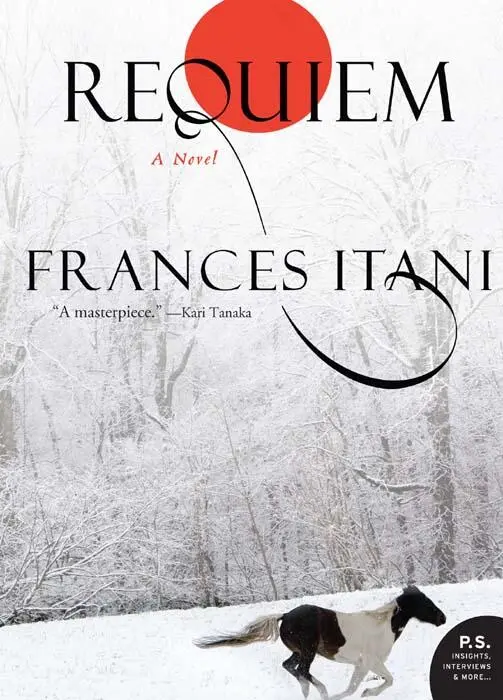
- Название:Requiem
- Автор:
- Издательство:A Phyllis Bruce Book
- Жанр:
- Год:2012
- Город:Toronto
- ISBN:978-1-44340-690-1
- Рейтинг книги:4 / 5. Голосов: 1
-
Избранное:Добавить в избранное
- Отзывы:
-
Ваша оценка:
Requiem: краткое содержание, описание и аннотация
Предлагаем к чтению аннотацию, описание, краткое содержание или предисловие (зависит от того, что написал сам автор книги «Requiem»). Если вы не нашли необходимую информацию о книге — напишите в комментариях, мы постараемся отыскать её.
delicately probes the complex adjustments we make to live with our sorrows…. [A] perfectly modulated novel.”
—
An extraordinary researcher and scholar of detail, Frances Itani—author of the best-selling novel
—excels at weaving breathtaking fiction from true-life events. In her new novel, she traces the lives, loves, and secrets in one Japanese-Canadian family during and after their internment in the 1940s.
In 1942, in retaliation for the attack on Pearl Harbor, the Canadian government removed Bin Okuma’s family from their home on British Columbia’s west coast and forced them into internment camps. They were allowed to take only the possessions they could carry, and Bin, as a young boy, was forced to watch neighbors raid his family’s home before the transport boats even undocked. One hundred miles from the “Protected Zone,” they had to form new makeshift communities without direct access to electricity, plumbing, or food—for five years.
Fifty years later, after his wife’s sudden death, Bin travels across Canada to find the biological father who has been lost to him. Both running from grief and driving straight toward it, Bin must ask himself whether he truly wants to find First Father, the man who made a fateful decision that almost destroyed his family all those years ago. With his wife’s persuasive voice in his head and the echo of their love in his heart, Bin embarks on an unforgettable journey into his past that will throw light on a dark time in history.
Requiem — читать онлайн бесплатно полную книгу (весь текст) целиком
Ниже представлен текст книги, разбитый по страницам. Система сохранения места последней прочитанной страницы, позволяет с удобством читать онлайн бесплатно книгу «Requiem», без необходимости каждый раз заново искать на чём Вы остановились. Поставьте закладку, и сможете в любой момент перейти на страницу, на которой закончили чтение.
Интервал:
Закладка:
I edged back slowly, casting a glance around the room at all that was familiar: the homemade table and bench, the few chairs, the low three-legged stool, the curtain in the doorway that led to the bedroom, the beautiful smooth sink and shelf that Ji had made for Mother, a hastily constructed cupboard that held our blue-and-white rice bowls and plates and chopsticks and kitchen utensils.
“Hurry!” Mother said. “Go and look for the others. And be sure to show your new father respect. He is an educated man. A good man. I am certain of it.”
She returned to the stove and stood without moving. She did not look in my direction. I had no choice but to let myself out the door.
As I walked away from my mother’s house, Ba called to me from her doorway.
“I’ve been watching for you,” she said. “I thought you would come back this morning. Try not to be sad. This is the way things happen sometimes, when one family has no sons and another has more than one.”
But I could see that she looked sad herself.
“Sit at the table,” she said. And she set out a green bowl and cut an orange into slices for me. “Ji is in the garden,” she added, when she saw me looking around for him. “He will be glad you were here to have a visit with me.” She sprinkled some raspberries around the orange slices in the bowl. “Finish them all,” she said, “and I will read my letter from Manzanar while you are eating.”
She patted the deep pocket of her dress, where she carried every letter that had arrived from her daughter, Sachi, in California. The letters were creased and flattened and had been read many times. When a new one arrived, she always took it over to read it aloud to Mother and to anyone else who was there. I had not heard the latest one, which had arrived the previous day. It had been written in the early summer, and had taken months to come from Manzanar because it had to go to the censor’s office before arriving at our camp. Ba sat on the chair across from me at the table.
“This letter slipped past the censor,” she said. “It must have been put in the wrong pile. There isn’t a single mark on it.” She laughed, and then she began to read.
Dear Mother and Father
Tom and I are okay. There are so many people around us every day, it is like living in a city, even though our “city” is surrounded by guard towers and barbed wire and it happens to be in the desert and there are men with machine guns in the towers .
Although some people are beginning to leave now, there have been as many as 10,000 here at one time. Much bigger than the camp you write about in your letters. Also, we have electricity here, and running water, and I am sorry that you do not. That must be a great hardship after living in Vancouver so many years .
Tom is still teaching apprentices about electricity and plumbing, but he volunteered his extra time to work on the new park I wrote about before. It’s in the middle of the main camp, inside the first round of barbed wire. The park has ball diamonds and even an outdoor stage. The schools here are huge—kindergartens, a high school, elementary schools—and we have a hospital now, with an operating room .
My own job at the co-op keeps me busy. I’ve been working there for a year, and it’s grown so much! What started out as a mail-order business has become much more, including a department store, where I’m to be found most days. My experience at our old Vancouver store while I was growing up has really helped. I still miss the store, don’t you? All the gossip that was exchanged over the counter, the stove people gathered around, I miss it all .
The farm outside our main camp, still inside barbed wire—don’t for a minute think anyone is free to walk out the gates—is so productive that we are able to ship a surplus of food to other prison camps. How about that for self-sufficiency? We grow every vegetable you can think of, and we raise cattle, pigs and poultry, too. Well, I don’t, but the farm workers do .
The churches and YMCA are still up and running, even though the rumour is that they will close as more and more inmates depart. What we’ll get, on departure, is $20 each and train fare to our destination. Great pat on the back! But most people have no place to go. The best way to get out of here is to have a job waiting in some state that wants us. Tom and I do not want to pick sugar beets. That’s one job that’s being advertised in our Manzanar newspaper. We’ll be staying a bit longer, until we know what we’re facing on the outside. I’ll let you know as soon as we decide .
Love to you both, and please stay healthy ,
SachiBa was lost in thought over Sachi, and I waited until she folded the letter along all of its creases, and replaced it in her pocket alongside the other letters. I thanked her for the orange and the berries and went across the road to the garden.
Hiroshi and Keiko were waiting.
“What’s he like?” Keiko said. “To live with.”
When I didn’t answer, Hiroshi said, “Your new father.” And then he blurted out, “Is he kind?”
“Yes,” I said in a soft, low voice, not unlike Okuma-san’s. “He is kind.”
I was aware of people in the rows around me, staring. Everyone seemed to know.
Keiko reached into her pocket and pulled out two Ritz crackers she had brought from home. She pushed them into my pocket and said, “For later. If you want a snack.”
I picked up an empty lard pail and began to drop the ripe tomatoes on top of one another, not caring if they became squashed or bruised.
CHAPTER 19
In the evenings, Okuma-san read books by the light of a kerosene lamp. Sometimes, he lit candles. Every evening, he left the same book for me on the chair after the supper meal was finished. Sometimes I stole a glance at the book, but it wasn’t until several weeks after school began that I opened the cover.
Okuma-san pretended not to notice.
There was a strange picture at the beginning of the book. A baby boy with a pleased expression on his face was inside a round fruit that looked like a peach. He was stepping out of its centre, where the pit should be, and the peach had split open. The boy held his fat little arms above his head as he strode out of the peach. He looked ready for adventure, and I began to wonder what the story was about.
Okuma-san peered over my shoulder and said, “Ah, yes. This is a story I was told when I was a boy about the same age you are now. It begins with an old man and his wife who are lonely because they have no children.”
I did not want that kind of story.
I ignored Okuma-san and turned the page. I saw a river. It was curving its way out of hills that had been drawn to look far away on the page. There were wavy lines on the surface of the river, and a large peach floating on its current. An old woman kneeled at the edge of the river. Beside her was a washtub filled with clothes. I turned the page to see that the peach had drifted to shore and was lodged next to the washtub. The old woman and her husband were smiling as they looked down at a baby curled up inside the peach, which had split open. I could see that pictures were helping to tell the story, but I did not know what the story was.
I looked at every page. A monkey and a dog were dressed up as humans and fighting with swords; a boat was sailing on a sea and heading for an island. I decided to read the story by myself. But there were a few big words I did not know.
When Okuma-san went outside for his evening walk through the gardens, I examined the pictures in the book again. Two were in colour. Others were shaded in black and white, as if they had been drawn with a pencil, or maybe with pen and ink. Okuma-san had three pencils in his shack, and these were kept sharpened in a small jam jar on the shelf. He had ink and a long pen with a nib that he sometimes dipped into a small bottle. The ink was dark, almost black. He had told me the name of the colour—indigo. In winter, the ink in our school froze on the coldest days. The teachers lined up the stubby bottles on a small table close to the stove, but it took hours for the ink to thaw. On those days, we wore our winter jackets all day, at our desks.
Читать дальшеИнтервал:
Закладка:
Похожие книги на «Requiem»
Представляем Вашему вниманию похожие книги на «Requiem» списком для выбора. Мы отобрали схожую по названию и смыслу литературу в надежде предоставить читателям больше вариантов отыскать новые, интересные, ещё непрочитанные произведения.






Обсуждение, отзывы о книге «Requiem» и просто собственные мнения читателей. Оставьте ваши комментарии, напишите, что Вы думаете о произведении, его смысле или главных героях. Укажите что конкретно понравилось, а что нет, и почему Вы так считаете.