Frances Itani - Requiem
Здесь есть возможность читать онлайн «Frances Itani - Requiem» весь текст электронной книги совершенно бесплатно (целиком полную версию без сокращений). В некоторых случаях можно слушать аудио, скачать через торрент в формате fb2 и присутствует краткое содержание. Город: Toronto, Год выпуска: 2012, ISBN: 2012, Издательство: A Phyllis Bruce Book, Жанр: Историческая проза, на английском языке. Описание произведения, (предисловие) а так же отзывы посетителей доступны на портале библиотеки ЛибКат.
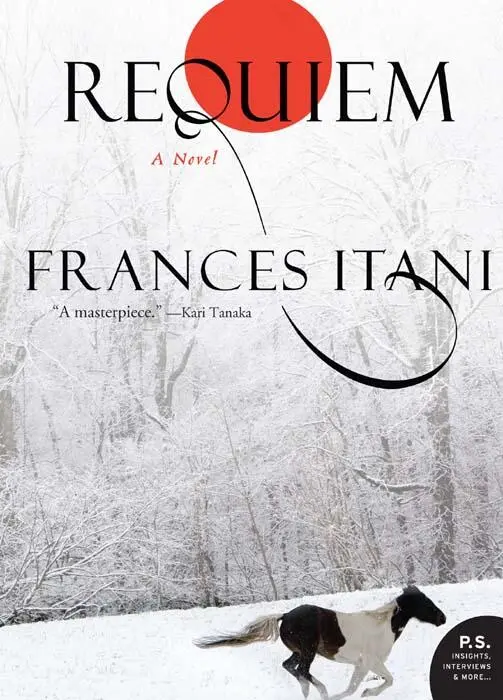
- Название:Requiem
- Автор:
- Издательство:A Phyllis Bruce Book
- Жанр:
- Год:2012
- Город:Toronto
- ISBN:978-1-44340-690-1
- Рейтинг книги:4 / 5. Голосов: 1
-
Избранное:Добавить в избранное
- Отзывы:
-
Ваша оценка:
Requiem: краткое содержание, описание и аннотация
Предлагаем к чтению аннотацию, описание, краткое содержание или предисловие (зависит от того, что написал сам автор книги «Requiem»). Если вы не нашли необходимую информацию о книге — напишите в комментариях, мы постараемся отыскать её.
delicately probes the complex adjustments we make to live with our sorrows…. [A] perfectly modulated novel.”
—
An extraordinary researcher and scholar of detail, Frances Itani—author of the best-selling novel
—excels at weaving breathtaking fiction from true-life events. In her new novel, she traces the lives, loves, and secrets in one Japanese-Canadian family during and after their internment in the 1940s.
In 1942, in retaliation for the attack on Pearl Harbor, the Canadian government removed Bin Okuma’s family from their home on British Columbia’s west coast and forced them into internment camps. They were allowed to take only the possessions they could carry, and Bin, as a young boy, was forced to watch neighbors raid his family’s home before the transport boats even undocked. One hundred miles from the “Protected Zone,” they had to form new makeshift communities without direct access to electricity, plumbing, or food—for five years.
Fifty years later, after his wife’s sudden death, Bin travels across Canada to find the biological father who has been lost to him. Both running from grief and driving straight toward it, Bin must ask himself whether he truly wants to find First Father, the man who made a fateful decision that almost destroyed his family all those years ago. With his wife’s persuasive voice in his head and the echo of their love in his heart, Bin embarks on an unforgettable journey into his past that will throw light on a dark time in history.
Requiem — читать онлайн бесплатно полную книгу (весь текст) целиком
Ниже представлен текст книги, разбитый по страницам. Система сохранения места последней прочитанной страницы, позволяет с удобством читать онлайн бесплатно книгу «Requiem», без необходимости каждый раз заново искать на чём Вы остановились. Поставьте закладку, и сможете в любой момент перейти на страницу, на которой закончили чтение.
Интервал:
Закладка:
“The man who gave this minuet to the world was called Beethoven. Can you say that?”
“Bait-o-ven,” I ventured.
“Good. He created this minuet 150 years ago. He was a great artist but he did not have an easy life. There were many problems that had to be faced. But he did not give up just because he had problems. He continued to create so others would always be able to listen to his music, even though he could not hear it himself. Because, you see, he was deaf from the time he was a very young man. The deafness made his life sad and empty sometimes, and he felt cut off from the people around him.”
I tried to imagine this, but it was difficult to picture a man called Bait-o-ven making music he could not hear. I wondered if Okuma-san was mistaken, or if this was another made-up story like the one about the boy inside the peach.
Okuma-san’s hands dropped to the keyboard and he began to play again. This time, however, he hummed in accompaniment to his own finger-tapping. To my astonishment, I recognized the melody that he was humming. I knew the entire piece in my head. It was the same one Missisu had played the morning we had been taken away on the mail boat. Having recognized the melody, I also remembered the noise of the grandfather clock and the way it had ticked emphatically in the background, merging with the drifting notes.
“Grandfather Minuet,” I said softly, more to myself than to Okuma-san. I was able to follow now, tap by tap, as his fingers moved against the wood.
“I see that you do know this one,” said Okuma-san. “Then I guessed correctly.”
He lifted the plank so he could get his knees out from under it, set it on the trestles again and walked over to the bookshelf. He chose a large, thin book that had a faded brown cover and loose pages, and he opened it carefully on the tabletop. He turned each page with two hands so that the paper, which was fragile and thin, would not tear. He pointed to a page that held row after row of markings and notes.
“This is what the minuet looks like on paper,” he said. “The one I have just played. I have owned this for a long time. But it is only a small part of the creations that came from the heart of the great man.”
He placed the sheet music back on the shelf. He sat me down at the end of the table and brought down the pen and the nib, the squat bottle of indigo ink and a small square of blotter. I did not have to ask him for any of these. He set his three sharpened pencils beside me, along with an eraser.
“You are very good at drawing. I have learned this about you. I have heard it from many people in the camp, and from your teacher, too. Perhaps it is something you can do while I am practising at my keyboard.”
I looked around for something to draw on.
“Ah,” he said, “I have forgotten the most important thing.” He reached up to the shelf and opened a different book. Four sheets of paper had been inserted inside the back cover. He put one of these in front of me. The paper was thick and cream-coloured.
“Take your time,” he said. “And I will take mine. You may draw what you wish.”
He went back to the shelf and chose another book of sheet music. He opened this and propped it against a wooden support he had nailed together to hold the pages upright. The support rested on a low cupboard. There was a small wind-up alarm clock on the cupboard. It was white and had a nickel finish and an oversized bell on top. Beside the clock was a photo of a woman in a small frame. She was wearing a traditional kimono, and she was smiling. This was Okuma-san’s wife, who had died; he had already told me that. She had been a singer and she had loved music, and sometimes he had played the piano for her when she had performed.
Okuma-san sat between the trestles now, and faced the propped-up pages. He adjusted the plank all over again until he was happy with its position. He raised and lowered his shoulders, shrugging a few times, preparing. He settled back and began to move his hands and fingers rapidly up and down the painted keys. I did not know what he was playing.
I looked at the blank paper on the table, the first I had ever been given only for the purpose of drawing. The paper was beautiful—too beautiful to use all at once in a single drawing. I folded it, and folded it again. I slid the blotter nervously towards the ink bottle, dipped the nib and tapped it against the rim as I had seen Miss Mori do in the classroom. I crouched over the paper. In the lower right-hand corner, I began to make small dots and lines that I hoped would resemble the river. My drawing might be part of a story; it might not. I only had a feeling that I wanted to put on the paper. If the feeling turned into a story, I did not know what the ending was going to be.
CHAPTER 20
No longer did I hide my drawings under a corner of the mattress. No longer did I receive knuckle raps to my head because I was a daydreamer. Even so, when I drew, I crooked my elbow, ready to cover the page with my arm in case anyone came to the shack and tried to see.
The paper I was given was sometimes a blank page that Okuma-san removed from the back of one of his books. He used the thin, sharp blade of a knife and did this painstakingly, so as not to further damage the book. If there was a blank page at the front, he removed that as well, to provide me with extra paper. Sometimes he folded the paper and, with the same knife, slit it in two. There were days when I returned home from school in the afternoon to find a new sheet of paper lying on top of my bedcovers. On one rare occasion, Okuma-san procured a long strip of paper from Ying’s truck. On the Monday, he had passed Ying a coin folded inside a strip of cloth and quietly asked him to bring what he could. On delivery day, Wednesday, the long rolled sheet was passed to Okuma-san after the women had finished gathering around the truck, after they had paid for and collected sugar and flour and thread, after they had laughed about extra-long chimpo sausage. When I held the oversized sheet of paper, I folded and refolded and divided it so that I could do many small drawings instead of one large one.
Sometimes, on a Saturday or Sunday, Okuma-san took me for a long walk up the side of the mountain or down the trail to the river. He pointed out plants and bushes and birds along the way. If neither of us knew the name of a species, we brought a leaf or a twig back with us to the shack, and tried to identify it from books, later.
Now that the harvest was over, money was distributed from the proceeds of the sale of produce, especially tomatoes. Families were ordering winter clothing from catalogues, which were passed around and shared. Okuma-san traced an outline of my foot on a piece of cardboard, and we had a long and serious discussion about ordering new shoes from Eaton’s and how many sizes larger than my foot the shoes should be. We decided on a pair a full size longer, but of a type that would lace past my ankles, so they wouldn’t fall off my feet. He also ordered a pair of thick socks for me, and he laughed about not being able to knit. I knew that Mother would knit socks for me; she always did, just before the snow came.
She and the other women in camp were busy now, pickling, preserving, knitting socks and mittens and scarves, lining winter clothes, everything done by hand. The men were making improvements to the root cellars near the shacks, and they dug more cellars out of the side of the hill and reinforced those with planks. Everyone, in some way or other, was occupied with finding wood, chopping wood, clearing deadwood, stacking wet wood, storing dry wood. Huge logs were dragged from the surrounding forest and sawed with a crosscut saw. Having enough wood for winter was important to every family, and the woodpiles grew higher and higher.
Читать дальшеИнтервал:
Закладка:
Похожие книги на «Requiem»
Представляем Вашему вниманию похожие книги на «Requiem» списком для выбора. Мы отобрали схожую по названию и смыслу литературу в надежде предоставить читателям больше вариантов отыскать новые, интересные, ещё непрочитанные произведения.






Обсуждение, отзывы о книге «Requiem» и просто собственные мнения читателей. Оставьте ваши комментарии, напишите, что Вы думаете о произведении, его смысле или главных героях. Укажите что конкретно понравилось, а что нет, и почему Вы так считаете.