Frances Itani - Requiem
Здесь есть возможность читать онлайн «Frances Itani - Requiem» весь текст электронной книги совершенно бесплатно (целиком полную версию без сокращений). В некоторых случаях можно слушать аудио, скачать через торрент в формате fb2 и присутствует краткое содержание. Город: Toronto, Год выпуска: 2012, ISBN: 2012, Издательство: A Phyllis Bruce Book, Жанр: Историческая проза, на английском языке. Описание произведения, (предисловие) а так же отзывы посетителей доступны на портале библиотеки ЛибКат.
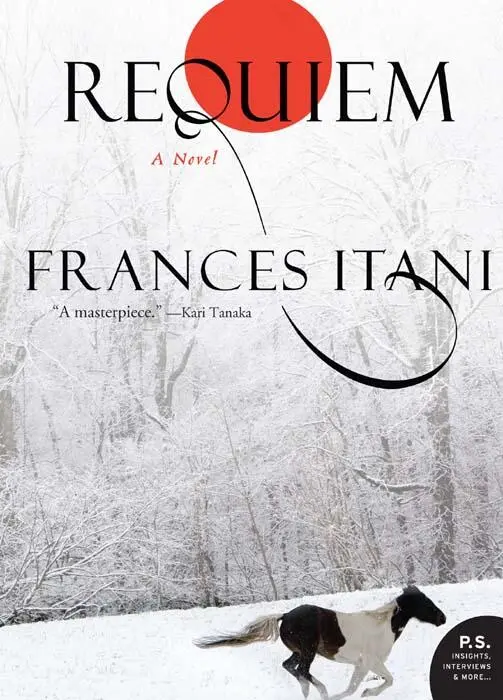
- Название:Requiem
- Автор:
- Издательство:A Phyllis Bruce Book
- Жанр:
- Год:2012
- Город:Toronto
- ISBN:978-1-44340-690-1
- Рейтинг книги:4 / 5. Голосов: 1
-
Избранное:Добавить в избранное
- Отзывы:
-
Ваша оценка:
Requiem: краткое содержание, описание и аннотация
Предлагаем к чтению аннотацию, описание, краткое содержание или предисловие (зависит от того, что написал сам автор книги «Requiem»). Если вы не нашли необходимую информацию о книге — напишите в комментариях, мы постараемся отыскать её.
delicately probes the complex adjustments we make to live with our sorrows…. [A] perfectly modulated novel.”
—
An extraordinary researcher and scholar of detail, Frances Itani—author of the best-selling novel
—excels at weaving breathtaking fiction from true-life events. In her new novel, she traces the lives, loves, and secrets in one Japanese-Canadian family during and after their internment in the 1940s.
In 1942, in retaliation for the attack on Pearl Harbor, the Canadian government removed Bin Okuma’s family from their home on British Columbia’s west coast and forced them into internment camps. They were allowed to take only the possessions they could carry, and Bin, as a young boy, was forced to watch neighbors raid his family’s home before the transport boats even undocked. One hundred miles from the “Protected Zone,” they had to form new makeshift communities without direct access to electricity, plumbing, or food—for five years.
Fifty years later, after his wife’s sudden death, Bin travels across Canada to find the biological father who has been lost to him. Both running from grief and driving straight toward it, Bin must ask himself whether he truly wants to find First Father, the man who made a fateful decision that almost destroyed his family all those years ago. With his wife’s persuasive voice in his head and the echo of their love in his heart, Bin embarks on an unforgettable journey into his past that will throw light on a dark time in history.
Requiem — читать онлайн бесплатно полную книгу (весь текст) целиком
Ниже представлен текст книги, разбитый по страницам. Система сохранения места последней прочитанной страницы, позволяет с удобством читать онлайн бесплатно книгу «Requiem», без необходимости каждый раз заново искать на чём Вы остановились. Поставьте закладку, и сможете в любой момент перейти на страницу, на которой закончили чтение.
Интервал:
Закладка:
I listened to these stories because I had never considered the fact that Okuma-san had once been a boy. Now I was forced to learn that he had lost not one set of parents but two. I did not like the way parents kept dying in his stories, nor did I like to think of him as an orphan, which was what I considered myself—even though my first family lived just along the row of shacks, a short walk from our doorstep. But one thing was different. When Okuma-san was adopted, he had been allowed to keep his Okuma surname, whereas I had not been allowed to keep the surname Oda. Nor did I want to, not anymore. If First Father did not want me, I reasoned, then I did not want his name.
Although I listened carefully to the things that had happened to Okuma-san, I was also waiting to hear a different kind of story. I thought about how he had arrived late at the camp, almost two years after everyone else. I did not ask about his wife, the singer, because he seldom talked about her. I had heard Mother say that the lines in his face were there because of grief over his wife’s death. But too many people died in his stories, and I did not want to hear more about death.
Then I thought of something else.
“Tell me about the bear,” I said suddenly. “How did you catch the bear when you first moved here to the camp?” This had been on my mind for some time, but I had never asked. I wanted to go to school and tell Hiroshi and Keiko that I had finally found out.
“Ah,” said Okuma-san. “It was fortunate for me that the bear cooperated.”
But that was all he would say.
Two wooden blocks clapped together. The clean knock of sound arrested all other noise in the room. An unseen hand wound the camp gramophone and set the music spinning. Unrecognized fathers took their places on the raised wooden platform, and I knew that First Father was among them. At school, Hiroshi had told me that Mother had been sewing a costume during the past several weeks, helping to prepare for the shibai , the winter play.
The storyteller stepped forward slowly, an air of magnificence about him. He made us wait, taking time to settle himself on a stool at the edge of the lantern-lit stage. A black curtain slid away from a painted backdrop and fell into darkness. No longer did I see a rough platform on wooden props. No longer did I see fisherman, farmer, mill hand, carpenter, cannery worker, storekeeper, factory hand. Instead, I saw imposing figures, the whirl of dark robes, makeup and mask, watercolours, banners of calligraphy fluttering before my eyes.
The story unfolded; a brand-new script had been created. All the roles, including women’s, were acted by the men. They had been practising for weeks, ever since the end of harvest. In the schoolhouse, after hours, props had been constructed and painted, and these had been pushed against the walls of the community room and covered over so we could not see what was on the backdrops before it was time for the performance. Even Okuma-san had put on his heavy coat and disappeared on weekends, working in secret alongside other men who were painting and nailing boards and planning the entertainment for this December night.
How we laughed, how we laughed, how our hands flew to our mouths. Between scenes, while backdrops were being changed, two men came out and sat at the front of the stage. Each man wore baggy trousers, hakama , and tabi , split-toe socks. They faced each other and held a running conversation and told jokes that made us laugh some more. One man held out a ripe banana, began to peel it slowly and carefully, and then tapped the side of his hand. A neat slice fell off. He tapped his hand again and another slice fell, the same size as the first. Everyone in the audience was roaring with laughter, but while I was laughing, tears rolled down my cheeks. The second man began to catch the slices, until finally, the banana skin was empty. How could this happen? I wiped my eyes. I couldn’t understand. It was only when I was older that I was shown the trick of piercing the skin of an unpeeled banana in layers, beforehand, with a long needle, making a steady stitch all the way around—an invisible stitch that would not be seen by the audience.
Auntie Aya and Uncle Aki were seated in the row in front of me, and Auntie Aya was wearing a new navy dress with a sparkly belt that Mother had made for her from material Uncle Aki had ordered from Eaton’s. It was the first time I had seen my aunt all dressed up. In the winter months there was no place to go anyway, except to visit from one shack to another. Apart from her calligraphy classes, she rarely left her shack. When she did go out, Uncle Aki was right beside her, hovering near, as always.
When the second act of the play was over, everyone clapped and clapped and protested and called for more, but the curtain was pulled and closed. The actors had run out of script. The jokes had been spent. The evening had come to an end.
When we’d entered the crowded community room at the beginning of the evening, Okuma-san had ensured that I would be seated next to Mother and my brother and sister. Ba and Ji were farther along in the same row. Ba had patted her thick pocket, where the end of a new envelope could be seen sticking out—another letter from the place called Manzanar. She was extra happy this night, because Sachi and Tom had written that they were expecting their first baby in April. This would be the first grandchild for Ba and Ji.
While we were all enjoying the entertainment, I had not once thought about missing my family. In fact, in the crowd of people and without thinking, I had inched my chair closer to Mother, as if I were part of my first family again.
Everyone was in high spirits at the end of the play, putting on coats and mittens and scarves, waving and calling out farewells, heading for the door. First Father remained behind in the community room because he had been one of the actors. As we were leaving, he was sprawled on the platform stage with the other players, half in and half out of costume. They had already begun to celebrate, some of them having stored homemade potato sake for this special night. For weeks, it had been brewing and fermenting with lemons and sugar, hidden away in heavy crocks in earth cellars dug into the side of the hill.
When we were outside in the cold again, I automatically followed Mother and Hiroshi and Keiko. They were ahead, halfway down the row, before they heard the crunch of footsteps on the snow behind them. They stopped, and Mother half-turned. When she saw me still making my way towards her, she shook her head, almost imperceptibly. When I caught up, she put her hands on my shoulders and turned me to face the direction from which we’d come. I looked back towards Okuma-san’s shack, which we had passed at the end of the row. My second father was standing by his door, staring at us, looking as if he had lost his way. His head was wrapped in a scarf, his face expressionless. I felt a small push between my shoulders and heard Mother’s voice say softly, “You are sure to sleep well tonight, Bin. It has been such a happy night for all of us.”
She continued on her way and I was left, caught between the two shacks.
I stood without moving. The mountains leaned in on all sides. The other families had quickly disappeared inside their homes, and I was alone on the path. I had to force myself to drag my feet towards Okuma-san. The excitement that had pulled me along behind my first family now deserted me, and I was stranded like an island in the midst of cross-currents that overlapped in the same stream.
The wind was blowing hard as Okuma-san and I stomped the snow from our boots and went inside. I began to prepare for bed, and climbed under the covers without saying good night. I was feeling badly, but I didn’t know what to say. As I lay there, I could hear the rattling of loose boards up and down the rows of shacks. The wind always howled more at night, and Okuma-san once suggested that I listen to it as a kind of music. Wind music that played against the roof, the tarpaper, the ill-fitting floorboards with frost on the nailheads, the doors, even the trees. For him, he said, the wind swayed and rocked the trees as if they were outdoor instruments being finely tuned.
Читать дальшеИнтервал:
Закладка:
Похожие книги на «Requiem»
Представляем Вашему вниманию похожие книги на «Requiem» списком для выбора. Мы отобрали схожую по названию и смыслу литературу в надежде предоставить читателям больше вариантов отыскать новые, интересные, ещё непрочитанные произведения.







Обсуждение, отзывы о книге «Requiem» и просто собственные мнения читателей. Оставьте ваши комментарии, напишите, что Вы думаете о произведении, его смысле или главных героях. Укажите что конкретно понравилось, а что нет, и почему Вы так считаете.