Frances Itani - Requiem
Здесь есть возможность читать онлайн «Frances Itani - Requiem» весь текст электронной книги совершенно бесплатно (целиком полную версию без сокращений). В некоторых случаях можно слушать аудио, скачать через торрент в формате fb2 и присутствует краткое содержание. Город: Toronto, Год выпуска: 2012, ISBN: 2012, Издательство: A Phyllis Bruce Book, Жанр: Историческая проза, на английском языке. Описание произведения, (предисловие) а так же отзывы посетителей доступны на портале библиотеки ЛибКат.
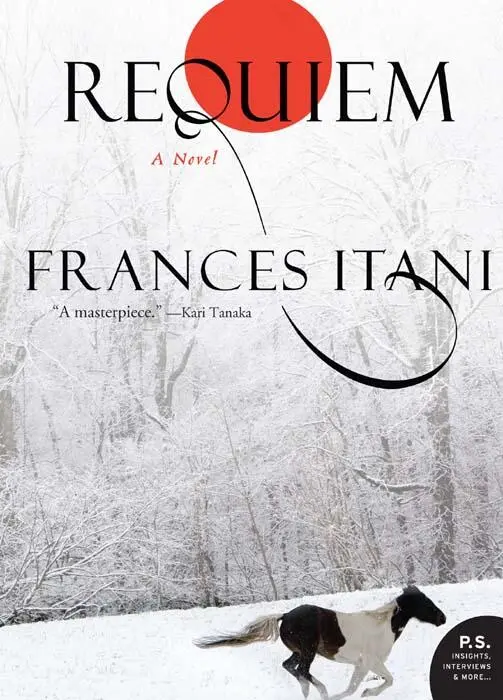
- Название:Requiem
- Автор:
- Издательство:A Phyllis Bruce Book
- Жанр:
- Год:2012
- Город:Toronto
- ISBN:978-1-44340-690-1
- Рейтинг книги:4 / 5. Голосов: 1
-
Избранное:Добавить в избранное
- Отзывы:
-
Ваша оценка:
Requiem: краткое содержание, описание и аннотация
Предлагаем к чтению аннотацию, описание, краткое содержание или предисловие (зависит от того, что написал сам автор книги «Requiem»). Если вы не нашли необходимую информацию о книге — напишите в комментариях, мы постараемся отыскать её.
delicately probes the complex adjustments we make to live with our sorrows…. [A] perfectly modulated novel.”
—
An extraordinary researcher and scholar of detail, Frances Itani—author of the best-selling novel
—excels at weaving breathtaking fiction from true-life events. In her new novel, she traces the lives, loves, and secrets in one Japanese-Canadian family during and after their internment in the 1940s.
In 1942, in retaliation for the attack on Pearl Harbor, the Canadian government removed Bin Okuma’s family from their home on British Columbia’s west coast and forced them into internment camps. They were allowed to take only the possessions they could carry, and Bin, as a young boy, was forced to watch neighbors raid his family’s home before the transport boats even undocked. One hundred miles from the “Protected Zone,” they had to form new makeshift communities without direct access to electricity, plumbing, or food—for five years.
Fifty years later, after his wife’s sudden death, Bin travels across Canada to find the biological father who has been lost to him. Both running from grief and driving straight toward it, Bin must ask himself whether he truly wants to find First Father, the man who made a fateful decision that almost destroyed his family all those years ago. With his wife’s persuasive voice in his head and the echo of their love in his heart, Bin embarks on an unforgettable journey into his past that will throw light on a dark time in history.
Requiem — читать онлайн бесплатно полную книгу (весь текст) целиком
Ниже представлен текст книги, разбитый по страницам. Система сохранения места последней прочитанной страницы, позволяет с удобством читать онлайн бесплатно книгу «Requiem», без необходимости каждый раз заново искать на чём Вы остановились. Поставьте закладку, и сможете в любой момент перейти на страницу, на которой закончили чтение.
Интервал:
Закладка:
Everyone in camp, including Okuma-san, had been making special foods and there was a festive air, despite the bitter cold. Mother came to visit, and helped with sushi making. Okuma-san put a chicken in the pot—our contribution to the larger celebration that would take place in the community room of the schoolhouse, where lanterns were hung from the ceiling and long tables and benches set out for the feast on New Year’s Day.
My gift from Mother was a shirt, one of Hiroshi’s that had been cut down and resewn. She also gave me a new pair of thick knitted socks and a navy blue bow tie. If the tie had been cut down from one that had belonged to First Father, I was never to know.
Okuma-san had something for me when I woke on the first day of 1945. It was a surprise, hidden on a shelf behind his books, and I wondered how I had not known it was there waiting for me. After I dressed on this special day, and put on my bow tie, and wet my hair and parted it with a comb, Okuma-san presented me with a small brown box, about four inches long and two inches high. He took it down from the shelf and held it out in both palms. He placed it in front of me, on the table.
“Lift the cover,” he said. He was smiling.
A half-moon indent on either side of the box permitted me to lift the lid with one hand while holding the bottom section in the other. Tucked inside was cream-coloured paper, tightly rolled and shaped like a cylinder. So neatly did this roll fit the space, the box had to be turned upside down to free it. A thin black ribbon attached to the outer edge had been wrapped around the roll several times to keep it from unravelling.
“This is a scroll, a scroll painting,” said Okuma-san, not without pleasure. He helped me unfurl the crisp, curled paper, and showed me how to use my right hand as an anchor. With my left, I rolled the scroll down the length of the table.
“I think you will want to see what this artist drew a long time ago. Eight hundred years ago. Can you imagine so much time going by? It is a famous piece of art in Japan. And here we are, sitting at a table in this camp in British Columbia, looking at the work.”
I said to myself, “Eight hundred years.” But so much time was a vagueness that was not easily pictured.
Okuma-san went on. “The artist was probably a priest. He might have lived in a monastery. This is not the original, but a copy. I treasure it because it was a gift from my father when he first took me with him to Japan when I was a boy. It was given to me before he boarded the ship to return to Canada. As I have told you, my parents were lost at sea during their voyage back to get me the following year.” He added this so softly, I wondered what else he was remembering from that time. But he continued.
“The artist drew the scroll with brush and ink. What we have here is the colour of charcoal. The paper is darker than it was at one time, because I opened it so many times when I was a child.”
I was anxious to keep unfurling. My right hand was secure as an anchor, but as the scroll opened, it became longer than my left arm could reach. I saw, too, that at the centre, a wooden dowel was attached to the inner edge. The wood for the dowel, said Okuma-san, had come from a cherry tree. He helped me to steady the unravelling scroll so it would not spring closed suddenly or fall to the floor. Once it was open all the way, he held the dowel and rewound the scroll so that we could start at the beginning again. This time, I scrolled left, slowly, by myself, and paid more attention to what the artist had drawn and to what the story was about. The opening images were of grasses and shadowy lines suggestive of hills and tree trunks. Animals were playing in water, perhaps a lake. The water then narrowed and might even have been a rolling river that flowed in the background.
The animals that splashed and played were rabbits and monkeys and frogs. Two monkeys were scratching each other’s back. The rabbits—hares, Okuma-san called them—were diving and swimming around the edges of the scroll. There were hills on either side of the wavy lines that depicted the river. The hills were drawn in simple strokes, soft and grey.
I stared. How was it possible to show a tree blowing in the wind this way, with only a few dark lines and a bit of shading? I watched the animals frolic down the length of the table while Okuma-san helped reroll the parts I had already seen. In this way, the two of us controlled the speed at which the pictures were displayed and, at the same time, kept the scroll from slipping off the edge of the table. A monkey raced in and out of the scene, among the frogs and hares, holding a switch in his hand while he ran. The river faded; a road began. A fox at the edge stood like a human and held his full, bushy tail between his legs. A large frog was shouting at the fox, and another hare suddenly appeared. I continued to unfurl, and saw a large lily pad tied to a frame made from branches. The lily pad was being used as a target for bow-and-arrow practice. Hares and frogs were in separate groups, aiming their arrows and testing their bows as if for a competition.
Leafless trees showed the passage of time and distance; these were deliberately spaced and rugged and blowing helter-skelter. After that, the hares began to dominate the activity. There were long-whiskered hares with short-tufted tails; hares with fans, or with cages they carried suspended from long poles; hares with fishing rods made from branches; hares talking, laughing, running, leading a deer with a long rein, inspecting a tied and captured boar. Badgers and monkeys squatted comically, wearing loose robes. A dead frog was sprawled on its back. There was a chase, a dance, tiny mice peering around the edges of the scene. I felt that I could make up my own story. I could create many stories from the pictures. Trees and shrubs began to leaf and flower as the scroll went on, but a single line of hill was always constant in the background. And then, all the animals in the foreground began to roll on the ground with laughter. Or so it seemed. A sober monkey sat smoking; a frog in the lotus position sat on a tabletop. An owl perched on the branch of a gnarled tree; a series of dots and marks showed the owl’s feathers. An outdoor feast was set up to the left of the tree. Picnic foods were spread out on a table and the spread continued along the ground.
I loved the simple lines of the scroll, the frenzy of activity, animals posing as humans, reading, smoking, eating, singing. The last of the figures, a solemn and important-looking frog, was carrying a rolled scroll that looked very much like my own.
Okuma-san was pleased that I liked my gift, I could tell. And I had something for him. Something I had drawn in secret at school and hidden in my desk. It was my own childish picture of the bear. Not the dead, upside-down hanging bear, the one that sometimes opened its jaws and gnawed its way into my nightmares, but a living bear. One that had raised its large head only a moment before to sniff out some danger that could not be seen with its small, dark eyes.
After the holiday, when school started again, rumour, confusion and fear were once more being stirred up. The war would soon be over. Japan was going to be defeated. The camps would close. The camps would not close. We would be allowed to return to our homes. We would not be allowed to return. Other people, hakujin people, lived in our houses now. Fishermen’s lives had changed forever. Japanese Canadian fishermen no longer had licences to fish. No one had boats; no one owned a car. If we did move, where would the men find work? Where would we move anyway, if the war did end?
And then, not many weeks later, something that was not a rumour had to be talked about. RCMP officers arrived from the town and asked to meet with the heads of families. Word was quickly sent around from shack to shack, and the men gathered in the community room. They were told that every family would have to sign a paper offering two choices: the first was “repatriation,” which meant authorized expulsion and exile to Japan, a country only a handful of people in the camp had ever seen; the alternative was to agree to “relocate” east of the Rocky Mountains.
Читать дальшеИнтервал:
Закладка:
Похожие книги на «Requiem»
Представляем Вашему вниманию похожие книги на «Requiem» списком для выбора. Мы отобрали схожую по названию и смыслу литературу в надежде предоставить читателям больше вариантов отыскать новые, интересные, ещё непрочитанные произведения.





Обсуждение, отзывы о книге «Requiem» и просто собственные мнения читателей. Оставьте ваши комментарии, напишите, что Вы думаете о произведении, его смысле или главных героях. Укажите что конкретно понравилось, а что нет, и почему Вы так считаете.