Frances Itani - Requiem
Здесь есть возможность читать онлайн «Frances Itani - Requiem» весь текст электронной книги совершенно бесплатно (целиком полную версию без сокращений). В некоторых случаях можно слушать аудио, скачать через торрент в формате fb2 и присутствует краткое содержание. Город: Toronto, Год выпуска: 2012, ISBN: 2012, Издательство: A Phyllis Bruce Book, Жанр: Историческая проза, на английском языке. Описание произведения, (предисловие) а так же отзывы посетителей доступны на портале библиотеки ЛибКат.
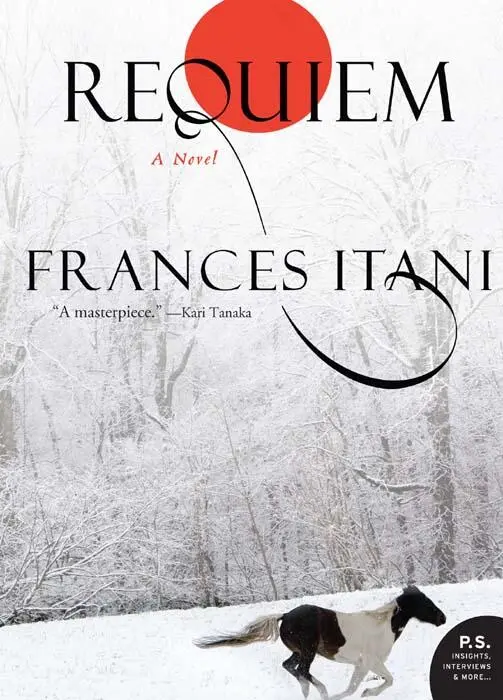
- Название:Requiem
- Автор:
- Издательство:A Phyllis Bruce Book
- Жанр:
- Год:2012
- Город:Toronto
- ISBN:978-1-44340-690-1
- Рейтинг книги:4 / 5. Голосов: 1
-
Избранное:Добавить в избранное
- Отзывы:
-
Ваша оценка:
Requiem: краткое содержание, описание и аннотация
Предлагаем к чтению аннотацию, описание, краткое содержание или предисловие (зависит от того, что написал сам автор книги «Requiem»). Если вы не нашли необходимую информацию о книге — напишите в комментариях, мы постараемся отыскать её.
delicately probes the complex adjustments we make to live with our sorrows…. [A] perfectly modulated novel.”
—
An extraordinary researcher and scholar of detail, Frances Itani—author of the best-selling novel
—excels at weaving breathtaking fiction from true-life events. In her new novel, she traces the lives, loves, and secrets in one Japanese-Canadian family during and after their internment in the 1940s.
In 1942, in retaliation for the attack on Pearl Harbor, the Canadian government removed Bin Okuma’s family from their home on British Columbia’s west coast and forced them into internment camps. They were allowed to take only the possessions they could carry, and Bin, as a young boy, was forced to watch neighbors raid his family’s home before the transport boats even undocked. One hundred miles from the “Protected Zone,” they had to form new makeshift communities without direct access to electricity, plumbing, or food—for five years.
Fifty years later, after his wife’s sudden death, Bin travels across Canada to find the biological father who has been lost to him. Both running from grief and driving straight toward it, Bin must ask himself whether he truly wants to find First Father, the man who made a fateful decision that almost destroyed his family all those years ago. With his wife’s persuasive voice in his head and the echo of their love in his heart, Bin embarks on an unforgettable journey into his past that will throw light on a dark time in history.
Requiem — читать онлайн бесплатно полную книгу (весь текст) целиком
Ниже представлен текст книги, разбитый по страницам. Система сохранения места последней прочитанной страницы, позволяет с удобством читать онлайн бесплатно книгу «Requiem», без необходимости каждый раз заново искать на чём Вы остановились. Поставьте закладку, и сможете в любой момент перейти на страницу, на которой закончили чтение.
Интервал:
Закладка:
CHAPTER 23
The weather was warmer, the season changing. With the approach of spring, there was much to talk about. The paper every family had to sign had become real and threatening. The paper represented what was known as the “dispersal policy.” All conversations, no matter what else was being discussed, ended with talk about the demands made and how to act in response.
Okuma-san asked if I wanted to go to the river one Sunday, and the two of us set out after lunch. On our way past the communal gardens, we greeted several men who were burning heaps of tumbleweed that had blown in and around the rows during the winter months. Flames leapt high as they crackled, and there was a sweet scent around us while the brittle weed scattered sparks into the air.
We hiked down the steep trail, with Okuma-san in the lead. He had placed a special order for me with Ying several weeks before, and Ying, in turn, had sent to Vancouver for a thin sketch pad of real art paper and a small box that held four sticks of charcoal. The entire pad was to be used for no other purpose than drawing, and it was the first sketch pad I had ever owned.
When we reached the bottom of the trail, I saw Okuma-san look intently towards the place where a small boy had drowned three weeks earlier. This was near the spot where First Father had once fished for sturgeon. The boy had fallen in and was swept away, his body never found. There had been a service in the community room of the school, and everyone in camp attended, crowding the room, the hall, the doorway, even the outside steps. I tried not to imagine the boy thrashing in panic in the water, but I could not keep the image from my mind. As if we were having a conversation of thoughts, Okuma-san now said, “Rivers sustain and nourish, yes, but they can also take life away.” I did not reply. I did not know what sustain meant but I knew what it meant to say that a river could take someone’s life. I had seen death in the camp: my baby cousin, Taro; several old people who had been cremated; and even the dead bear that had hung upside down behind Okuma-san’s shack. Now there was another death: the boy who had fallen into the river and would never be returning to his parents’ shack. This was one more ghost to worry about, a child ghost, footless, joining the others.
I settled myself on a flat rock and smelled the air around me and thought about this same rock shelf where Mother had sat and stretched her legs in the sun. I opened my new drawing pad to the first page and began to shade until lines resembling a riverbank appeared on the paper. Okuma-san stayed close by, reading a book while I drew. I tried first of all with a thick pencil and then I added charcoal, rubbing it sideways across the paper. I was thinking of the scroll I’d been given at the new year, and about the river that ran through it from end to end. Even though the river could not always be seen in the scroll, there was somehow a suggestion that it was there. Sure enough, a bump or a wavy line would reappear as the scroll was unrolled, and there it was again.
I was also thinking of Okuma-san telling me once that there were many different ways to draw. That it was all right to change the shapes I made on the page, that it was all right to alter them from what they started out to be. What I drew did not have to be the object that happened to be in front of me. It did not have to have the same edges or shape. I could look at the object as a starting point and use my imagination in any way I wished.
It was peaceful in that place, even with the roar of river beside us. And just as I was attempting to create an outline of the island, I heard footsteps crunching on the grit of the pathway that descended the embankment. At once, I recognized the father of the boy who had drowned. He stood near us and stared out over the river, which, when I looked, now appeared sullen and dark. He and Okuma-san quietly exchanged a few words and I heard them discussing the paper that everyone had to sign, choosing one path or another into the future. There was to be a meeting later that afternoon, in the community room in the schoolhouse. “Alone or together, we are helpless,” the man said. “There is no place we are wanted.”
“But it is pointless to allow the rage,” Okuma-san said. “If we allow the rage, it will consume us.”
The man shrugged and then turned to me and asked if he could see what I was drawing.
His request took me by surprise, and gave my drawing a sudden importance I did not want it to have. I was aware of his sadness, which could be seen on his face, but I became unsatisfied with what I was doing and did not want to show the page in my sketch pad to him or to anyone else. I closed the pad and turned it face down on the rock, and even put my hands over it, fearing that he would pick it up, or that he would take it away from me and examine the drawing.
Of course, he did no such thing. He smiled sadly and stood on shore for a few more minutes, looking out over the water. Then he turned and made his way back up the path.
After he left, I asked Okuma-san which family I was to be a part of when the important paper was signed.
“You are my family now,” said Okuma-san. “You and I will remain in Canada. This is our country, and we will not be forced to leave.”
I was glad to hear this, but I wondered about my first family. I did not want them to be on the other side of the wide blue stretch I had seen on the globe at school when I’d spun it around and stopped it abruptly, my finger landing on the Pacific Ocean. I did not want them to be so far away that I would never see them again.
Later that afternoon, after Okuma-san and I climbed the embankment and returned to the shack, I ripped out the page I had worked on by the river and crumpled it in my hand. I threw the drawing into the fire and burned it, right after Okuma-san left for the meeting. The men were to have one last discussion about the dispersal policy and the paper that had to be signed.
The next day, Hiroshi and Keiko came to me at school, and I learned that First Father had decided to take his chances and had signed the paper, agreeing to be sent to Japan, over which bombing raids were now in progress. He was going to take Mother and Keiko and Hiroshi with him. He had been planning this for some time, Keiko told me, because she had begged to have a haircut that was more stylish, with shorter hair. First Father refused to allow this because he said she would have to have long hair when they went to Japan so that she would fit in with girls her age and not look like a foreigner. She recounted all of this in the schoolyard, and then she told me what had happened next.
Mother, in a surprising and unexpected burst of defiance, declared that she was not going to leave. What would she do in a foreign place, even if it was the country of the ancestors? Hadn’t she been born in Vancouver? Hadn’t she attended school in that city as a child? Wasn’t she entitled to raise the children in their own country?
The final comment had come from next door. Ba and Ji heard the argument and came in to take Mother’s side. Because they were elders, they had no worries about interfering. Ji declared that any child sent to Japan after the end of the war would be in danger of dying of illness or starvation.
Mother, given support from the elders, would not change her mind. “Whether we are wanted here or not,” she said, “we should stay. If we move, we won’t see Bin again. Okuma-san will never agree to go to Japan. He has already said.”
Keiko’s eyes were puffy from crying, her cheekbones flushed. She said she’d been frightened when Mother’s voice was raised in argument against First Father. Hiroshi, too, was unhappy about what was going on around him. But Father had signed the paper, and now the paper had to be unsigned.
Читать дальшеИнтервал:
Закладка:
Похожие книги на «Requiem»
Представляем Вашему вниманию похожие книги на «Requiem» списком для выбора. Мы отобрали схожую по названию и смыслу литературу в надежде предоставить читателям больше вариантов отыскать новые, интересные, ещё непрочитанные произведения.






Обсуждение, отзывы о книге «Requiem» и просто собственные мнения читателей. Оставьте ваши комментарии, напишите, что Вы думаете о произведении, его смысле или главных героях. Укажите что конкретно понравилось, а что нет, и почему Вы так считаете.