Frances Itani - Requiem
Здесь есть возможность читать онлайн «Frances Itani - Requiem» весь текст электронной книги совершенно бесплатно (целиком полную версию без сокращений). В некоторых случаях можно слушать аудио, скачать через торрент в формате fb2 и присутствует краткое содержание. Город: Toronto, Год выпуска: 2012, ISBN: 2012, Издательство: A Phyllis Bruce Book, Жанр: Историческая проза, на английском языке. Описание произведения, (предисловие) а так же отзывы посетителей доступны на портале библиотеки ЛибКат.
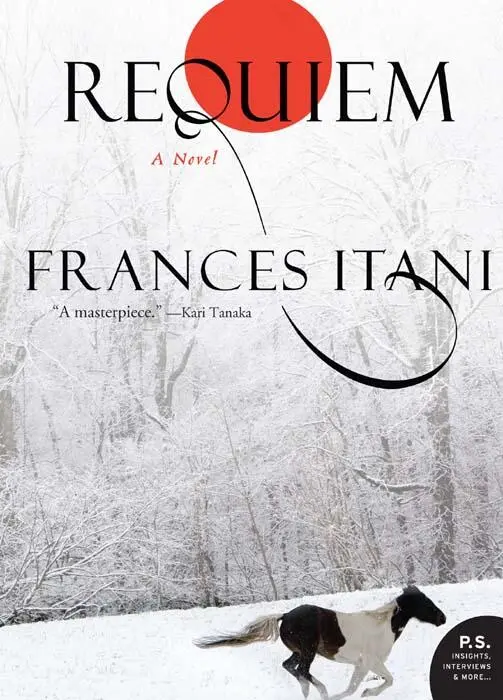
- Название:Requiem
- Автор:
- Издательство:A Phyllis Bruce Book
- Жанр:
- Год:2012
- Город:Toronto
- ISBN:978-1-44340-690-1
- Рейтинг книги:4 / 5. Голосов: 1
-
Избранное:Добавить в избранное
- Отзывы:
-
Ваша оценка:
Requiem: краткое содержание, описание и аннотация
Предлагаем к чтению аннотацию, описание, краткое содержание или предисловие (зависит от того, что написал сам автор книги «Requiem»). Если вы не нашли необходимую информацию о книге — напишите в комментариях, мы постараемся отыскать её.
delicately probes the complex adjustments we make to live with our sorrows…. [A] perfectly modulated novel.”
—
An extraordinary researcher and scholar of detail, Frances Itani—author of the best-selling novel
—excels at weaving breathtaking fiction from true-life events. In her new novel, she traces the lives, loves, and secrets in one Japanese-Canadian family during and after their internment in the 1940s.
In 1942, in retaliation for the attack on Pearl Harbor, the Canadian government removed Bin Okuma’s family from their home on British Columbia’s west coast and forced them into internment camps. They were allowed to take only the possessions they could carry, and Bin, as a young boy, was forced to watch neighbors raid his family’s home before the transport boats even undocked. One hundred miles from the “Protected Zone,” they had to form new makeshift communities without direct access to electricity, plumbing, or food—for five years.
Fifty years later, after his wife’s sudden death, Bin travels across Canada to find the biological father who has been lost to him. Both running from grief and driving straight toward it, Bin must ask himself whether he truly wants to find First Father, the man who made a fateful decision that almost destroyed his family all those years ago. With his wife’s persuasive voice in his head and the echo of their love in his heart, Bin embarks on an unforgettable journey into his past that will throw light on a dark time in history.
Requiem — читать онлайн бесплатно полную книгу (весь текст) целиком
Ниже представлен текст книги, разбитый по страницам. Система сохранения места последней прочитанной страницы, позволяет с удобством читать онлайн бесплатно книгу «Requiem», без необходимости каждый раз заново искать на чём Вы остановились. Поставьте закладку, и сможете в любой момент перейти на страницу, на которой закончили чтение.
Интервал:
Закладка:
Mother, with Ba and Ji’s help, won the argument. A new paper was signed and my first family was not among those escorted to the coast to board a ship that sailed to Japan after the end of the war. But as Okuma-san later explained, the politicians were successful in ridding the country of thousands of Japanese Canadians. In the spring of 1946, the first shipload of exiles, immunized and with papers signed, sailed away from the West Coast and headed for Japan. In all, some four thousand people left Canada. Some were from our camp. One man told everyone he was glad to leave after being interned for years. He hoped for a life better than the one he’d been living since the bombing of Pearl Harbor. Other families were caught up in the atmosphere of chaos and had signed the paper out of fear.
First Father now became undecided about what to do next, and I often saw him outside, pacing around, engaged in bitter arguments and rantings with the men who remained. He was not the only one who had lost everything he had ever worked for. His boat and licence, his business, the house he had built in our fishing village, his honour and now, perhaps, his country. He had received a letter from his brother, our uncle Kenji, who had been sent to a road camp just after we’d been removed from the coast in early 1942. Uncle Kenji had spent eighteen months separated from his family, who were living in an internment camp in New Denver. He was with them now because he had finally been permitted to join them the previous year.
Uncle Kenji wanted to return to fishing, but that was impossible. Like the rest of us, he wasn’t allowed back on the coast. In the letter he wrote to First Father, he said that he’d heard about work being available farther south, maybe at a sawmill not far from where we were now. He did not want to leave British Columbia, which had always been his home. None of us had seen Uncle Kenji since we’d been taken from our homes in 1942.
I worried about all of this. For a second time, we had to move out of our homes. One family after another began to depart. Some arranged to meet relatives who had been detained in other locations. Some left on the running boards of trucks that were filled to capacity with people on the move. Most were leaving the province and heading east, disappearing to different parts of the country—everywhere but to the West Coast. None of us was allowed back there—not yet. That would not happen for another four years. When Japanese Canadians were finally allowed to vote in 1949, that was when we were allowed to return to the coast. But by then, of course, most had been dispersed elsewhere.
For now, the places people moved to were mainly chosen by chance. Someone had heard that a job might be found. Two rooms were offered in a city in Manitoba or Ontario. A housekeeper was wanted here or there. A minister from a church arranged for several families to move and found work for them on Ontario farms. A mushroom factory was hiring and said it would take internees from the camps. The sugar-beet fields in Alberta needed more workers. Some older Japanese children were being accepted into regular high schools. University students were in classes in the East. A Japanese doctor had been asked to work in a rural area that had no hospital or physician.
In the camp, in the middle of August 1945, this is how we learned more about hate, and about victory over Japan and about what would become known as VJ Day.
On a hot day, cars from across the river were heard approaching the camp. Most of the adults, including Okuma-san, were working in the communal gardens on the other side of the road. Some of the men were down at the river, fishing. Hiroshi was up on the Bench, picking currants. Keiko was with me because she had come to borrow a book from Okuma-san’s shelf and had stayed on to read and keep me company. Keiko had short hair now, and shiny black bangs like Mother’s, but without the curls on her forehead. She was laughing out loud while she was reading a story in the book.
There was suddenly so much noise from the road, we went to the doorway to see what was happening. Some of the mothers were running towards the shacks and bringing their children inside. We became frightened because many cars driven by men from the town had begun to circle through camp. Keiko and I banged the door shut and pushed the table against it and pulled the curtains tight so it would be dark inside the room. The two of us kneeled on a bench by the window and watched through a tiny crack. Our whole camp, within minutes, appeared to be deserted, but we were all there, hiding inside.
The men in the cars drove round and round, back and forth on the road and up and down the rows between shacks, blasting their horns and shouting through the car windows they had rolled down. “Have you heard the news? We dropped the big bomb and we won the war against you goddamned Japs!” This went on for about fifteen minutes until, finally, the drivers and shouters seemed to tire of roaring through a silent camp. The cars turned and went honking back to the bridge and towards town.
We knew then that Japan had surrendered, and we were glad, too. A few weeks later, during the first week of September, we heard about the formal ceremonies and final surrender of the Japanese military aboard the American battleship USS Missouri . But on that hot August day, when the news first came to the camp, we had been forced to hide behind the walls of our shacks because Canada, our country, was no longer at war.
Newspapers were brought from across the river. News of the terrible bombs that had been dropped on Hiroshima and Nagasaki had greatly disturbed everyone, and no one knew the extent of the destruction. People were being more cautious about their decisions now. Okuma-san decided that he and I would stay on until the end of the next school year, even though we were now free to move east. He was watching and waiting to see what would happen next. He sent letters to Vancouver friends he’d had before the war, knowing that he would not be able to teach or even travel back to the West Coast. He hoped that someone might be able to help him find work in some interior location of the province, even though we were being pressured to move east of the Rockies.
Hiroshi and Keiko and I met frequently up on the slope behind the camp and talked and played Jan-Ken-Po , and told one another of any changes or plans that had been overheard within the two families. But nothing changed for a while. Until Ba and Ji left.
Ba and Ji had been like family to all of us, but we had to make the best of their departure. They cried when it was time to leave, but they laughed, too, because they hoped to be reunited soon with their daughter’s family. Sachi and Tom were now living in Nebraska, where they’d moved from Manzanar, and their baby had been born, a son named after Ji. The baby had Ji’s first and last names, since Tom had taken Sachi’s surname when they’d married in Vancouver before our expulsion from the coast.
Ba and Ji planned to travel across the country as far as Winnipeg. They would stay there with a family friend until Sachi could arrange for them to join her. Ba wore a grey dress and black gloves and a black hat with a short veil over her forehead for the train journey. The letters from Manzanar she had once stored in her pocket had been replaced by a photograph of the new grandson. She kept the photo of the baby in an envelope and pulled it out of the pocket of her dress to show everyone one more time before she left.
The numbers in camp were steadily shrinking, but First Father carried on with the gardening, as did Okuma-san. The sale of tomatoes was still bringing in enough money to support us. The school stayed open for another year, with one Japanese teacher and seventeen students. The Caucasian teacher, Mr. Blackwell, had gone back to Vancouver at the end of the war. And then, finally, in 1946, it was decided that the school would have to be closed at the end of the term. There would be only a few families remaining in the fall, not enough to keep the building open any longer.
Читать дальшеИнтервал:
Закладка:
Похожие книги на «Requiem»
Представляем Вашему вниманию похожие книги на «Requiem» списком для выбора. Мы отобрали схожую по названию и смыслу литературу в надежде предоставить читателям больше вариантов отыскать новые, интересные, ещё непрочитанные произведения.






Обсуждение, отзывы о книге «Requiem» и просто собственные мнения читателей. Оставьте ваши комментарии, напишите, что Вы думаете о произведении, его смысле или главных героях. Укажите что конкретно понравилось, а что нет, и почему Вы так считаете.