Frances Itani - Requiem
Здесь есть возможность читать онлайн «Frances Itani - Requiem» весь текст электронной книги совершенно бесплатно (целиком полную версию без сокращений). В некоторых случаях можно слушать аудио, скачать через торрент в формате fb2 и присутствует краткое содержание. Город: Toronto, Год выпуска: 2012, ISBN: 2012, Издательство: A Phyllis Bruce Book, Жанр: Историческая проза, на английском языке. Описание произведения, (предисловие) а так же отзывы посетителей доступны на портале библиотеки ЛибКат.
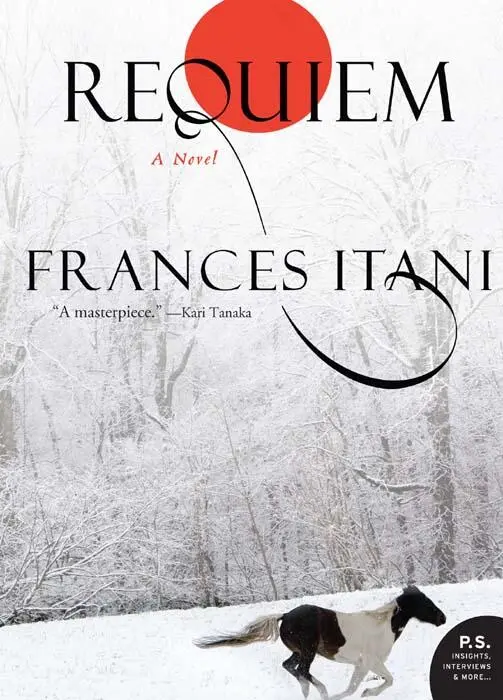
- Название:Requiem
- Автор:
- Издательство:A Phyllis Bruce Book
- Жанр:
- Год:2012
- Город:Toronto
- ISBN:978-1-44340-690-1
- Рейтинг книги:4 / 5. Голосов: 1
-
Избранное:Добавить в избранное
- Отзывы:
-
Ваша оценка:
Requiem: краткое содержание, описание и аннотация
Предлагаем к чтению аннотацию, описание, краткое содержание или предисловие (зависит от того, что написал сам автор книги «Requiem»). Если вы не нашли необходимую информацию о книге — напишите в комментариях, мы постараемся отыскать её.
delicately probes the complex adjustments we make to live with our sorrows…. [A] perfectly modulated novel.”
—
An extraordinary researcher and scholar of detail, Frances Itani—author of the best-selling novel
—excels at weaving breathtaking fiction from true-life events. In her new novel, she traces the lives, loves, and secrets in one Japanese-Canadian family during and after their internment in the 1940s.
In 1942, in retaliation for the attack on Pearl Harbor, the Canadian government removed Bin Okuma’s family from their home on British Columbia’s west coast and forced them into internment camps. They were allowed to take only the possessions they could carry, and Bin, as a young boy, was forced to watch neighbors raid his family’s home before the transport boats even undocked. One hundred miles from the “Protected Zone,” they had to form new makeshift communities without direct access to electricity, plumbing, or food—for five years.
Fifty years later, after his wife’s sudden death, Bin travels across Canada to find the biological father who has been lost to him. Both running from grief and driving straight toward it, Bin must ask himself whether he truly wants to find First Father, the man who made a fateful decision that almost destroyed his family all those years ago. With his wife’s persuasive voice in his head and the echo of their love in his heart, Bin embarks on an unforgettable journey into his past that will throw light on a dark time in history.
Requiem — читать онлайн бесплатно полную книгу (весь текст) целиком
Ниже представлен текст книги, разбитый по страницам. Система сохранения места последней прочитанной страницы, позволяет с удобством читать онлайн бесплатно книгу «Requiem», без необходимости каждый раз заново искать на чём Вы остановились. Поставьте закладку, и сможете в любой момент перейти на страницу, на которой закончили чтение.
Интервал:
Закладка:
Miss Paxton then called for complete silence. We stood, sang “God Save the King” and recited the Lord’s Prayer, and the school year began.
To start off the day, Miss Paxton said, “Let’s take turns, class. As you all know, on the first day of school, we stand beside our desks, one at a time, and say our names out loud. Both names,” she reminded. “Last and first. I’ll begin. My name is Miss Paxton.” She said this as if Miss was her first name, and then she printed MISS PAXTON on the board.
As I was in the last seat of the farthest row, my turn came after everyone else had finished. I stood, pressed a hand to the back of my desk and said, “Okuma, Binosuke,” putting my last name first, because I was not certain what I should do. I sat down quickly.
The children laughed so loudly, I became confused and wondered if, instead, I should have given the surname of my first, and not my second, father. I stood again and the room went silent. I blurted out, “Oda, Binosuke,” and my cheeks felt as if they had been slapped.
“Did you just say two different names?” said Miss Paxton. She looked down at her attendance sheet and then back to me.
I nodded and sat in my seat.
“And how do you come to have two sets of names?” she said.
I told her I had two because I had once lived in the family of my first father.
“Stand up again,” she said. “How many fathers have you had?”
“Two,” I said, and quickly sat down again. All of this sitting and standing made the class laugh even harder.
“What kind of names are those, anyway?” Miss Paxton said. “What kind of names, class? Shall we hear them again? Stand up and tell us, so that we can understand.”
“My name is Bin,” I said, thinking that if I gave only my shortest name, no one would laugh.
“Bin,” said Miss Paxton. She printed B-I-N on the board in giant letters with white chalk, and she drew an even bigger X through my name.
“Bin is not a name we use for children in this country,” she said.
“We say bin for dustbin or garbage bin, but it is not a name we give a child. We’ll assign a name that we can remember, an English name. We will call you Ben. Can you remember that?”
“Yes,” I said. And I wanted to leave this room and never come back, even knowing that Okuma-san would not let me stay home from school.
Miss Paxton printed B-E-N on the board and erased my crossed-out Japanese name.
When the day was finished, I walked out the school door alone. Behind me, I heard a boy’s voice mutter: “So long, rice paddy. Don’t bother coming back.”
Okuma-san was waiting for me at the end of Main Street as he had promised. When he asked how the day had gone, I said, “Fine.” I told him nothing about Miss Paxton, nor did I tell him that my name had been changed back to an English name again.
But that was only the beginning. On my second morning, Miss Paxton said, “Stand up, Ben. Stand beside your desk and tell the class your mother’s name.”
I had only one mother, but I wasn’t certain if Miss Paxton was laying a trap. I did not want the class to know anything more about my family, so I stood and spoke quickly. “My mother’s name is Oda, Reiko.”
And the entire class, as well as Miss Paxton, laughed as if they would never stop.
Every morning, for the rest of the week, Miss Paxton made me stand and say the name of my mother aloud so that the class could start off the day with a good laugh.
Miss Paxton was my Sensei , my teacher, and I knew that I had to show respect and do what she told me to do.
No one else in the class was asked to stand and say the name of a parent.
Miss Paxton was not able to make me cry.
That was my first week in my new school.
CHAPTER 25
Ihad never had a school art lesson until the year I was in grade eight. It was 1950, and an announcement was made at the beginning of the year that art classes were to start on Friday afternoons in late November. When I heard this, I felt an excitement that was physical, an excitement I had not known before.
On that first Friday morning, my heart beat faster. I raced through morning lessons. The clock slowed, intentionally. No one in our class knew who would be giving the lessons, but it was rumoured to be one or the other of two veterans, each of whom had fought overseas during the war and had returned to take up teaching again.
I had already had an encounter with one of the veterans, Mr. Abbott, and I was hoping he would not be the one to teach art. His regular class was geography, and he was also responsible for physical education. After gym class one day the previous June, a boy complained that his wallet had been stolen from a bench in the locker room on the main floor. I was accused of the theft. Mr. Abbott believed the boy and, despite my protests, took me to the principal’s office, where both he and the principal tried to force me to admit my guilt. But I would not; I was innocent. My pockets were turned inside out and my desk was searched, but the wallet was not found. “I’ve dealt with these Japs before,” Mr. Abbott told the principal. “I’ll get it out of him yet.”
While I was being threatened that a letter would be sent home to my father and that I would be expelled, an older boy came running into the office and said the wallet had been found in another boy’s locker. Mr. Abbott turned and left the office. No apology was made. The principal sent me back to my classroom. I never learned if the real thief was punished. I do know that for several days, in the schoolyard outside, the boys chanted, “Stealer! He’s a stealer!” when I came near.
I recounted none of these events to Okuma-san. Nor did I tell him that the covers of war comics occasionally turned up in my desk drawer in the classroom. There was always a Japanese soldier depicted on these covers. A soldier with an ugly yellow face, large buck teeth, eyes squinting behind thick glasses. I ripped up the covers and learned not to react. If someone started a fight outside, I did not run away. I did have a few friends, boys my age, and though they did not join the taunting, they did not come to my defence. It was too risky for them.
Occasionally, letters arrived from Mother. Keiko wrote, as well. She and Hiroshi were both in high school and doing well. Our camp school had not let us down. I had kept up my own marks, and was at the top of my class every year. When Mother wrote and asked about my grades, I reported back. But whenever a letter came from her, I fell into a dark mood and brooded for days. Our old lives were far away. I had not seen my first family since 1946. No one had the money to travel.
Okuma-san was saving money to move us to Ontario the following year and had been promised work in Ottawa as a music teacher. Letters had been coming and going. The job was at a small college, teaching music to students of high school age. He would be giving both group and individual lessons. One of his conditions was that I would be able take my high school studies at the same college. Of course, a piano would be available to him. Okuma-san had always kept up his practice on the plank keyboard, which had a permanent place against one wall of our chicken coop. After years of listening to Beethoven rapped out on ponderosa pine, I could tell almost as soon as he began which piece he was playing.
One day in the early fall, when I came home from school scuffed from fighting, I walked into the chicken coop and saw a small refrigerator tucked in behind the door and plugged in overhead. Okuma-san had purchased it secondhand. Mr. Boyd had picked it up in his truck and had helped to carry it in and set it up.
We had nothing to keep cold in the refrigerator that afternoon, except for one egg. We set the egg on a shelf by itself and laughed as if it were the funniest thing we’d ever seen. The refrigerator rattled and buzzed every time we opened the door. Okuma-san said he would buy cold food the next day, milk and butter and meat. He did not comment on my appearance, though it was obvious that I’d been in a fight. The two of us kept opening the door to look at the egg. During the night, I was wakened by the rattle and I heard Okuma-san in the kitchen, opening the fridge door again. I pictured the lone egg in that cool and empty space.
Читать дальшеИнтервал:
Закладка:
Похожие книги на «Requiem»
Представляем Вашему вниманию похожие книги на «Requiem» списком для выбора. Мы отобрали схожую по названию и смыслу литературу в надежде предоставить читателям больше вариантов отыскать новые, интересные, ещё непрочитанные произведения.






Обсуждение, отзывы о книге «Requiem» и просто собственные мнения читателей. Оставьте ваши комментарии, напишите, что Вы думаете о произведении, его смысле или главных героях. Укажите что конкретно понравилось, а что нет, и почему Вы так считаете.