Frances Itani - Requiem
Здесь есть возможность читать онлайн «Frances Itani - Requiem» весь текст электронной книги совершенно бесплатно (целиком полную версию без сокращений). В некоторых случаях можно слушать аудио, скачать через торрент в формате fb2 и присутствует краткое содержание. Город: Toronto, Год выпуска: 2012, ISBN: 2012, Издательство: A Phyllis Bruce Book, Жанр: Историческая проза, на английском языке. Описание произведения, (предисловие) а так же отзывы посетителей доступны на портале библиотеки ЛибКат.
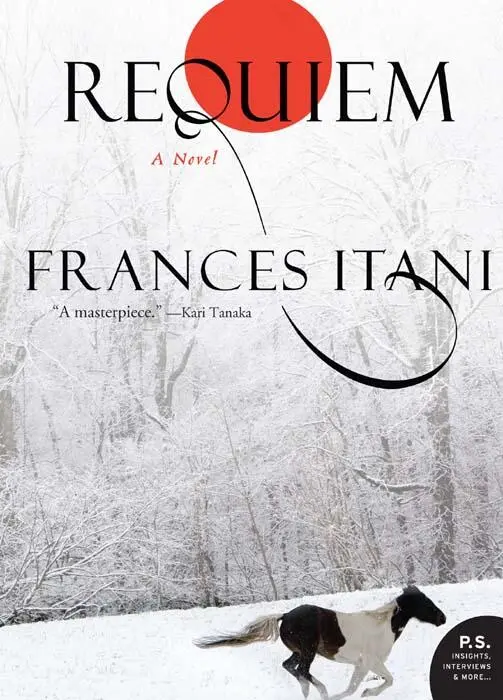
- Название:Requiem
- Автор:
- Издательство:A Phyllis Bruce Book
- Жанр:
- Год:2012
- Город:Toronto
- ISBN:978-1-44340-690-1
- Рейтинг книги:4 / 5. Голосов: 1
-
Избранное:Добавить в избранное
- Отзывы:
-
Ваша оценка:
Requiem: краткое содержание, описание и аннотация
Предлагаем к чтению аннотацию, описание, краткое содержание или предисловие (зависит от того, что написал сам автор книги «Requiem»). Если вы не нашли необходимую информацию о книге — напишите в комментариях, мы постараемся отыскать её.
delicately probes the complex adjustments we make to live with our sorrows…. [A] perfectly modulated novel.”
—
An extraordinary researcher and scholar of detail, Frances Itani—author of the best-selling novel
—excels at weaving breathtaking fiction from true-life events. In her new novel, she traces the lives, loves, and secrets in one Japanese-Canadian family during and after their internment in the 1940s.
In 1942, in retaliation for the attack on Pearl Harbor, the Canadian government removed Bin Okuma’s family from their home on British Columbia’s west coast and forced them into internment camps. They were allowed to take only the possessions they could carry, and Bin, as a young boy, was forced to watch neighbors raid his family’s home before the transport boats even undocked. One hundred miles from the “Protected Zone,” they had to form new makeshift communities without direct access to electricity, plumbing, or food—for five years.
Fifty years later, after his wife’s sudden death, Bin travels across Canada to find the biological father who has been lost to him. Both running from grief and driving straight toward it, Bin must ask himself whether he truly wants to find First Father, the man who made a fateful decision that almost destroyed his family all those years ago. With his wife’s persuasive voice in his head and the echo of their love in his heart, Bin embarks on an unforgettable journey into his past that will throw light on a dark time in history.
Requiem — читать онлайн бесплатно полную книгу (весь текст) целиком
Ниже представлен текст книги, разбитый по страницам. Система сохранения места последней прочитанной страницы, позволяет с удобством читать онлайн бесплатно книгу «Requiem», без необходимости каждый раз заново искать на чём Вы остановились. Поставьте закладку, и сможете в любой момент перейти на страницу, на которой закончили чтение.
Интервал:
Закладка:
Another afternoon, Okuma-san had a secondhand turntable to show me when I came in from school. He had bought it that day, along with a great find, a record of Beethoven’s Emperor Concerto that someone no longer wanted, though it was almost new. Okuma-san prepared our supper and I set the table, and the two of us sat in silence while the music surrounded us. Okuma-san could not keep his fingers still. Every inch of space in the room was filled with glorious and noble sounds. Hands and fingers played real keys. The second movement was so beautiful it seemed to float into the walls of the chicken coop. When it was over, we listened again as if for the first time. Had we been seated in one of the grand concert halls of Europe, we could not have enjoyed it more.
That evening, Okuma-san told me about the Heiligenstadt Testament , which Beethoven wrote when he was thirty-one years old. He had addressed it to his brothers, one of them by name, but it was never sent and was discovered among his papers after his death.
“It is a sad document,” said Okuma-san. “Very sad. Because in it, Beethoven finally accepted his permanent infirmity, his deafness. Imagine, at thirty-one and with the kind of genius that was inside him. Who knows how he was able to triumph over those devastating conditions? Maybe his deep love of life and his love of God allowed him to continue.”
The kitchen was almost dark by then, and I went to bed feeling that the music was still inside me. I did not want the feeling to escape.
On the Friday that art classes began, I had begun to worry about the possibility that Mr. Abbott, the gym instructor, would walk into our classroom and announce that he was the teacher. I knew he could make my life as difficult and as complicated as he wished it to be. It was a relief to me when the other veteran—there wasn’t a student in the school who did not know which two teachers had fought in the war—Mr. Owen, walked through the doorway and announced, “Today we will begin the study of art.”
Mr. Owen had fought in the Battle of Hong Kong and had been wounded. A bullet had gone through his cheek. There was a large scar on the left side of his face. His left eye was lower than the right, as if it had been mangled in the process of being wounded. He had been taken prisoner in Hong Kong by Japanese soldiers and was sent to Japan to work in a factory. Everyone knew how weak and sick he had been at the end of the war, when he’d finally returned home.
Our first class was a drawing class, and that was fine with me. Mr. Owen wanted us to draw either a horse or a dog. He handed out art paper and then he began to draw on the board with chalk, demonstrating a model of ovals and circles that could be created into a horse’s head and belly and back. The outer lines could be erased after a likeness had been found.
The demonstration of the dog began with two ovals and a circle. The circle was positioned behind the oval and transformed into a long, floppy ear on each side of the head. Another oval was positioned on its side and became the dog’s seated body. Legs and tail were added at the end.
I drew the horse, but did not need circles and ovals to help me. From memory, I drew one of the wild horses from the camp.
Mr. Owen walked up and down the rows of desks, looking over our shoulders. He was impressed with what I had done.
“It’s good, Ben. It’s really very good. You didn’t need any of my teaching aids to get started. And as you already know, there are many ways to draw a picture.”
He asked me to stay after class that day.
“Ben,” he said, “have you ever looked at real paintings in a gallery? Would you like to borrow some of my art books? I have quite a library at home. It’s important, when you are an artist, to look at the work of others and to know what has been done before.”
I agreed, cautiously. I was not accustomed to excessive kindness from teachers. But a friendship between us began that day.
Mr. Owen helped me to pay more attention to the natural world. He encouraged this so as to provide me with grounding. To start with basics but to be aware of every aspect of my own creations. “Look at what is around and between the objects you draw,” he told me. And I did. I began to focus on the spaces between, the angles and shadows, the fragmentation of light. I even began to wonder if I could draw these on their own: the shapes and groups of shapes above and between and below—instead of the objects themselves.
It was almost a decade later when I experimented in earnest this way, divorcing myself, freeing myself from being bound to actual objects, appreciating abstract shapes, real and imagined, and the ways they could exist for their own sake.
Along with Okuma-san, Mr. Owen helped me at the beginning of this journey. He challenged me to believe that every new drawing and painting deserved the excitement I gave to it as I searched for new forms that might bring it to life. Even when I was in grade eight, this was deemed to be important.
Some days, during those Friday afternoon classes, my classmates would ask Mr. Owen to tell us about the war. One time, he spoke about being a prisoner in Japan.
“I was weak,” he said, “and I had lost a great deal of weight. More than fifty pounds. My clothes were ragged; I had no shoes; there was little food to be shared. One of my jobs was to take deliveries from the factory in which I worked to a second factory, more than a mile away. I was given a heavy knapsack that was filled with metal parts, and told where to deliver it. I did not have to have a guard because there was no place for me to escape. If I had tried to hide, some of my comrades would have been killed in my place. In my weakened condition, barefoot, it was a long walk for me at the time. I had to pass through a remote village on the way. The village was poor and it was obvious that the people who lived there were barely scraping by.
“One afternoon, while I was walking past a small house, I became dizzy from hunger and from the heat, and I had to sit down at the edge of the road. An elderly couple came outside and offered water. Then they went back inside and came out with a small scoop of cooked rice. They helped me to stand, and I was able to continue. The scoop of rice and the water kept me going.”
Mr. Owen stared out the classroom window for a long time before he continued, but none of us spoke or tried to interrupt.
“I can never adequately explain to you what that meant to me,” he said. “Apart from the obvious fact that I stayed alive one more day.
“The old couple looked out for me after that, and helped me whenever they saw me on the road between factories, carrying the heavy knapsack. When they had extra food, they shared it. Sometimes it was nothing more than a fish head pulled from a watery stew. Sometimes it was a rice ball. They were probably putting their own lives in danger by giving me food, and I have always felt badly that I had nothing to give in return.
“When the war ended, before I left, I sat on the floor of my bunkhouse and made a drawing of the two of them, the man and his wife. I took it to them and said goodbye. I was able to leave them a ration kit, given to me by American soldiers. Many of my comrades had died from starvation and abuse in the prison factory. But I am alive today and standing in this classroom because one elderly Japanese couple who had almost nothing themselves were humane enough to help me.”
It is possible that after Mr. Owen told his story, I found myself in fewer fights at school. Certainly, my classmates and I remembered the story, because we talked about it several times, among ourselves.
I did borrow art books from Mr. Owen that year. Week after week, month after month, until I had gone through most of his library. One of his books was about Japanese woodblock prints, and some of the representations within reminded me of the scroll I had been given by Okuma-san. I took the book home to the chicken coop and showed it to Okuma-san, and we delighted in turning the pages, examining the uniqueness of the art. I was especially captivated by the way water had been drawn. Some waves looked like hard chunks of river. Others showed as soft ripples or shadows. I began to understand that there could be a soft or hard look to water, that there could be many ways of depicting rivers, that this was a matter of technique and of choice.
Читать дальшеИнтервал:
Закладка:
Похожие книги на «Requiem»
Представляем Вашему вниманию похожие книги на «Requiem» списком для выбора. Мы отобрали схожую по названию и смыслу литературу в надежде предоставить читателям больше вариантов отыскать новые, интересные, ещё непрочитанные произведения.



Обсуждение, отзывы о книге «Requiem» и просто собственные мнения читателей. Оставьте ваши комментарии, напишите, что Вы думаете о произведении, его смысле или главных героях. Укажите что конкретно понравилось, а что нет, и почему Вы так считаете.