Frances Itani - Requiem
Здесь есть возможность читать онлайн «Frances Itani - Requiem» весь текст электронной книги совершенно бесплатно (целиком полную версию без сокращений). В некоторых случаях можно слушать аудио, скачать через торрент в формате fb2 и присутствует краткое содержание. Город: Toronto, Год выпуска: 2012, ISBN: 2012, Издательство: A Phyllis Bruce Book, Жанр: Историческая проза, на английском языке. Описание произведения, (предисловие) а так же отзывы посетителей доступны на портале библиотеки ЛибКат.
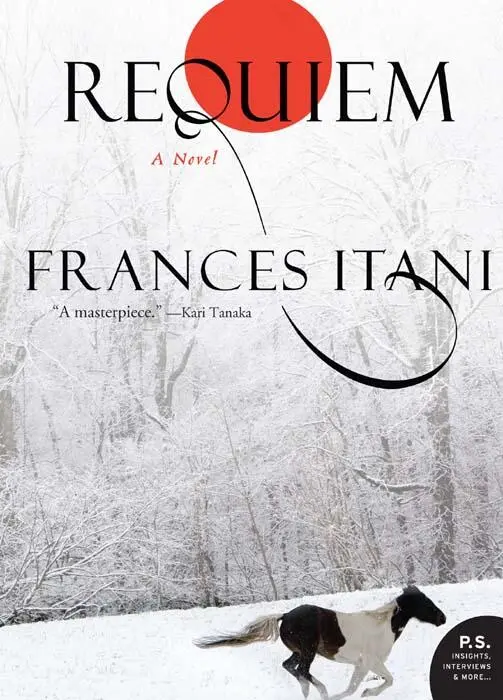
- Название:Requiem
- Автор:
- Издательство:A Phyllis Bruce Book
- Жанр:
- Год:2012
- Город:Toronto
- ISBN:978-1-44340-690-1
- Рейтинг книги:4 / 5. Голосов: 1
-
Избранное:Добавить в избранное
- Отзывы:
-
Ваша оценка:
Requiem: краткое содержание, описание и аннотация
Предлагаем к чтению аннотацию, описание, краткое содержание или предисловие (зависит от того, что написал сам автор книги «Requiem»). Если вы не нашли необходимую информацию о книге — напишите в комментариях, мы постараемся отыскать её.
delicately probes the complex adjustments we make to live with our sorrows…. [A] perfectly modulated novel.”
—
An extraordinary researcher and scholar of detail, Frances Itani—author of the best-selling novel
—excels at weaving breathtaking fiction from true-life events. In her new novel, she traces the lives, loves, and secrets in one Japanese-Canadian family during and after their internment in the 1940s.
In 1942, in retaliation for the attack on Pearl Harbor, the Canadian government removed Bin Okuma’s family from their home on British Columbia’s west coast and forced them into internment camps. They were allowed to take only the possessions they could carry, and Bin, as a young boy, was forced to watch neighbors raid his family’s home before the transport boats even undocked. One hundred miles from the “Protected Zone,” they had to form new makeshift communities without direct access to electricity, plumbing, or food—for five years.
Fifty years later, after his wife’s sudden death, Bin travels across Canada to find the biological father who has been lost to him. Both running from grief and driving straight toward it, Bin must ask himself whether he truly wants to find First Father, the man who made a fateful decision that almost destroyed his family all those years ago. With his wife’s persuasive voice in his head and the echo of their love in his heart, Bin embarks on an unforgettable journey into his past that will throw light on a dark time in history.
Requiem — читать онлайн бесплатно полную книгу (весь текст) целиком
Ниже представлен текст книги, разбитый по страницам. Система сохранения места последней прочитанной страницы, позволяет с удобством читать онлайн бесплатно книгу «Requiem», без необходимости каждый раз заново искать на чём Вы остановились. Поставьте закладку, и сможете в любой момент перейти на страницу, на которой закончили чтение.
Интервал:
Закладка:
What sort of egg? I had asked at the time.
But Father didn’t know.
I wanted an answer. A year later, I still wanted an answer. Thinking back, I kicked at loose gravel and watched my feet disappear as the bottom turned to murk and cloud. I inhaled the smell of river deep into my lungs.
“ Are! Are! Come see! Come see!”
My concentration was broken by the shouts of my brother and sister, and by the terse voice of our father. I was curious to know what they had discovered, but I stayed where I was because I had found treasure of my own: a resting caddis fly, its wings folded in the shape of a peaked tent, the tiniest tent imaginable. I squatted to stare, and I marvelled.
When at last it was time to leave the island, Father called me to his side. I might have been last over, but because I was the youngest, I would be first to go back. I thought of Mother again, and looked anxiously across the channel, relieved to see her sitting on a rock shelf, her legs stretched out. So seldom did I see her outside, sitting idly like this, I wondered for a moment if the person on the far bank was the same one who stayed inside most of the time, cooking, baking, sewing, knitting, washing and mending clothes, sweeping, keeping our place clean. Indeed, it was Mother, and she was staring downriver as if her eyes were following the current as it swept along on its journey to the coast.
Father hoisted me up with a single hand, as if to remind me that I weighed no more than a dried and brittle clam. Back we went, over turquoise and marble green and muddy water, until I was handed into the outstretched arms of my mother. She wrapped a towel tightly around me and began to rub at my heels because she knew, without being told, that my feet were stinging with pain from playing in the cold river. Father returned to the island and swam alongside Keiko, and then he went back for Hiroshi. Finally, we were all safely returned to the main shore.
Mother had set out picnic food, knowing how hungry we would be, and she lifted a square of damp cotton to reveal thinly sliced strips of omelette. Earlier in the morning, Keiko had helped to make nigiri sushi —balls of rice pressed to diamond shapes, with black sesame and dried seaweed sprinkled overtop. There were homemade pickles, tsukemono; thick radishes from the garden; and for dessert, a large hot cross bun for each of us, decorated with thin lines of white icing. Hiroshi was sent to fetch the jug that had been set in scooped-out gravel at the outlet of a cold spring that fed into the river. I watched as Mother added sugar to the water and then poured in the contents of a corked vial, which she shook end to end, dispersing a thick and oily lemon extract. She tilted the jug until the yellow colour had spread throughout the liquid, and then she held it to the sun. Satisfied, she poured the lemonade into our waiting cups.
Father kept urging us to eat, to finish every bite of the food we had carried down the embankment. With his chopsticks, he passed me an extra helping of sushi , and then he offered me half of his hot cross bun. He had never done this before, and I glanced up at Mother to see if I should accept. She nodded yes, and looked towards the river while I ate my own and then half of my father’s dessert. Hiroshi and Keiko looked on in envy.
As soon as we finished eating, Father told Keiko to stay with Mother to help clean up. Hiroshi and I were to follow him along the bank while he checked his fishing line. As we approached the cotton-wood tree, we could see that the line he had attached to the branch was badly shredded.
Father nodded darkly and said, “Only a great fish would break such a line.”
Hiroshi nodded, assuming the same expression.
I looked up at Father and saw a quick flash of anger, but I saw something else, too. Respect for the great fish. The summer before, I had watched him and several other fishermen haul in a large sturgeon, longer than my own body. I had shrunk back, out of the way, awed by its gaping gills and slow-moving tail, by the ridge on its back, by its mottled, purplish-pink skin. I had seen respect then, too, on the faces of men who were no longer permitted to fish in coastal waters. They fished below camp in the mighty Fraser and with makeshift equipment—their own having been stolen or auctioned off. But this was not the ocean.
In the late afternoon, our picnic came to an end for another year. Fatigued, sated with food and sun and fresh air, we began the slow, steep climb up the sand-and-gravel trail towards our shack. My head was filled with images of rock and canyon and river below, though the picnic site could not be seen once we had crossed the garden plots and the dirt road.
Mother seemed preoccupied when we were home again, but she warmed some green tea and gave us a snack and, just before sunset, sent us up the trail to the Bench so that we could pick berries before bedtime.
I knew exactly where to find raspberries and currants on the plateau, and I scrambled up behind my brother and sister, knowing that other children would be there, too. We spread out, intent on filling our buckets, and I wandered away by myself until I came to a thick clump of raspberry canes. The silence of the mountain settled around me, though I was aware of occasional spurts of laughter and a low murmur of voices drifting in and out of the evening air.
I tried to remember all that had happened since early morning: the excitement of waking on picnic day; the walk down the steep trail; the wriggling, darting creatures of the Fraser; the changing colours of the big river; the scent beneath the cottonwoods; the feel of the branch in my palm when I poked and prodded under rocks. I thought of Mother’s arms reaching for me when I was first to return across the channel on Father’s back. I thought of the way she had rubbed at my heels to warm my feet. I thought of the perfect yellow lemonade and the sticky-sweet taste of hot cross buns and the extra portion I had been given by my father. I looked down over the fast river, which could be seen from the height of the Bench, and I told myself that this had been the happiest day of my life.
But my cocoon was broken harshly by a shrill voice shouting, “Bear! Bear!” and every one of us on the Bench, every child, including me, raced down the slope. By the time we reached bottom, laughing and calling out, no one knew if a bear had actually been seen or if fresh droppings had been sighted, but the cry of “Bear! Bear!” had scattered us and sent us running down the hill to our beds.
When we returned to our shack, we saw that we had a visitor. Our parents were standing side by side in the kitchen, the room bloated with silence. Father was rigidly tall and looked uncomfortable, as if something had gone wrong. I had never seen an expression on his face like the one I was seeing now. Mother’s face appeared to be crumpled and small. Her eyes were red and I could not think what could possibly be wrong at the end of our day of days, our picnic of picnics. I handed the bucket of raspberries to Mother, who did not seem to notice that it was only half full. She placed the bucket on the shelf beside the smoothly jointed sink that Ji had built for her.
The third person in the room was standing across from our parents. A bundle of clothes was on a chair, along with blankets and a small pillow. I recognized a sleeve from my knitted sweater sticking out of the bundle. I looked to Hiroshi and Keiko but they did not know what was happening any more than I did. Hiroshi sat down on the bench against the wall and waited. Keiko looked from Mother to Father and was about to speak. But before she could get a word out, we were told why the adults had been waiting silently for us to come down the hill.
My father, who had two sons, had made the decision to give me away. I was to be given to Okuma-san, the man from the end of the row, who lived alone and had never been fortunate enough to have a son of his own to carry on his family name. He had come to collect me, and it was then that I was told that my surname would no longer be Oda, and that I would be taking the Okuma name as my own.
Читать дальшеИнтервал:
Закладка:
Похожие книги на «Requiem»
Представляем Вашему вниманию похожие книги на «Requiem» списком для выбора. Мы отобрали схожую по названию и смыслу литературу в надежде предоставить читателям больше вариантов отыскать новые, интересные, ещё непрочитанные произведения.






Обсуждение, отзывы о книге «Requiem» и просто собственные мнения читателей. Оставьте ваши комментарии, напишите, что Вы думаете о произведении, его смысле или главных героях. Укажите что конкретно понравилось, а что нет, и почему Вы так считаете.