Frances Itani - Requiem
Здесь есть возможность читать онлайн «Frances Itani - Requiem» весь текст электронной книги совершенно бесплатно (целиком полную версию без сокращений). В некоторых случаях можно слушать аудио, скачать через торрент в формате fb2 и присутствует краткое содержание. Город: Toronto, Год выпуска: 2012, ISBN: 2012, Издательство: A Phyllis Bruce Book, Жанр: Историческая проза, на английском языке. Описание произведения, (предисловие) а так же отзывы посетителей доступны на портале библиотеки ЛибКат.
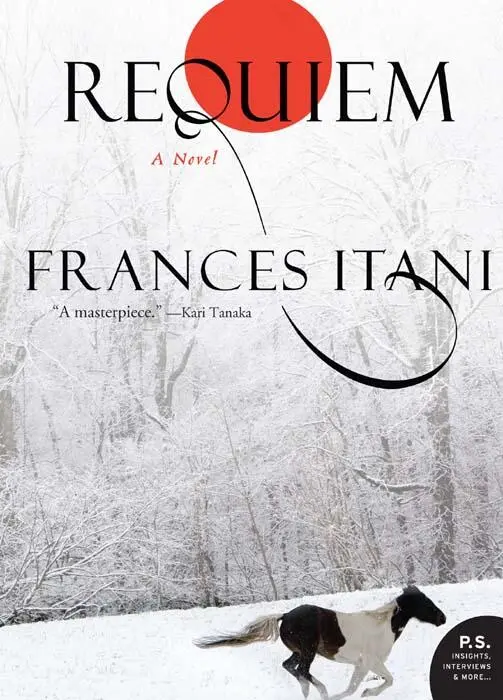
- Название:Requiem
- Автор:
- Издательство:A Phyllis Bruce Book
- Жанр:
- Год:2012
- Город:Toronto
- ISBN:978-1-44340-690-1
- Рейтинг книги:4 / 5. Голосов: 1
-
Избранное:Добавить в избранное
- Отзывы:
-
Ваша оценка:
Requiem: краткое содержание, описание и аннотация
Предлагаем к чтению аннотацию, описание, краткое содержание или предисловие (зависит от того, что написал сам автор книги «Requiem»). Если вы не нашли необходимую информацию о книге — напишите в комментариях, мы постараемся отыскать её.
delicately probes the complex adjustments we make to live with our sorrows…. [A] perfectly modulated novel.”
—
An extraordinary researcher and scholar of detail, Frances Itani—author of the best-selling novel
—excels at weaving breathtaking fiction from true-life events. In her new novel, she traces the lives, loves, and secrets in one Japanese-Canadian family during and after their internment in the 1940s.
In 1942, in retaliation for the attack on Pearl Harbor, the Canadian government removed Bin Okuma’s family from their home on British Columbia’s west coast and forced them into internment camps. They were allowed to take only the possessions they could carry, and Bin, as a young boy, was forced to watch neighbors raid his family’s home before the transport boats even undocked. One hundred miles from the “Protected Zone,” they had to form new makeshift communities without direct access to electricity, plumbing, or food—for five years.
Fifty years later, after his wife’s sudden death, Bin travels across Canada to find the biological father who has been lost to him. Both running from grief and driving straight toward it, Bin must ask himself whether he truly wants to find First Father, the man who made a fateful decision that almost destroyed his family all those years ago. With his wife’s persuasive voice in his head and the echo of their love in his heart, Bin embarks on an unforgettable journey into his past that will throw light on a dark time in history.
Requiem — читать онлайн бесплатно полную книгу (весь текст) целиком
Ниже представлен текст книги, разбитый по страницам. Система сохранения места последней прочитанной страницы, позволяет с удобством читать онлайн бесплатно книгу «Requiem», без необходимости каждый раз заново искать на чём Вы остановились. Поставьте закладку, и сможете в любой момент перейти на страницу, на которой закончили чтение.
Интервал:
Закладка:
The next day, before nightfall, I returned to look at the bear. This time, I hid in shadow of the trees so I wouldn’t be seen. To my surprise, the bear’s hide had been removed and its body flipped end to end. Now it was hanging by its hind legs, which had a stick between them to keep them apart. In the dim light and from where I stood, the carcass had taken the shape of a human without a head. Only a bit of fur remained around its paws. I was so shocked by the sight, I couldn’t keep myself from shouting out. I stumbled and fell in the dirt, and picked myself up and raced for home.
For the rest of the summer, I dreamed of the headless bear that had once ambled alive and free over the Bench up on the side of the mountain. The dark mountain that cast its shadow, and that stretched up and up above the camp and the turbulent river.
CHAPTER 16
“Does the river have voices, Dad?”
Greg.
A fisherman in hip waders was standing in the middle of the river, casting for trout. The kind of sports fishing First Father had never done—probably never had a chance to do. I watched as the flyline snapped forward, back, forward, back again, curving in on itself and out again, lighting, finally, on the surface of a small dark pool downstream. Amazing grace. Motion efficient, appearing effortless. Line at a standstill mid-air, yet moving again, again. Grace. Amazing.
“Voices?”
“You know. Like it might be trying to tell you something.”
I was trying to still the motion, the snaking of the tip through space, and yet create the illusion that the line, the movement, was about to thrust itself off the edge of the paper into—what? Imagination? Extension of imagined space?
It was the early eighties, I recall, and we were in Prince Edward Island beside the Dunk, a river so narrow we could toss a stone from one bank to the other. There was a muffled dampness to the surrounds, the result of strong rains the night before. Branches along the banks drooped over one another like crossed swords. We had walked the trail for a mile or so, no problem for seven-year-old Greg, who loved being outside in his rubber boots, loved to examine life along the trail—underbrush, wildflowers, plants and weeds. He was listening, that day, to the river.
“I do hear the river,” I said. “I listen because it has a story to tell. Sometimes many stories. What does it tell you?”
“Well,” he said, seriously, “I hear it say my name when it’s rushing by. It sounds like gregogregogrego .” He looked down sheepishly, then smiled, more to himself than to me. “I can hear the sea, too. I sure heard it in that big storm last night.” He added this bravely, and raised his chin to look up so he could check my reaction.
The storm last night . It was the end of August and we’d rented a cottage—our first family visit to that province. But something about the sea and the excitement of being there stayed with Greg from that time and never left. No surprise that he’s a science student now, and that his graduate work will be in marine studies.
The cottage we’d rented on the north shore of the island was actually a mobile home—a large trailer, though we called it a cottage. It was about thirty feet back from the edge of a cliff, set at the bottom of a long, narrow field owned by a bachelor farmer named Albert. We were in the wide part of the Gulf of St. Lawrence, the part that is expansive and so almost sea, it is sea. The storm the night before had been fierce, and we had been witness to the gathering of forces the entire day. Breezes changed to winds, winds to almost gale, low-lapping waves to fierce whitecaps rolling over the surface of the water. I ran outside to the car to get a map, and the car door snapped back against my legs after I’d pushed it open. The sea was flowing rapidly into dips between dunes below the cliff, as if there were empty vessels to fill all along the beach. By nightfall, the trailer was shaking so badly I wondered if we were experiencing the tail end of a hurricane that had swept up the Atlantic coast from Florida and Georgia and the Carolinas, and was now blowing out to sea. There was no radio in the place, no phone, no warning system. We were a mile from Albert’s farmhouse and the nearest human.
While being tucked in at bedtime, Greg looked up, white-faced but with small, perfectly round patches of red on his cheeks, the telltale sign of excitement—and worry.
“Are mobile homes stable enough to withstand hurricanes?” he asked. His voice was thin and earnest, but trusting, always trusting.
Lena and I came out of his room together. She whispered, “He will think up every adverse condition. He has no idea he’s unearthing my deepest fears. This damned wind sounds as if it will lift us right off the cliff and into the waves. I don’t like it one bit.”
Greg called us back to his room. “I don’t like the way the cottage shakes when you both walk down the hall at the same time,” he said. “It frightens me.”
We bundled him up and brought him out to sit with us in the narrow living room, and looked outside—though all we could see was blackness—and told stories while the arms of the wind battered at the long sides of the trailer, which felt so fragile from within, the place might as well have been made of tin. Lena brought out a lamp from our bedroom and tried to find a place to plug it in, but the power went out and we had to light candles. We told stories about bravado and trickery and good humour. By the time the worst part of the storm had passed, Greg was asleep. Shadows flickered behind me as I carried him down the hall to his room and tucked him in for the second time. And heaped blankets overtop so he wouldn’t be cold in the night.
In the morning, we woke to a strong breeze, this time from the northwest. Puffs of clouds, plump and grey, hung from a line above the horizon. A far-off haze made the sky look as if a triangular chunk had been removed. The rain stopped, and from the window, we could see surf crashing in sideways. Humps of sand-covered seaweed shaped the outline of the beach for miles. I suggested that we give the sea a chance to calm down, that we drive inland, away from the wind and in shelter of the woods, a trail walk along the river. Lena said she would stay at the cottage because she wanted to read for a while. Later, she would prepare a picnic supper to take to the beach in the evening, if the wind had died down by then. Easy foods that we could carry over the dunes. Island corn, sandwiches, marshmallows to roast. We made a plan to collect driftwood high up on the sand later in the afternoon so that we could make a night bonfire at the base of the cliffs. If the wood was too wet, we’d use the supply of dry wood that Albert had left under a shelter. The weather turned quickly on the island, and we hoped for a calm sea by nightfall.
I had been working with watercolours, trying something new, wanting to capture sea, sky, shore; tough marram grasses that bound the sand; the shadow of a hawk that hunted in the afternoons along the edge of the field; a mix of quick and dramatic changes. The light around me altered every time I looked up. I had already begun to move away from my early work, and now every stroke I made was stretching towards some new form. Here, it was stretching against the threatening bulge of dark sea. “Sombre,” Lena said when she came up behind me one morning. “Moody, moody.” I wondered what she saw, but I didn’t ask. She was right, though. A sombre tone was creeping in from underneath. The only other comment she made was after we had returned home. “There’s been a change,” she said. “Almost as if the sea left its mark on you. The shapes seem to disappear into the painting itself, and yet some part of them is still there—if you know what I mean.”
Читать дальшеИнтервал:
Закладка:
Похожие книги на «Requiem»
Представляем Вашему вниманию похожие книги на «Requiem» списком для выбора. Мы отобрали схожую по названию и смыслу литературу в надежде предоставить читателям больше вариантов отыскать новые, интересные, ещё непрочитанные произведения.








Обсуждение, отзывы о книге «Requiem» и просто собственные мнения читателей. Оставьте ваши комментарии, напишите, что Вы думаете о произведении, его смысле или главных героях. Укажите что конкретно понравилось, а что нет, и почему Вы так считаете.