Frances Itani - Requiem
Здесь есть возможность читать онлайн «Frances Itani - Requiem» весь текст электронной книги совершенно бесплатно (целиком полную версию без сокращений). В некоторых случаях можно слушать аудио, скачать через торрент в формате fb2 и присутствует краткое содержание. Город: Toronto, Год выпуска: 2012, ISBN: 2012, Издательство: A Phyllis Bruce Book, Жанр: Историческая проза, на английском языке. Описание произведения, (предисловие) а так же отзывы посетителей доступны на портале библиотеки ЛибКат.
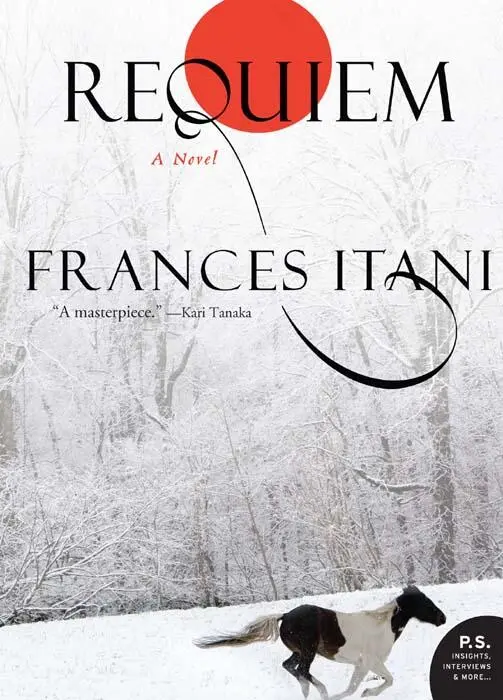
- Название:Requiem
- Автор:
- Издательство:A Phyllis Bruce Book
- Жанр:
- Год:2012
- Город:Toronto
- ISBN:978-1-44340-690-1
- Рейтинг книги:4 / 5. Голосов: 1
-
Избранное:Добавить в избранное
- Отзывы:
-
Ваша оценка:
Requiem: краткое содержание, описание и аннотация
Предлагаем к чтению аннотацию, описание, краткое содержание или предисловие (зависит от того, что написал сам автор книги «Requiem»). Если вы не нашли необходимую информацию о книге — напишите в комментариях, мы постараемся отыскать её.
delicately probes the complex adjustments we make to live with our sorrows…. [A] perfectly modulated novel.”
—
An extraordinary researcher and scholar of detail, Frances Itani—author of the best-selling novel
—excels at weaving breathtaking fiction from true-life events. In her new novel, she traces the lives, loves, and secrets in one Japanese-Canadian family during and after their internment in the 1940s.
In 1942, in retaliation for the attack on Pearl Harbor, the Canadian government removed Bin Okuma’s family from their home on British Columbia’s west coast and forced them into internment camps. They were allowed to take only the possessions they could carry, and Bin, as a young boy, was forced to watch neighbors raid his family’s home before the transport boats even undocked. One hundred miles from the “Protected Zone,” they had to form new makeshift communities without direct access to electricity, plumbing, or food—for five years.
Fifty years later, after his wife’s sudden death, Bin travels across Canada to find the biological father who has been lost to him. Both running from grief and driving straight toward it, Bin must ask himself whether he truly wants to find First Father, the man who made a fateful decision that almost destroyed his family all those years ago. With his wife’s persuasive voice in his head and the echo of their love in his heart, Bin embarks on an unforgettable journey into his past that will throw light on a dark time in history.
Requiem — читать онлайн бесплатно полную книгу (весь текст) целиком
Ниже представлен текст книги, разбитый по страницам. Система сохранения места последней прочитанной страницы, позволяет с удобством читать онлайн бесплатно книгу «Requiem», без необходимости каждый раз заново искать на чём Вы остановились. Поставьте закладку, и сможете в любой момент перейти на страницу, на которой закончили чтение.
Интервал:
Закладка:
Little Taro, however, was not so fortunate. He died not long after Auntie Aya’s bleeding stopped. He had looked so perfect when he was born, but because of the condition of the afterbirth, he did not have a chance. That is what Ba told everyone. All those months he had survived inside Auntie Aya’s womb, but when he was born he lived only seven days.
When Baby Taro died, he was dressed and wrapped in a blanket and carried to the cremation site that had been established in a small clearing surrounded by woods on the side of the mountain. The sun was sparkling; the trees around the edges of the clearing were dappled with light. I looked up and saw the wild horses grazing on the plateau above us. Auntie Aya was too weak to stand, and a chair was brought for her so that she could sit during the service. Uncle Aki stood behind her, and they wept openly.
After the cremation, after the smouldering ashes had cooled somewhat, after the mourners had returned to their shacks, Hiroshi and Keiko and I were taken back to the site by Father and Uncle Aki. Each of us was given a pair of special chopsticks, and we were told that we had to sift through the ashes to pick up any tiny bones that remained. We had to be especially vigilant for a fragment that might resemble a teardrop shape. As cousins of Baby Taro, that was our duty. Keiko was handed an empty baking powder tin, and with the chopsticks, we were to drop the pieces of bone into the tin.
I was worried that my chopsticks would slip and I would get into trouble, but Father and Uncle Aki crouched down and said that this was important and we must not let a single piece of bone fall back to earth. For our baby cousin’s journey, we must not.
Although I was very much afraid, I helped Hiroshi and Keiko pick out every tiny fragment we could find in the cooling ashes. Father and Uncle Aki stood by to ensure that nothing was dropped. The fragments in the baking powder tin were carried by Uncle Aki back to his home, where Auntie Aya awaited.
Auntie Aya was to keep the fragments of Taro’s bones for many years, until long after the war was over and there could be a proper grave in a real cemetery. But more and more, Auntie Aya was seen sitting outside on a low stool in front of her shack, even in the fall, when the days became cold and we were in school. She spoke less as people came by to see her. Uncle Aki often came to our place to visit, and I overheard him tell my parents how worried he was. At night, when my parents were in bed and thought I was sleeping, I heard Mother say that Ba had told Auntie Aya she must never become pregnant again. She was not strong enough to carry another baby inside her. Father did not comment; I never heard a reply from him when Mother was telling him what went on in Uncle Aki and Auntie Aya’s house. He listened in silence and he did not say what he was feeling.
Some days, Auntie Aya got up off her stool and stood in her doorway and called out to anyone who would listen. She called out that she could hear Baby Taro’s bones knocking against the inside of the baking powder tin. The bones were knocking against the sides, she said, because they wanted to be free.
Shortly after Baby Taro died, an old man came to live in our camp. Not old like Ba and Ji, but older than our parents. He had been hiding in Vancouver and caring for his sick wife ever since December 1941, when Pearl Harbor was bombed. After his wife died, the man wandered out onto the street and was picked up by police. No one knew how he had escaped detection for so long. The adults said that he must never have gone outside, that he must not have left the rooms he was renting in Japtown. They said he must have had help from Caucasians, his hakujin friends, to get food and supplies. They said that after his wife died, he didn’t care anymore about being seen. He went outside and was immediately detained and then sent to our camp above the Fraser. Ba and Ji told Mother and Father that he was known to the Vancouver community, and that he was an educated man who had once played the piano and knew a great deal about music. Everyone had assumed that he had been sent to a road camp somewhere in northern British Columbia and had been put to work building roads.
The old man’s shack, at the end of our row, was built with the help of Father and some of the other men. They worked quickly because they had to return to work in the gardens. The communal gardens had become large and productive, and everyone helped so that money would keep coming in from the sale of tomatoes, which were shipped to Vancouver by train.
The old man’s home was slightly smaller than everyone else’s because most of the ready building materials had already been used. With his arrival, the camp now had sixty-one shacks and a population of two hundred and seven.
Every day and evening, Hiroshi and Keiko and I saw the man outside his shack, chopping wood for kindling. When he was not chopping wood, he was tending a garden plot that he had started late. In the evenings, he went for long walks alone up to the Bench and around the hills behind the camp. Sometimes I saw Father speaking to him at the end of our row, and they had long conversations.
It was rumoured that of the many boxes that had accompanied the man when he arrived, several held books. These were unpacked and lined up on rough shelves in his shack. Some of the books contained pages of musical notes. Why, the neighbours wondered aloud, would anyone use an allotment of space for books? He could have brought bedding, or tools, or an extra bag of rice.
The old man’s name was Okuma-san, and not long after he arrived, he killed a bear. No one knew how he had done this, because no man in camp was allowed to have a gun. Father told us that Okuma-san’s name meant Great Bear, and that it was fitting he had killed such an animal.
Hiroshi and Keiko and I spoke about this among ourselves.
“He probably set a snare,” Hiroshi said, insisting that the old man must have read about snares in one of his books.
We all wondered if this was so, and if it was possible to learn how to catch a bear by reading a book. When Hiroshi asked Father about this, he said, “It is surprising, it is true, but Okuma-san is a wise person and he must have studied the habits of the bear. He knows that bear follows the same trails, over and over. He knows what bear likes to eat and where he takes his rest.”
The bear was hung with a rope around its neck in a rough and open woodshed that Okuma-san had erected behind his shack. Everyone came to see, knowing that after the carcass had hung for a few days, the meat would be shared out among the neighbours. With high summer temperatures and no refrigeration, fresh meat had to be eaten quickly before it decayed.
The day after the news of the bear went through the camp, I walked by myself to the end of the row and stared up into the cavity of the bear. Its belly was slit all the way to its groin, its organs removed, and I could see the thick lining of beige and milky-coloured fat that showed how the animal had begun to prepare for its long winter sleep. The bear’s eyes were open and its pink tongue lolled out the side of its jaw. The old man came out of his shack and asked my name, and I replied, giving my last name first. “Oda,” I said. “My first name is Bin. It’s short for Binosuke.”
Okuma-san nodded and repeated my name, and I was surprised to hear the softness in his voice. He told me that he had met my father, and that they’d had long talks. That was all he said, that and my name, and then the two of us stood in silence before the open woodshed, and despite the foul odour coming from the bear, we admired its beauty. I wanted to look through the window of Okuma-san’s shack so I could see the books that were rumoured to have pages of notes, but I was shy and I turned and went home without asking.
Читать дальшеИнтервал:
Закладка:
Похожие книги на «Requiem»
Представляем Вашему вниманию похожие книги на «Requiem» списком для выбора. Мы отобрали схожую по названию и смыслу литературу в надежде предоставить читателям больше вариантов отыскать новые, интересные, ещё непрочитанные произведения.






Обсуждение, отзывы о книге «Requiem» и просто собственные мнения читателей. Оставьте ваши комментарии, напишите, что Вы думаете о произведении, его смысле или главных героях. Укажите что конкретно понравилось, а что нет, и почему Вы так считаете.