Stewart Binns - Conquest
Здесь есть возможность читать онлайн «Stewart Binns - Conquest» весь текст электронной книги совершенно бесплатно (целиком полную версию без сокращений). В некоторых случаях можно слушать аудио, скачать через торрент в формате fb2 и присутствует краткое содержание. Город: London, Год выпуска: 2011, ISBN: 2011, Издательство: Penguin Books, Жанр: Историческая проза, на английском языке. Описание произведения, (предисловие) а так же отзывы посетителей доступны на портале библиотеки ЛибКат.
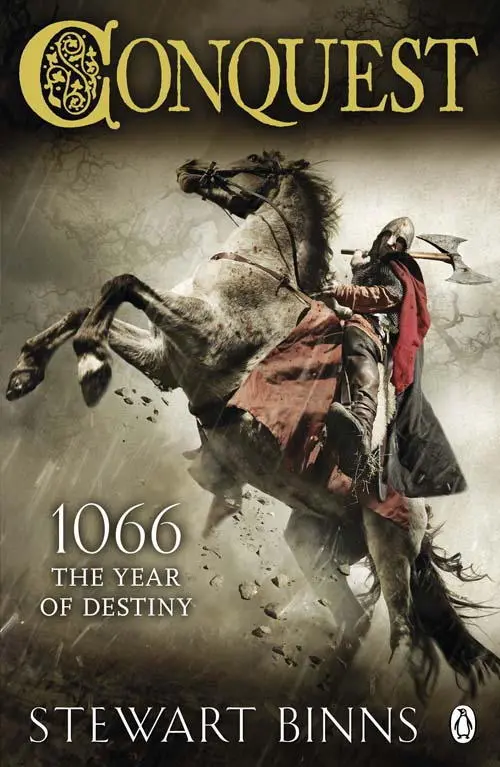
- Название:Conquest
- Автор:
- Издательство:Penguin Books
- Жанр:
- Год:2011
- Город:London
- ISBN:978-0-141-96059-3
- Рейтинг книги:5 / 5. Голосов: 1
-
Избранное:Добавить в избранное
- Отзывы:
-
Ваша оценка:
Conquest: краткое содержание, описание и аннотация
Предлагаем к чтению аннотацию, описание, краткое содержание или предисловие (зависит от того, что написал сам автор книги «Conquest»). Если вы не нашли необходимую информацию о книге — напишите в комментариях, мы постараемся отыскать её.
The battle is hard fought and bloody, the lives of thousands have been spent, including that of King Harold. But England will not be conquered easily, the Anglo-Saxons will not submit meekly to Norman rule.
Although his heroic deeds will nearly be lost to legend, one man unites the resistance. His name is Hereward of Bourne, the champion of the English. His honour, bravery and skill at arms will change the future of England. His is the legacy of the noble outlaw.
This is his story.
Conquest — читать онлайн бесплатно полную книгу (весь текст) целиком
Ниже представлен текст книги, разбитый по страницам. Система сохранения места последней прочитанной страницы, позволяет с удобством читать онлайн бесплатно книгу «Conquest», без необходимости каждый раз заново искать на чём Вы остановились. Поставьте закладку, и сможете в любой момент перейти на страницу, на которой закончили чтение.
Интервал:
Закладка:
A long silence ensued.
The King’s eyes softened and he began to look vulnerable and sad. ‘I should have you killed.’ Then he paused again and looked down. ‘The truth is, I am a king in name only; in that, you are right. As for the rest of it, we’ll talk again when I am calm. In the meantime, my stewards will issue the men with their silver. Now leave me.’
‘It would be better if you did it, sire.’
Yet again, Hereward had trusted his instincts – but he feared that he may have taken a step too far.
Macbeth resumed his pacing of the length and breadth of his hall, muttering as he did so. Each time he reached his hearth he threw another log on to the fire and peered into its flames. After several minutes of brooding, he returned to stand face-to-face with Hereward.
He adopted a more forthright demeanour. ‘I will give them their silver, thank them for their loyal service and send them home to their families.’ He turned to Earl Duncan. ‘Tell the High Steward to summon the men Hereward has dismissed. Then call my servants; I will go to the river to bathe. Tomorrow, Earl Duncan and I will join the army for training.’
Hereward had gambled that beneath Macbeth’s irascible, disheartened facade was a decent man and a good king.
Macbeth offered Hereward his hand, an honour rarely given to a man of modest birth. ‘It took great courage to speak as you did. Now make my army as strong as you are.’
The training of the army went on through 1056 and into the early months of 1057; only the deepest snows of winter brought a temporary halt.
Macbeth and Earl Duncan did exactly the same training as their men, and word spread throughout Scotland that the army had regained its pride, and that the discipline, though hard, was fair. Men started to arrive almost daily. By the beginning of March 1057, the army numbered six cohorts of highly trained men, plus seventy recent arrivals, who were still undergoing training. There was an entire cohort of cavalry, every soldier had a full complement of weapons and two of the cohorts were trained archers.
But Macbeth’s army was still relatively small. If he was to face Malcolm Canmore in a full-scale battle, he would need several hundred more men. Word arrived that Malcolm Canmore was moving north with a large force. Once again, he had the support of King Edward and the English, this time in the guise of Tostig, the new Earl of Northumbria and the brother of Harold Godwinson.
Hereward advised caution, but Macbeth was impatient to regain the throne.
After many months of peaceful preparation, Macbeth began the march south to meet his enemy.
Events began to take on a sudden momentum when messengers arrived with news that a large force of allies of Malcolm Canmore had sailed up the Firth of Cromarty and landed on the Black Isle, near Dingwall. This was in the heart of Macbeth’s homeland, where his people were largely unprotected. Canmore knew that Macbeth would have to turn back towards the north-east and fight. It was an attempt to outflank Macbeth’s army, which duly turned and began the long march northwards up the Great Glen of Mor.
They made a fine sight: the cavalry rode the flanks with small reconnaissance parties of horsemen peeling off on scouting missions; the infantry marched in closed ranks in double-time, occasionally breaking into a trot when the ground allowed it. The rhythmic din of feet and hooves and the clatter of the baggage train reverberated for miles around the peaks and troughs of the mountains.
After three days of marching, scouts returned with news of the strength of Canmore’s forces. The northern contingent included over 100 English light cavalry, almost 200 housecarls sent by Tostig, an assortment of Celtic archers, mercenaries from Ireland and several squadrons, at least 80 men, from Denmark. Canmore’s main force in the south was a large army of lowland Scots, well in excess of 1,000 men, which was moving north to rendezvous with his allies.
Macbeth knew he could not defeat both armies; his only chance was to strike at the head of the beast and confront Canmore and his main force.
He spent several hours in private, mulling over his strategy, before announcing the audacious plan to turn east, traverse the Mountains of Monadhliath and cross into the Grampians. Canmore would not believe anyone would attempt such a bold move, especially with the remnants of winter still making the mountains treacherous. The baggage train was sent the long way round and told to meet in two weeks’ time at Inverurie on the Don.
As the days passed and Hereward became familiar with the terrain, he realized how daring Macbeth’s route was. Some of the passes were lethal, with progress only possible in single file. There were steep and precarious climbs and descents and exposed crags and ridges where footholds were difficult to find. Nevertheless, late in the afternoon, after five days of hard marching unique in the history of Scottish warfare, they found Canmore’s main army making its way north towards the Howe of Alford along a small tributary of the River Dee near the settlement of Lumphanan.
Macbeth’s army appeared from the mountains, to the amazement of Canmore and his men.
Canmore’s force was stretched out over a wide area and it would take them some time to become organized. Macbeth ordered Hereward and Earl Duncan to lead his cavalry in a lightning attack. The tactic worked: the well-disciplined horsemen, riding in tight formations, inflicted heavy casualties on scattered groups of Lowlanders.
Hereward was at the vanguard, creating a maelstrom with his axe and driving large gaps in Canmore’s infantry. Macbeth looked on in wonder as Hereward’s exploits became more and more prominent. Men were drawn to him like a magnet as he drove deeper into the enemy ranks. His great axe, and the massive arc he could scythe with it, created a devastating killing ground around him.
Eventually, as nightfall approached, Macbeth signalled to his cavalry to disengage. Both armies made camp in the forests above Lumphanan, Macbeth to savour a victory in the initial skirmish, Canmore to lick his wounds.
Before first light the next morning, Hereward pleaded with Macbeth not to launch a frontal attack. He had barely 700 men and was outnumbered almost two to one, but Macbeth had rediscovered his conviction, was flushed with the success of his march through the mountains and euphoric from victory in the previous evening’s cavalry charge.
‘You have trained the army well; they are ready to fight, and so am I. No more talk! Today I will wear my crown again.’
By dawn, the two armies had formed up on either side of the narrow vale of Lumphanan. The scene was set for a formal pitched battle, but events took a surprising turn.
When Canmore surveyed his opponents, he saw a royal army that looked like a force to be reckoned with. Its march across the mountains had impressed him, and last night’s bloody nose had unnerved him. He was also conscious that the forces of his allies were a long way away.
Canmore strode out more than fifty yards into the no-man’s-land between the two armies. For several minutes, he paced up and down, peering at the ranks of Macbeth’s forces. He could see how uniform and steadfast they were; this was an army ready to fight. His own force was ill prepared, having expected to trap Macbeth much further north. He feared that his numerical superiority might not be enough to ensure victory.
He needed a new plan and, within minutes, had decided on a bold gamble for the throne of Scotland.
He sent an envoy galloping across the open ground with a message for Macbeth. It offered a personal duel – a fight to the death for the crown – in front of their armies.
It was an extraordinary move, but there were precedents for it in the traditions of conflict in northern Europe. Canmore’s reasoning was sound: he was young and virile; Macbeth was much older and the best of his fighting days were long gone.
Читать дальшеИнтервал:
Закладка:
Похожие книги на «Conquest»
Представляем Вашему вниманию похожие книги на «Conquest» списком для выбора. Мы отобрали схожую по названию и смыслу литературу в надежде предоставить читателям больше вариантов отыскать новые, интересные, ещё непрочитанные произведения.









Обсуждение, отзывы о книге «Conquest» и просто собственные мнения читателей. Оставьте ваши комментарии, напишите, что Вы думаете о произведении, его смысле или главных героях. Укажите что конкретно понравилось, а что нет, и почему Вы так считаете.