Stewart Binns - Conquest
Здесь есть возможность читать онлайн «Stewart Binns - Conquest» весь текст электронной книги совершенно бесплатно (целиком полную версию без сокращений). В некоторых случаях можно слушать аудио, скачать через торрент в формате fb2 и присутствует краткое содержание. Город: London, Год выпуска: 2011, ISBN: 2011, Издательство: Penguin Books, Жанр: Историческая проза, на английском языке. Описание произведения, (предисловие) а так же отзывы посетителей доступны на портале библиотеки ЛибКат.
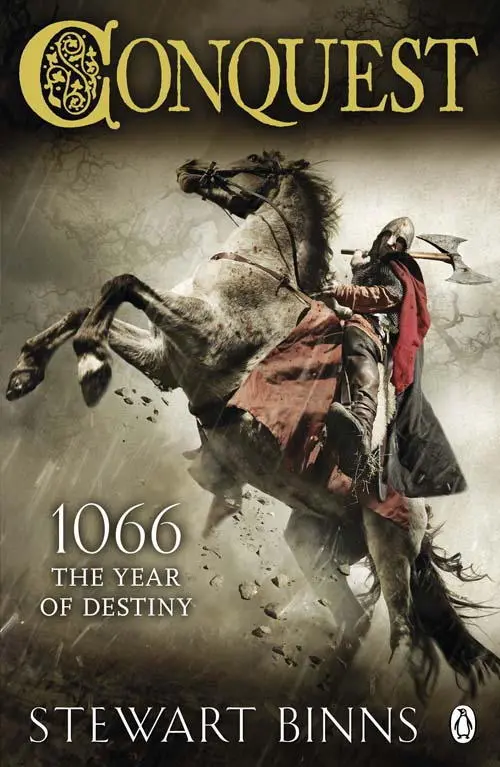
- Название:Conquest
- Автор:
- Издательство:Penguin Books
- Жанр:
- Год:2011
- Город:London
- ISBN:978-0-141-96059-3
- Рейтинг книги:5 / 5. Голосов: 1
-
Избранное:Добавить в избранное
- Отзывы:
-
Ваша оценка:
Conquest: краткое содержание, описание и аннотация
Предлагаем к чтению аннотацию, описание, краткое содержание или предисловие (зависит от того, что написал сам автор книги «Conquest»). Если вы не нашли необходимую информацию о книге — напишите в комментариях, мы постараемся отыскать её.
The battle is hard fought and bloody, the lives of thousands have been spent, including that of King Harold. But England will not be conquered easily, the Anglo-Saxons will not submit meekly to Norman rule.
Although his heroic deeds will nearly be lost to legend, one man unites the resistance. His name is Hereward of Bourne, the champion of the English. His honour, bravery and skill at arms will change the future of England. His is the legacy of the noble outlaw.
This is his story.
Conquest — читать онлайн бесплатно полную книгу (весь текст) целиком
Ниже представлен текст книги, разбитый по страницам. Система сохранения места последней прочитанной страницы, позволяет с удобством читать онлайн бесплатно книгу «Conquest», без необходимости каждый раз заново искать на чём Вы остановились. Поставьте закладку, и сможете в любой момент перейти на страницу, на которой закончили чтение.
Интервал:
Закладка:
Torfida absorbed everything she could from everyone she met: new languages and dialects; information about trade and prices; stories of pilgrimages and miracles; news about the building of new churches and castles; and confirmation that the schism between the churches of Rome and Byzantium, begun by a papal bull in 1054, had become permanent.
This last piece of news greatly saddened her: if men could not agree on God’s word, on what could they agree?
Hereward and his companions were ready to leave their temporary home in Dublin in March 1056.
Their captain on the journey to the west of Scotland was a Norseman. Captain Thorkeld’s trade was weapons – the finest a warrior could want. His home port of Göteborg, in the land of the Swedes, was a place renowned for forging the swords and axes of war. There was an ancient art to the folding and working of hot iron to make it both tensile enough to take a sharp edge and malleable enough not to break. The furnaces of Göteborg were known throughout Europe for the skill of their weaponsmiths.
Thorkeld had learned of Macbeth’s plans to raise a new army. Originally, his consignment of weapons was destined for a chieftain in Cork, whom he knew would pay well, but not as well as Macbeth. So Thorkeld had decided to turn tail and return northwards. He offered Hereward and his companions free passage to Scotland in exchange for service as men-at-arms on the treacherous journey to Macbeth’s garrison in the Scottish Highlands.
They made landfall at the head of Loch Linnhe, where they bought horses for the long journey into the mountains of the north. Thorkeld left his four sailors with his ship and set off with Hereward and his companions, accompanied by six fearsome henchmen. His cargo was very valuable and these men provided escort in exchange for a share of the profits. The cargo of weapons was carefully hidden within rolls of wool and flax and the group agreed that, if challenged, Torfida would purport to be a lady of the Earldom of Northumberland with her escort.
Hereward and Torfida had never seen a land like Scotland before. The further they travelled, the bigger the mountains became; snow still lay on the highest peaks; the streams and rivers were torrents from the melting snow of a long winter and, in the great forests of pine, the wildlife was beginning to stir again after its long hibernation.
The group finally arrived at Glenmore, a huge valley protected by the tallest of mountains. Here the locals confirmed that Macbeth was camped between two vast lochs, at the site of an ancient Roman fort dedicated to the Emperor Augustus. It was a place secure from attack, where Macbeth could be supplied from both the western and the northern seas. It took most of the next day to reach the first outpost of Macbeth’s camp. As they approached, guards stationed high in the rocks hurried towards them.
Communication with the guards was not difficult: their native language was a Celtic tongue that Martin could understand. When the Sergeant of the Guard was shown what the packhorses were carrying, he insisted that they wait for a mounted escort into the camp. When it arrived thirty minutes later, it numbered more than twenty heavily armed horsemen.
Hereward’s first impression of these men was that they were seasoned warriors but ill disciplined and dispirited. Their appearance was shabby, their weapons dull, their horses neglected. If these mounted men were from Macbeth’s elite housecarls, then the King had a dire military problem.
His initial assessment was not changed by the state of the King’s camp as they rode in. Few sentries could be seen, and men sat about idly poking their fires or snoozing on their sacks. Some looked up as the new arrivals passed by, but with a nonchalance not typical of a king’s army. Most disturbingly, a quick count by Hereward tallied no more than 400 men and perhaps 250 non-combatants; it was hardly an army to recapture a stolen crown.
As they dismounted, the King emerged from his hall. Macbeth was less than impressive: his eyes were sunken into his gaunt face; his skin was pale and lifeless; his dark-red hair and beard were lank and tangled; and he stooped as if his hulking bearskin cloak was too heavy for him. His men spoke to him in their Celtic language; he responded in English.
‘I hear you bring weapons to trade.’
Hereward spoke first. ‘My Lord King, our good friend Thorkeld will sell you his fine weapons. My companions and I have come to fight for your cause. We hear you are a rightful king and that your rival, Malcolm Canmore, has taken your throne by force of arms.’
‘Isn’t it more usual for men like you to fight for money and spoils, rather than a good cause?’
‘It is, sire. We would expect to be rewarded, of course, but our main purpose is to help your cause and to pursue our destinies, which have led us to you.’
‘Well, it is an unusual introduction. Perhaps you are a good omen.’
Torfida interrupted before Hereward could answer. To Macbeth’s astonishment, she spoke in North Gaelic, the language of the local people.
‘We are, my Lord King.’
‘Who are you?’
‘I am Torfida of Winchester, and I pursue the same destiny as these men. Hereward of Bourne is my betrothed.’ Torfida reverted to English, not wanting to stumble with her limited Gaelic. ‘He is a great warrior, as are his companions. They can help prepare your men for battle.’
Colour began to return to Macbeth’s face, but it was a flush of anger, not of ruddy good health. ‘Can they now? I think you are impudent, madam.’
‘I do not mean to be, sire. Hereward fought with Gruffydd ap Llywelyn at the Battle of Hereford and saved his life. Einar was Aelfgar of Northumbria’s Champion, and Martin Lightfoot was King Gruffydd’s swiftest messenger. They will testify to Hereward’s courage and strength. Hereward –’
Realizing that the King was losing patience, Hereward interrupted. ‘Let us work with your Captain, under his command… but, rest assured, we can help you.’
‘I will summon my Captain. He will be the judge of that. If he doesn’t take to you, he will run you out of these mountains on the point of his sword.’ The King turned and disappeared into his hall.
Hereward turned to Torfida, clearly displeased. ‘Torfida, you spoke too soon and said too much.’
‘This King needs your help; there is no time to waste on niceties.’
‘I have no experience of leading armies.’
‘Well, now’s the time to learn. Talk to Einar and Martin. They’ve been in armies; they can help us work out how we can impress the King and his Captain with our military prowess.’
Hereward interrupted forcefully. ‘When you say “we”, you mean “me”. Don’t ever speak out again on my behalf, or on behalf of Martin and Einar, without talking to us first.’
Just as Hereward had finished speaking, a tall man, accompanied by his men-at-arms, loomed behind him. His Sergeant announced him.
‘This is Duncan, Earl of Ross, Captain of the King’s hearthtroop.’
‘My Lord Earl, I am Hereward of Bourne, the outlawed son of Leofric, Thegn of Bourne.’
‘You have strong nerves to walk into this camp and presume to speak to the King.’
Einar rarely spoke but, when he did, everyone listened. ‘My Lord, he can match any man here. I am Einar, Champion to Earl Aelfgar of Northumbria, the son of the late Earl Siward.’
‘Not a good recommendation my friend, coming from the Champion of a house that colludes with our enemies.’
‘I was the Earl’s Champion, my Lord; I didn’t decide his alliances. Test Hereward in combat. He will prove his worth against any of your men.’
‘I think I’ll just kill the upstart.’
The Earl drew his sword and threw back his cloak. He was a powerful, dark-haired man who carried the scars of many years of combat. Hereward stepped back, withdrew his sword and adopted a defensive posture.
Читать дальшеИнтервал:
Закладка:
Похожие книги на «Conquest»
Представляем Вашему вниманию похожие книги на «Conquest» списком для выбора. Мы отобрали схожую по названию и смыслу литературу в надежде предоставить читателям больше вариантов отыскать новые, интересные, ещё непрочитанные произведения.










Обсуждение, отзывы о книге «Conquest» и просто собственные мнения читателей. Оставьте ваши комментарии, напишите, что Вы думаете о произведении, его смысле или главных героях. Укажите что конкретно понравилось, а что нет, и почему Вы так считаете.