Stewart Binns - Conquest
Здесь есть возможность читать онлайн «Stewart Binns - Conquest» весь текст электронной книги совершенно бесплатно (целиком полную версию без сокращений). В некоторых случаях можно слушать аудио, скачать через торрент в формате fb2 и присутствует краткое содержание. Город: London, Год выпуска: 2011, ISBN: 2011, Издательство: Penguin Books, Жанр: Историческая проза, на английском языке. Описание произведения, (предисловие) а так же отзывы посетителей доступны на портале библиотеки ЛибКат.
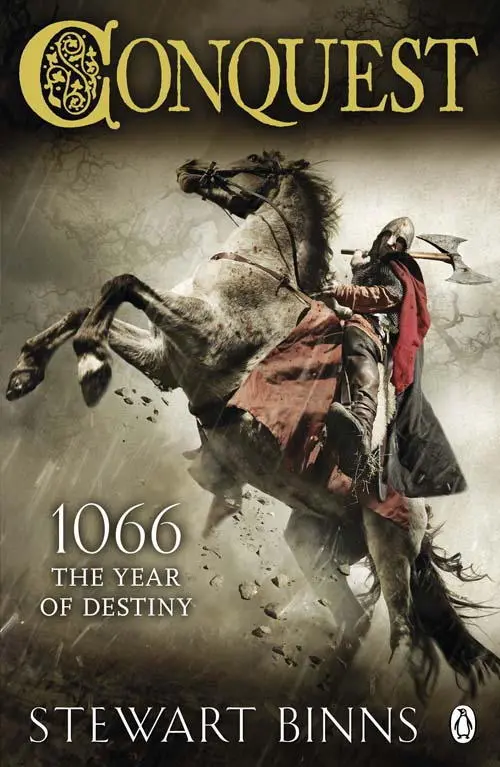
- Название:Conquest
- Автор:
- Издательство:Penguin Books
- Жанр:
- Год:2011
- Город:London
- ISBN:978-0-141-96059-3
- Рейтинг книги:5 / 5. Голосов: 1
-
Избранное:Добавить в избранное
- Отзывы:
-
Ваша оценка:
Conquest: краткое содержание, описание и аннотация
Предлагаем к чтению аннотацию, описание, краткое содержание или предисловие (зависит от того, что написал сам автор книги «Conquest»). Если вы не нашли необходимую информацию о книге — напишите в комментариях, мы постараемся отыскать её.
The battle is hard fought and bloody, the lives of thousands have been spent, including that of King Harold. But England will not be conquered easily, the Anglo-Saxons will not submit meekly to Norman rule.
Although his heroic deeds will nearly be lost to legend, one man unites the resistance. His name is Hereward of Bourne, the champion of the English. His honour, bravery and skill at arms will change the future of England. His is the legacy of the noble outlaw.
This is his story.
Conquest — читать онлайн бесплатно полную книгу (весь текст) целиком
Ниже представлен текст книги, разбитый по страницам. Система сохранения места последней прочитанной страницы, позволяет с удобством читать онлайн бесплатно книгу «Conquest», без необходимости каждый раз заново искать на чём Вы остановились. Поставьте закладку, и сможете в любой момент перейти на страницу, на которой закончили чтение.
Интервал:
Закладка:
‘Why do I have the feeling that I am going to spend the rest of my life entranced by your spell?’ With that, he slapped her horse’s hindquarters, making it gallop away.
Hereward’s heart was pounding with the joy of youthful passion. His feelings were true and pure; it was an exhilarating sensation. Twenty yards ahead of him, Torfida laughed aloud, her raven hair streaming in the wind behind her.
As Hereward and Torfida raced along the shoreline, they became distant specks to Martin and Einar. Even at a distance, the intimate playfulness of their encounter was plain to see.
After a while, Einar, a man of few words, observed, ‘I suppose we should busy ourselves and organize our passage to Ireland. It looks like young Herry is thinking of other things.’
Hereward and Torfida found a quiet cove several miles along the coast and made camp. They started a large fire and, despite the chill of autumn, took off their clothes and bathed in the sea. They dried one another by the fire, and combed each other’s hair, before preparing a meal of fresh hare and root vegetables.
After their food, they made garlands from what they could find in the pastures around them and began an ancient ritual of marriage from the days of their pagan ancestors.
With a horn of mead in their left hand, they grasped each other’s right hand and slowly circled the fire, skipping every third stride and gulping a swig of potent mead after each circuit. Gradually they increased their pace and the height of their skip, until it became a leap.
The ritual’s gentle eroticism was well crafted. Each could see every detail of the other’s body, and the simple rhythms of the dance and the warming effect of the mead aroused them both intensely.
Their lovemaking was gentle and tender at first, but became more and more passionate as time passed. For Hereward, it was a gradual reawakening after a very long abstinence and the trauma created by his wild infatuation with Gythin. For Torfida, it was all she dreamed it would be, and she warmed to it with increasing relish.
They had only two needs: wood for the fire and sustenance for their bodies.
And wanted only one thing: each other.
6. Amulet of the Ancients
Einar had been right about the extended tryst between Hereward and Torfida. They returned to St David’s at dusk on the next evening, both glowing contentedly. Martin and Einar said nothing to them, other than to impart the important news that the monks had agreed to buy their horses and that passage to Ireland had been arranged on the ship of a Breton trader. Its captain, Vulgrin of Brest, spoke little English, but had a reasonable grasp of Irish Danish, a tongue close enough to Einar’s Anglo-Norse to allow arrangements to be reasonably straightforward.
The Great Western Sea to Ireland could be treacherous, and the cold westerly winds of autumn made progress slow on the long crossing. Late into the second night on board, Hereward and Torfida found themselves alone at the prow of the ship. At the stern, with Captain Vulgrin at his side keeping a watchful eye on the skies, the helmsman held the huge tiller hard into the wind as he tacked against it. The waning moon was bright enough to throw silver flashes across the undulating water, while the few clouds that did appear dashed across the night sky. The lunar glow kept most stars at bay, but Venus shone through like a sentinel. Vulgrin was watching its position in the sky and knew where it had risen against the Pole Star, making navigation on such a night relatively easy for an experienced sailor. It was on nights when the elements closed in that seafaring became a challenging, often frightening, experience, when the precious lodestone, which by some miracle always pointed north, became essential in averting disaster.
Vulgrin’s ship sat broad and deep in the water. Like the Viking ships of legend, its elegantly sweeping boarded sides came to powerful points fore and aft in the form of mythical beasts. Its large single sail could be tilted if the wind was against, but there were also rowlocks along the timber-heads where oarsmen could lend their strength and skill in difficult conditions. With its ruby-red sail fully set and the wind behind from the south-west, it was a fine sight, prompting Hereward to imagine the terror that must have been struck into Anglo-Saxon hearts as, generations ago, the ‘dragon ships’ of his Danish ancestors suddenly appeared off England’s coast.
Hereward felt that he and his companions were safe in the hands of their confident and experienced Breton captain. He was a small but sturdy man who reminded Hereward of the Welsh, a similarity that made him think about the mix of blood on board their craft. The captain and his helmsman were both Bretons, but the four oarsmen were taller and fairer men from Caen, in the heart of neighbouring Normandy, and were typical of its Viking ancestry. Despite her dark hair and complexion, which was more a Celtic characteristic, Torfida was an Anglo-Saxon of pure blood on both her father’s and mother’s side, while Martin was a small, dark native Celt from one of the North Wales tribes. Einar was Northumbrian Danish, a true Norseman, like a Viking of legend, whose large ruddy appearance matched perfectly the image of his ancestors who had sailed through the Skagerrak generations ago to maraud the British coastline. Hereward was the only one on board who was of mixed blood; he was equally proud of both his Anglo-Saxon and Danish origins.
He remembered the stories Aidan the Priest had told him as a child of the many historic battles between the Saxons and the Danes. It struck him again how unsettled his native land had been, as its many different peoples vied for supremacy. That struggle continued. The great battle at Hereford had shown only too clearly that, under Gruffydd’s forceful leadership, the Welsh tribes were a formidable force. The Scandinavian kings in Norway and Denmark still had designs on the throne of England, which was also drifting ever closer to Normandy, a dukedom with which King Edward had strong ties.
As a boy, Hereward had assumed that life in the England he knew would always be stable and settled. Now he realized that many forces were at work; his homeland had a precarious future. As the ship sailed on, he occasionally looked back towards his native soil.
Would he ever return?
Was it his destiny to play a part in the turmoil to come?
Torfida suddenly put an end to Hereward’s introspection by handing him the Talisman. ‘You should take this now.’
‘So this is what your father talked of – the thing that made Gruffydd tremble and contemplate his future.’
‘My father told me that it has made many men question not only their future, but also their past.’
‘Is it supposed to frighten me?’
‘Does it?’
‘No.’
‘Then you have your answer.’
‘Gruffydd said it had special powers.’
‘Its power lies in what men think of it.’
Hereward examined it, slowly turning it against the light of the moon. ‘It is the face of the Devil, in what looks like amber. But how can it have the Devil’s face in it, with those little creatures? And is that a splash of blood?’
‘I don’t know. My father said that the ancients believed it to be the blood of the Saviour, spilled by him on the cross, and that it holds the Devil at bay by trapping him in the stone.’
‘But why did your father think it important for us?’
‘He believed that the Talisman was like a key to wisdom, and that only great men could understand its message.’
‘That still doesn’t explain its importance for us.’
‘The Talisman has always had a messenger. You are now the envoy; you must carry the Talisman until you find the leader who should wear it.’
Читать дальшеИнтервал:
Закладка:
Похожие книги на «Conquest»
Представляем Вашему вниманию похожие книги на «Conquest» списком для выбора. Мы отобрали схожую по названию и смыслу литературу в надежде предоставить читателям больше вариантов отыскать новые, интересные, ещё непрочитанные произведения.










Обсуждение, отзывы о книге «Conquest» и просто собственные мнения читателей. Оставьте ваши комментарии, напишите, что Вы думаете о произведении, его смысле или главных героях. Укажите что конкретно понравилось, а что нет, и почему Вы так считаете.