Stewart Binns - Conquest
Здесь есть возможность читать онлайн «Stewart Binns - Conquest» весь текст электронной книги совершенно бесплатно (целиком полную версию без сокращений). В некоторых случаях можно слушать аудио, скачать через торрент в формате fb2 и присутствует краткое содержание. Город: London, Год выпуска: 2011, ISBN: 2011, Издательство: Penguin Books, Жанр: Историческая проза, на английском языке. Описание произведения, (предисловие) а так же отзывы посетителей доступны на портале библиотеки ЛибКат.
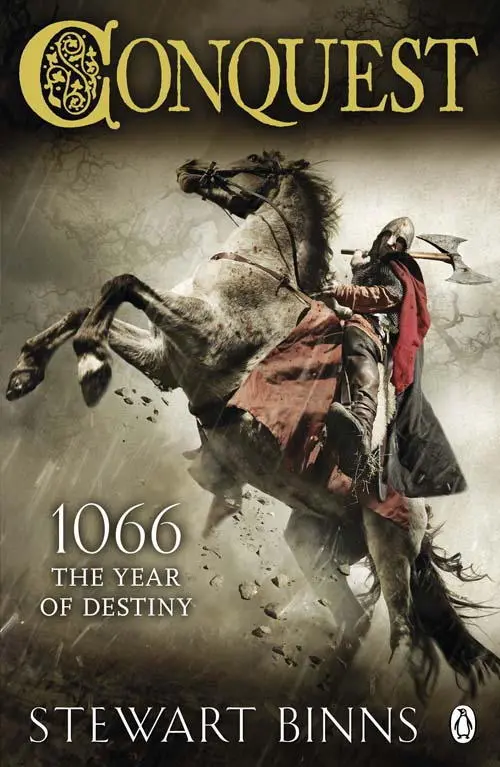
- Название:Conquest
- Автор:
- Издательство:Penguin Books
- Жанр:
- Год:2011
- Город:London
- ISBN:978-0-141-96059-3
- Рейтинг книги:5 / 5. Голосов: 1
-
Избранное:Добавить в избранное
- Отзывы:
-
Ваша оценка:
Conquest: краткое содержание, описание и аннотация
Предлагаем к чтению аннотацию, описание, краткое содержание или предисловие (зависит от того, что написал сам автор книги «Conquest»). Если вы не нашли необходимую информацию о книге — напишите в комментариях, мы постараемся отыскать её.
The battle is hard fought and bloody, the lives of thousands have been spent, including that of King Harold. But England will not be conquered easily, the Anglo-Saxons will not submit meekly to Norman rule.
Although his heroic deeds will nearly be lost to legend, one man unites the resistance. His name is Hereward of Bourne, the champion of the English. His honour, bravery and skill at arms will change the future of England. His is the legacy of the noble outlaw.
This is his story.
Conquest — читать онлайн бесплатно полную книгу (весь текст) целиком
Ниже представлен текст книги, разбитый по страницам. Система сохранения места последней прочитанной страницы, позволяет с удобством читать онлайн бесплатно книгу «Conquest», без необходимости каждый раз заново искать на чём Вы остановились. Поставьте закладку, и сможете в любой момент перейти на страницу, на которой закончили чтение.
Интервал:
Закладка:
Hoots of laughter echoed around the gathering as Hereward hit the ground, dazed and in great pain. In an instant, the big man’s sword was drawn, ready to strike a mortal blow, but Hereward grabbed a fistful of earth and threw it into his adversary’s eyes. This bought him a vital moment to jump into a crouching position and propel himself into his foe’s stomach, knocking him to the ground. Maddened by the pain of a broken nose, Hereward kicked the fallen man several times, winding him badly, before jumping on his sword hand with one foot while kicking him in the face with the other. Einar rolled away, spitting blood through his smashed teeth, but in doing so left his sword behind. Seizing it, Hereward was able to parry the first blow from Einar’s battle-axe.
As it was now obvious that Hereward had decided to fight, the King beckoned to one of his hearthtroop to throw the Englishman a shield. A ferocious duel ensued with neither man giving ground. Every blow was blocked, every thrust parried, until Hereward’s youth and strength began to tell and Einar tired. Hereward was able to grab the shaft of Einar’s axe and use it to turn him into a headlock which immobilized the big man.
As soon as the fight had gone out of the giant redhead, Hereward released him and stepped away, declining the custom to despatch his beaten opponent.
‘My Lord King, I have killed too many men in my life already; I have no desire to kill another.’
‘Agreed. You have made your point well. Tomorrow you ride with me.’
Martin began to lead Hereward away, but not before Einar offered him his hand. He had never been bested in a contest before and was full of admiration for the young Englishman.
The two men embraced as a murmur of appreciation rippled around the assembly of warriors; none had ever seen a stranger so quickly win over a crowd, or so readily gain the respect of a king.
5. Battle of Hereford
Hereward shivered with emotion as he watched four huge columns of heavily armed infantry, each led by a cohort of cavalry, weave their way through the forest. His pulse raced with excitement, but he was also troubled that this army of Celts, Danes and Norsemen, allied with treacherous Northumbrians, was about to attack his homeland.
Despite the fact that his own people had outlawed him, he felt guilty that he was experiencing the primordial thrill of impending battle.
He looked around at his companions, who were grim-faced and determined. It excited Hereward to be with seasoned warriors like Einar, men to stand with in a fight, men with whom it would be an honour to die.
He had spent several weeks with Gruffydd’s Welsh army, enduring their training regimes and helping them replenish their supplies of weapons, food and horses for a new wave of military campaigns. It was late October 1055 and over the long weeks of preparation he had decided that, if it came to a battle with King Edward’s army, he would fight. It had been a difficult decision, but he was now riding with Celts and Norsemen; he was wearing their armour and carrying their weapons.
He looked at Martin and Einar, riding at his side, and acknowledged them with a nod of respect. Hereward knew that in moments like these, lives change for ever.
The Welsh had prepared for months to attack Hereford, one of England’s most strategically important burghs. Ralph, Earl of Hereford, was the Norman nephew of King Edward, who had made him Warden of the Welsh Marches. He had brought many Norman knights, clerics and administrators to his earldom, much to the consternation of the locals.
As Gruffydd’s columns made open ground in a wide valley, some two miles west of Hereford, Ralph’s cavalry were skulking on the wooded hillsides. The Earl had determined that Gruffydd’s combined force of Welsh, Northumbrians and Irish-Norse was an ill-disciplined rabble, weakened by mercenaries of dubious loyalty. Also, because many of the Celts were on foot, he thought it would be vulnerable to a swift and decisive cavalry attack. His horsemen broke cover and bore down on the invaders. The Earl’s thegns carried the red and yellow banners of his lands in Worcestershire, Herefordshire and Gloucestershire, but most of his senior commanders were Normans, recognizable by their full-length mail coats and heavy continental horses.
At first their attack, with the advantage of surprise and higher ground, looked like it might be decisive as there was little more than 200 yards between the leading horses of the Earl’s cavalry and Gruffydd’s infantry. But Ralph’s strategy was naïve. The Welsh army and its allies were elite warriors who had fought many battles during years of campaigning. Within moments of the surprise attack, Gruffydd’s hearthtroop began to circle to protect him, while the body of his force re-formed to charge the oncoming cavalry. Supported by the Northumbrians on their right and the Irish on their left, they surged forwards in a V-shaped formation towards the heart of Ralph’s phalanx of horses.
The Earl’s cavalry had not expected such a bold response. They were in loose formation, expecting easy pickings among infantry exposed on open ground, but Gruffydd’s column was tightly packed, rigidly disciplined and had gained significant momentum. As the two armies collided, the carnage began in the front ranks: men screamed, trying to inflict blows or avoid them; horses reared, struggling to free themselves.
Gruffydd’s infantry held its shape. The lances and shields of its front ranks, reinforced by its collective discipline, formed a solid, surging wall that was far too strong for the Earl’s cavalry. The horses behind the first wave of the attack streamed down the sides of the solid phalanx of foot soldiers and made easy targets for the spirited infantrymen of Wales, wielding swords and battle-axes. Many riders turned and fled but a small group, perhaps no more than thirty, were more determined. From their distinctive shield designs and the human skulls tied to their saddles, Hereward guessed they were Welsh chieftains, defeated by Gruffydd, who had thrown in their lot with the Earl of Hereford. Despite the catastrophe of Ralph’s reckless attack, this small group fought on, moving ever closer to Gruffydd’s position.
Although they were small in number, the ferocity of their onslaught soon saw them engaging the King’s hearthtroop. Their leader, distinguished by a magnificent bronze helmet with a boar’s head crest, suddenly burst through the line of defending guards and made open ground within a few yards of the King. Several of his followers poured through the gap and, in a blind fury of revenge, began cutting down Gruffydd’s housecarls in swathes. Hereward was only a few feet from the King and, supported by Einar and Martin, moved forward to protect the royal cordon. The three men put themselves between the King and his assailants and unleashed a fury of blows that cut down several of the attackers.
Hereward was at the forefront, tall in his saddle and using his axe to murderous effect. He moved purposefully towards the boars’ head chieftain and made eye contact with him. They clashed immediately, with Hereward ducking under a huge swing of the Welshman’s axe. It gave Hereward the split second he needed as he thrust his lance deep into his opponent’s ribcage, somersaulting him over the rear of his horse. He then turned to the back of the melee, grabbed Gruffydd’s reins and pulled his mount around.
As he did so, he shouted at the King’s housecarls: ‘Hold your ground, protect the King!’
He pulled the King’s steed away from the assault, and shouted again: ‘Make way for the King! Make way for the King.’
The wall of royal hearthtroops parted and Hereward escorted Gruffydd over to Earl Aelfgar’s cavalry, which had been holding firm in reserve.
Читать дальшеИнтервал:
Закладка:
Похожие книги на «Conquest»
Представляем Вашему вниманию похожие книги на «Conquest» списком для выбора. Мы отобрали схожую по названию и смыслу литературу в надежде предоставить читателям больше вариантов отыскать новые, интересные, ещё непрочитанные произведения.








Обсуждение, отзывы о книге «Conquest» и просто собственные мнения читателей. Оставьте ваши комментарии, напишите, что Вы думаете о произведении, его смысле или главных героях. Укажите что конкретно понравилось, а что нет, и почему Вы так считаете.