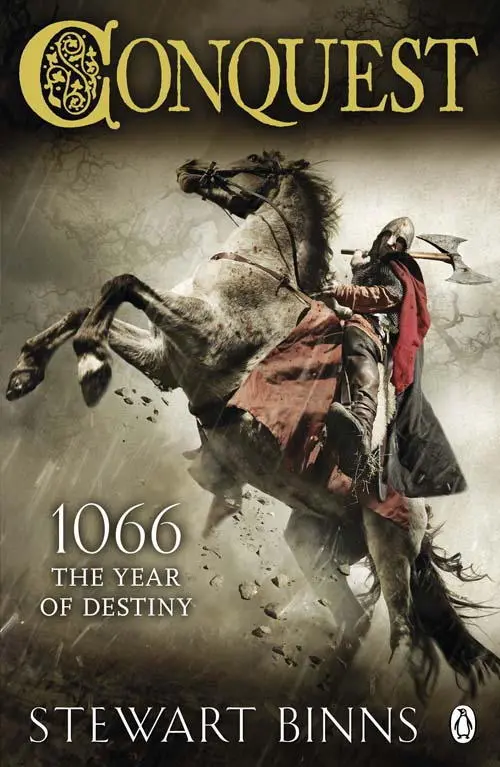
Stewart Binns - Conquest
Здесь есть возможность читать онлайн «Stewart Binns - Conquest» весь текст электронной книги совершенно бесплатно (целиком полную версию без сокращений). В некоторых случаях можно слушать аудио, скачать через торрент в формате fb2 и присутствует краткое содержание. Город: London, Год выпуска: 2011, ISBN: 2011, Издательство: Penguin Books, Жанр: Историческая проза, на английском языке. Описание произведения, (предисловие) а так же отзывы посетителей доступны на портале библиотеки ЛибКат.
- Название:Conquest
- Автор:
- Издательство:Penguin Books
- Жанр:
- Год:2011
- Город:London
- ISBN:978-0-141-96059-3
- Рейтинг книги:5 / 5. Голосов: 1
-
Избранное:Добавить в избранное
- Отзывы:
-
Ваша оценка:
Conquest: краткое содержание, описание и аннотация
Предлагаем к чтению аннотацию, описание, краткое содержание или предисловие (зависит от того, что написал сам автор книги «Conquest»). Если вы не нашли необходимую информацию о книге — напишите в комментариях, мы постараемся отыскать её.
The battle is hard fought and bloody, the lives of thousands have been spent, including that of King Harold. But England will not be conquered easily, the Anglo-Saxons will not submit meekly to Norman rule.
Although his heroic deeds will nearly be lost to legend, one man unites the resistance. His name is Hereward of Bourne, the champion of the English. His honour, bravery and skill at arms will change the future of England. His is the legacy of the noble outlaw.
This is his story.
Conquest — читать онлайн бесплатно полную книгу (весь текст) целиком
Ниже представлен текст книги, разбитый по страницам. Система сохранения места последней прочитанной страницы, позволяет с удобством читать онлайн бесплатно книгу «Conquest», без необходимости каждый раз заново искать на чём Вы остановились. Поставьте закладку, и сможете в любой момент перейти на страницу, на которой закончили чтение.
Интервал:
Закладка:
‘How do you know all this?’
‘When I was young, my father told me that I was destined to meet the man who would be the messenger of the Talisman and that he would stand at the right hand of kings, be their chosen warrior and lead their armies in battle. The Talisman would become a symbol of trust between the messenger and his lord, a private bond of companionship. You are that man. I know this as my father did; that’s why he sent you to me. He told me that I would need to guide the messenger, that we would complement one another and that together we would succeed in fulfilling our destinies. I understand that now. You know my strengths and my weaknesses, and I know yours. My love for you grows every day. I will be at your side for ever – in spirit, if not in flesh.’
‘Your father has been right about everything so far. I would be foolish to doubt him, but all I want for us at the moment is a settled and peaceful life in Ireland.’
‘A peaceful life is not your destiny. You will become a great warrior; everyone can see it in you. A peaceful life is not my destiny either. I am the guide to a man whose strength and skill will allow us to carry the Talisman to a leader who is worthy of it.’
‘Did your father know where the Talisman came from and why he was entrusted with it?’
‘It was given to him by Queen Emma, the mother of King Edward. Even during his long years in the forest, the Queen found ways of getting messages to him. Early one morning, when I was eleven years old, we heard a mounted housecarl from her private retinue in the distance. He had been sent to summon my father to Queen Emma’s deathbed at the monastery of Glastonbury. That’s when she gave him the Talisman. She said that England would soon face a great turning point in its history, when men would fight for the kingdom. Although a Norman herself, she loved her adopted home and its mixed blood and hoped the future king, whoever he might be, would rule England with wisdom and kindness and be a worthy bearer of the ancient Talisman.
‘She said that it had been passed to her by her father, Richard I, Duke of Normandy, who had inherited it from her grandfather, William Longsword, and her great-grandfather, Rolf, the first Viking Duke of Normandy. Before that, its pedigree was illustrious. The story among the Norman aristocracy claims that it had been passed through the old Frankish kings and that it had even been worn by the great Emperor Charlemagne. Legend says that Charlemagne had been given it when he married Theodora, the daughter of Desiderio, King of Lombardy, whose family claimed descent from the emperors of Rome.’
‘And now it’s in our lowly hands on a ship bound for the edge of the world!’
‘Let me finish, Hereward. Queen Emma married two kings of England and was mother to two more, but she either decided that her husbands and sons were not worthy of the Talisman, or perhaps they refused it, so she asked my father, the only man she could trust, to find a way for it to continue its journey to its rightful inheritor. She believed in its power and that it was important for the future of the realm. My father promised to try but said that he preferred the contemplative life of the forest to a search for wisdom among future kings. “Then it must be Torfida’s task,” was her response. “If she is as beautiful as her mother was and as wise as her father, she will be worthy. Trust in the Talisman; it will find a way.” They were her final words to him.’
Hereward thought about what Torfida had said and what it might mean for their future.
He held the Talisman at arm’s length. ‘Given its illustrious history, I suppose we should take great care of it.’ Then he placed it around his neck, tucked it into his smock and turned to look out to sea. ‘One more thing, Torfida. Your father talked about the Wodewose, and not just as a figment of the imagination of our ancestors, or a myth told by the fire on long winter nights. Your father seemed certain that he was real.’
‘My father often thought about the mysteries that exist between the real world of today and the world of our memories and our imagination. As he got older, he talked more and more about the land, the forests and the traditions of our ancestors. He knew a lot about the religion of the Celtic Druids; I think he had great respect for their ways. He saw Wodewose as a symbol – like our Talisman – something to remind us of things we might otherwise forget.’
‘I think I am beginning to understand.’
Torfida looked at him contentedly; their great journey together had begun.
By the middle of the next day, the Irish coast was in sight and, by holding tight to the shoreline, the long traverse northwards to the port of Dublin was soon at an end.
As they tied up on the newly extended wooden quay, they were struck by the bustle of life there. They lost count of the number of ships loading and unloading their wares. Cases of pottery were being carried into warehouses by men as dark in complexion as they had ever seen. Rolls of linen and woollen garments were being piled into the bowels of waiting ships, and a large group of armed men appeared to be embarking on a military campaign. Einar and Martin were well travelled and had witnessed the life of a major city before, but for Hereward and Torfida this was an experience they had only heard about from others. They both stared in wonder as new sights, sounds and smells assailed them from every direction.
Dublin was a well organized city, governed by Irish chieftains under Danish laws and customs. It was a trading settlement, run under firm military rules, and offered few opportunities for permanent work, except as part of the local garrison, for whom the only excitement was settling local quarrels or quelling drunken brawls.
There were better opportunities in the Irish interior, which was not under Danish control, and where rival chieftains fought for supremacy. Here it would be relatively easy for the three men to find work as a chieftain’s men-at-arms.
However, recent events in a land far to the north presented a more appealing prospect.
The year before the great battle of Hereford between the English and the Welsh, civil war had broken out in Scotland. With the enthusiastic support of the English Earl Siward of Northumbria, the Scottish king of many years, the proud and much-respected Macbeth, had been usurped by his rival, Malcolm Canmore. A great battle had taken place on the plains of Gowrie, west of Dundee, where Macbeth had been heavily defeated in battle. He had fled to the wild and desolate north, from where he was now looking for good men to rebuild his army. Macbeth’s cause seemed to be a just one: kings who were respected by their people were a rare breed and worthy of help.
The quartet discussed their options and agreed to spend the winter of 1055 in Dublin and to set sail for Scotland in the spring of 1056. Torfida found employment as a tutor to the children of a wealthy local merchant and the men joined the militia of a Gaelic trader who made frequent visits to Cork to collect wool and linen.
The time passed quickly as the prospect of an adventure in a new land grew closer. The men practised their fighting skills every day in a gruelling series of drills and exercises, while Torfida’s charm and personality endeared her to the wealthy of Dublin and prompted many conversations with visitors to her employer’s home, one of the finest in Dublin. Guests came from many lands, and with news of turmoil throughout Europe. Henry of France had invaded Normandy, but had been defeated by the formidable Duke William. The Viking King of the Rus, Jaroslav I, had died early in 1055 and his lands, stretching from the Baltic to the Black Sea, had been split between his five sons. The predictable civil war had soon followed.
Читать дальшеИнтервал:
Закладка:
Похожие книги на «Conquest»
Представляем Вашему вниманию похожие книги на «Conquest» списком для выбора. Мы отобрали схожую по названию и смыслу литературу в надежде предоставить читателям больше вариантов отыскать новые, интересные, ещё непрочитанные произведения.








Обсуждение, отзывы о книге «Conquest» и просто собственные мнения читателей. Оставьте ваши комментарии, напишите, что Вы думаете о произведении, его смысле или главных героях. Укажите что конкретно понравилось, а что нет, и почему Вы так считаете.