Stewart Binns - Conquest
Здесь есть возможность читать онлайн «Stewart Binns - Conquest» весь текст электронной книги совершенно бесплатно (целиком полную версию без сокращений). В некоторых случаях можно слушать аудио, скачать через торрент в формате fb2 и присутствует краткое содержание. Город: London, Год выпуска: 2011, ISBN: 2011, Издательство: Penguin Books, Жанр: Историческая проза, на английском языке. Описание произведения, (предисловие) а так же отзывы посетителей доступны на портале библиотеки ЛибКат.
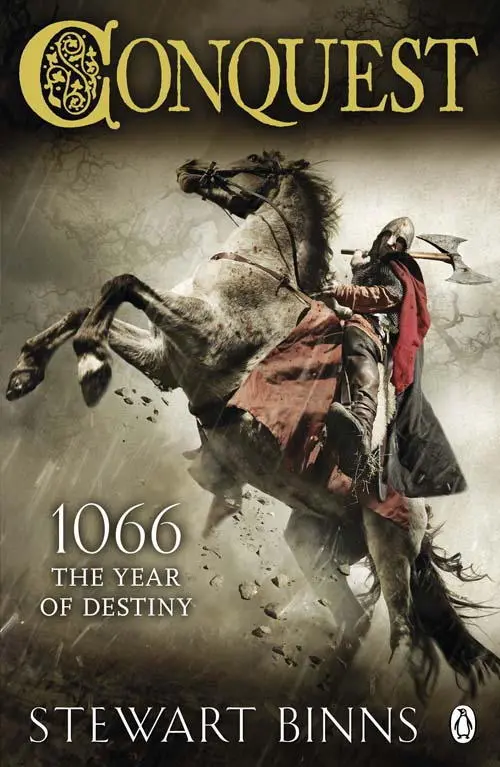
- Название:Conquest
- Автор:
- Издательство:Penguin Books
- Жанр:
- Год:2011
- Город:London
- ISBN:978-0-141-96059-3
- Рейтинг книги:5 / 5. Голосов: 1
-
Избранное:Добавить в избранное
- Отзывы:
-
Ваша оценка:
Conquest: краткое содержание, описание и аннотация
Предлагаем к чтению аннотацию, описание, краткое содержание или предисловие (зависит от того, что написал сам автор книги «Conquest»). Если вы не нашли необходимую информацию о книге — напишите в комментариях, мы постараемся отыскать её.
The battle is hard fought and bloody, the lives of thousands have been spent, including that of King Harold. But England will not be conquered easily, the Anglo-Saxons will not submit meekly to Norman rule.
Although his heroic deeds will nearly be lost to legend, one man unites the resistance. His name is Hereward of Bourne, the champion of the English. His honour, bravery and skill at arms will change the future of England. His is the legacy of the noble outlaw.
This is his story.
Conquest — читать онлайн бесплатно полную книгу (весь текст) целиком
Ниже представлен текст книги, разбитый по страницам. Система сохранения места последней прочитанной страницы, позволяет с удобством читать онлайн бесплатно книгу «Conquest», без необходимости каждый раз заново искать на чём Вы остановились. Поставьте закладку, и сможете в любой момент перейти на страницу, на которой закончили чтение.
Интервал:
Закладка:
Rapid movement and the precise coordination of sword and shield were the keys to survival in an uneven contest of this sort. Although Hereward was a man equal in size to his opponents, he was much younger and quicker on his feet.
In a contest that did not take long, what followed brought gasps of admiration from the army.
Hereward’s four opponents tried to encircle him, but he always moved to a point where he could see at least three and catch any thrust from the fourth in the corner of his eye. They attacked in unison to reduce Hereward’s freedom of movement, but he kept moving and parried his way between them. He was soon able to grab the crazed-looking one and put him in an arm lock against his elbow joint to persuade him to release his sword. He then let him go and struck him hard with the edge of his shield, knocking the sense out of him.
Three to one was much easier to deal with, as they found it much more difficult to encircle him. A slash to the thigh of one, and a heavy blow from Hereward’s shield to the head of another, brought the contest to an abrupt end. In between, he had playfully tripped them, tapped them on their backsides and ducked away from all their blows. None of the four men had been able to put a scratch on the young Englishman.
Donald of Moray fell to his knees, exhausted. He took some large gulps of air, then slowly regained his feet.
‘You are a fine swordsman; I salute you. You have earned our respect… sir.’
The army cheered. They had enjoyed a dazzling exhibition of swordplay.
Earl Duncan stepped forward. ‘Well, young man, it appears you have won the respect of the men; they seem to like you. Do you have anything else to say to them?’
Hereward bowed to Duncan. ‘My Lord Earl, with your permission…’ He then turned to address the army. ‘Men, go back to your tents and make ready! There will be a full inspection in one hour; every man to be in battle order.’
Earl Duncan was stony faced. ‘Very well, we will see how the men respond.’ His expression remained severe for a few moments, but then softened. ‘You have my authority to take in hand the preparation of the army. I will need a daily report.’
‘Thank you, my Lord.’
On Hereward’s signal, Einar took over.
‘Move! You heard what he said. Move!’
On time and in good order, the army assembled once more. They already had a more purposeful air about them: faces had been swilled, beards trimmed and knots dragged from hair. Weapons had been cleaned, as had mail and leather coats, and mud had been shaken from wolfskins and woollen cloaks.
Hereward stepped forward once more. ‘I have pledged my loyalty to your lord, Macbeth of Moray, King of all Scotland, Lord of the Isles. Does any man here not do the same?’
There was silence.
‘As I inspect your ranks, any man temporarily unfit will be excused training until he is fit for duty; any man no longer able to fight will be sent home to his family with a piece of the King’s silver in his pouch; the rest will work hard every day. You will long for battle as a welcome relief from the hard work of training, but no man will do more than I do. I will do everything I ask of you and more. We will eat together twice a day – first, two hours after sunrise, then again at dusk. There will be no personal cooking pots and no private expeditions for game. I will organize hunting parties and the King’s stewards will organize the food for all of us. There will be two hours of training at dawn, before food, and then rest. We will resume at midday and finish one hour before dusk. Everyone will use that hour to wash and prepare for food; I will have no filthy warriors at our tables.’
He paused and looked along the ranks. ‘In an army worth fighting for, every man has the right to speak his mind. Does any man here have a question, or anything to say?’
‘Who is the pretty English lassie, sir? They say she’s bewitched you and the King.’
A chorus of laughter erupted from the men. The voice was impossible to identify, hidden deep in the ranks.
Hereward replied with a grin. ‘I cannot speak for the King, but she has certainly bewitched me; we are to be married.’
A peal of cheers rang out.
‘We want to be married in Scone, by the Bishop, with the good Macbeth sitting on the Stone of Kings, in his rightful place!’
Another, louder clangour swept over the glen as the men waved their battle-axes and swords in a gesture of approval. They had first taken to Hereward, not only because of his display with a sword, but also because he treated them with openness and honesty.
For the rest of the morning he brought each rank forward and inspected every man in turn. There were many fine warriors in the army, and Hereward chose almost sixty whom he decided would become the King’s new hearthtroop. He intended to take personal control of it, reorganize it and train it as befitted an elite corps.
At the end of the long inspection, during which Hereward had allowed the men to sit, he spoke to them once more. As he turned to face them, they all jumped up as one and the ground shook. Armour and weapons clanked and clattered, creating echoes down the glen. Hereward felt a shiver down his spine.
Torfida, watching from a perch above the glen, glowed with pride. She saw Hereward, a 22-year-old former outlaw, striding around in front of his new army.
‘There will be only three parts to your training: speed, with Martin Lightfoot, the swiftest man I have ever seen; strength, which Einar will lead, the strongest man in the armies of the North of England; and skill, which I will oversee personally. We start tomorrow at dawn. The men I spoke to about the King’s hearthtroop, I will see you in two hours. Hail, Macbeth! Hail, the King!’
The men echoed Hereward’s clarion call for several minutes.
Afterwards, Donald of Moray spoke to Hereward. ‘No one has ever addressed them like that before, the men respect you and so do I… sir.’
Hereward shook the Celt firmly by the hand, grateful for his words of support.
He spent the rest of the afternoon talking to his selected band of men for the new hearthtroop. Hereward surprised himself: he was not sure how or why, but he seemed to have an instinctive grasp of military techniques and disciplines.
He was in his element, and he knew this would be his calling for the rest of his life.
When Hereward arrived at the High Steward’s tent just before dusk, he was met by Earl Duncan, who told him that the King demanded his presence in his Great Hall. When they arrived, Macbeth was pacing up and down.
‘I hear you intend to give away my silver?’
‘Yes, sire.’
‘Not even Earl Duncan gives away my money without my permission.’
‘Sire, you must allow me to make decisions about military matters.’
‘I must! I must! I must not do anything of the sort! Don’t you dare tell me what I must do!’
‘Sire, I earned the right to perform this role for your army.’
Macbeth rose, puce with anger. ‘By God, I will strike you down myself!’
‘That decision needed to be taken today. I couldn’t send those men home with nothing in their pouches. They have no spoils of victory; they will be destitute.’
‘Let them starve!’ the King bellowed.
‘My Lord King, your army will not serve you if they know that is what you think of them.’
‘They will serve me, whether they like it or not!’
‘Sire, I had heard that you were a wise and good king. Those are not the words of such a king.’
Macbeth jumped up and made towards Hereward with rage in his eyes.
Earl Duncan stepped between them. ‘Kneel before the King, Hereward of Bourne. Beg his forgiveness!’
‘I will not!’
In the few dreadful moments that followed, Hereward’s future – indeed, his life and the lives of his companions – hung by a thread. He thought about the Talisman around his neck. Was it speaking through him, giving him the courage to defy a king? Macbeth glowered at him, poised with his hand grasping his sword, until his fury slowly subsided.
Читать дальшеИнтервал:
Закладка:
Похожие книги на «Conquest»
Представляем Вашему вниманию похожие книги на «Conquest» списком для выбора. Мы отобрали схожую по названию и смыслу литературу в надежде предоставить читателям больше вариантов отыскать новые, интересные, ещё непрочитанные произведения.









Обсуждение, отзывы о книге «Conquest» и просто собственные мнения читателей. Оставьте ваши комментарии, напишите, что Вы думаете о произведении, его смысле или главных героях. Укажите что конкретно понравилось, а что нет, и почему Вы так считаете.