Stewart Binns - Conquest
Здесь есть возможность читать онлайн «Stewart Binns - Conquest» весь текст электронной книги совершенно бесплатно (целиком полную версию без сокращений). В некоторых случаях можно слушать аудио, скачать через торрент в формате fb2 и присутствует краткое содержание. Город: London, Год выпуска: 2011, ISBN: 2011, Издательство: Penguin Books, Жанр: Историческая проза, на английском языке. Описание произведения, (предисловие) а так же отзывы посетителей доступны на портале библиотеки ЛибКат.
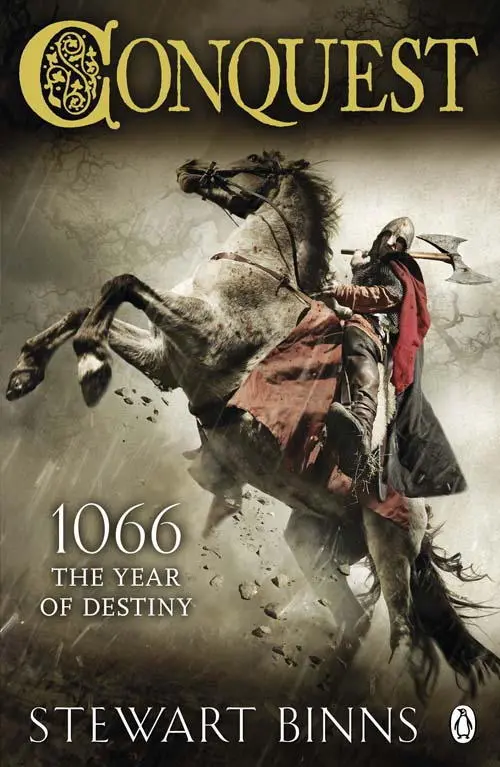
- Название:Conquest
- Автор:
- Издательство:Penguin Books
- Жанр:
- Год:2011
- Город:London
- ISBN:978-0-141-96059-3
- Рейтинг книги:5 / 5. Голосов: 1
-
Избранное:Добавить в избранное
- Отзывы:
-
Ваша оценка:
Conquest: краткое содержание, описание и аннотация
Предлагаем к чтению аннотацию, описание, краткое содержание или предисловие (зависит от того, что написал сам автор книги «Conquest»). Если вы не нашли необходимую информацию о книге — напишите в комментариях, мы постараемся отыскать её.
The battle is hard fought and bloody, the lives of thousands have been spent, including that of King Harold. But England will not be conquered easily, the Anglo-Saxons will not submit meekly to Norman rule.
Although his heroic deeds will nearly be lost to legend, one man unites the resistance. His name is Hereward of Bourne, the champion of the English. His honour, bravery and skill at arms will change the future of England. His is the legacy of the noble outlaw.
This is his story.
Conquest — читать онлайн бесплатно полную книгу (весь текст) целиком
Ниже представлен текст книги, разбитый по страницам. Система сохранения места последней прочитанной страницы, позволяет с удобством читать онлайн бесплатно книгу «Conquest», без необходимости каждый раз заново искать на чём Вы остановились. Поставьте закладку, и сможете в любой момент перейти на страницу, на которой закончили чтение.
Интервал:
Закладка:
The odds were heavily in Canmore’s favour.
Macbeth thought long and hard about the challenge and turned to Hereward for advice.
He was forthright. ‘Sire, let us stand our ground here. It will be many days before Duncan’s army of cut-throats arrives from the north. We’ve grasped the initiative; that’s why Canmore has issued the challenge.’
‘But I have a chance to resolve this here and now. It is my throne; I can win it back myself and prevent more bloodshed. Remember, I need to keep my army intact. King Edward has greedy eyes for Scotland and has been plotting my downfall for years. If too many Scots kill one another here at Lumphanan, who will stop Harold Godwinson’s housecarls when Edward orders them to cross our borders?’
The King had made up his mind. He rode along the ranks of his men as word of the challenge filtered through to them.
At first, there was silence, then a cry went up: ‘Hail, Macbeth, King of the Scots.’
A retort soon came from the opposing army standing 500 yards away: ‘Hail, King Malcolm.’
As the competing chants echoed around the glens, Macbeth turned to the messenger. ‘Tell Malcolm Canmore that I accept his challenge for the Throne of Scone. All weapons, treasure and the loyalty of their men go to the victor to unite Scotland under a strong king. We will meet in fifteen minutes.’
Macbeth chose Earl Duncan and Hereward as his seconds, while Canmore chose two Lowland earls from the English borders.
Macbeth was almost forty years of age; Canmore was fifteen years his junior and a much more powerful man.
The preparations for the contest were meticulous. Tridents were placed in the open ground, midway between the armies, to receive the combatants’ cloaks and weapons. The duel would begin with swords and shields, but axes and spears were placed in the tridents and could be used at any time.
When everything was ready, the two men faced each other.
As the seconds retreated, Hereward placed the Talisman around Macbeth’s neck.
‘What is this?’
‘It is an amulet of kings from many generations and many lands. It is said that it has been worn since the days of Rome. You should wear it as the true king.’
Macbeth looked at it. ‘Not the most attractive of charms!’
‘No, but a very powerful one.’
‘Thank you, Hereward, for all you have done for my army… and for me.’
Earl Duncan spoke the final words before stepping away. ‘For Scotland, my Lord King, for the Throne of Scone.’
Canmore and Macbeth eyed one another warily.
Macbeth spoke first. ‘For the throne of Scotland, Malcolm Canmore.’
‘For the throne of Scotland, Macbeth of Moray.’
A long and gruelling struggle followed.
Canmore began impetuously, and Macbeth was able to parry his attacks with ease. After a while, some blows began to land on both men, but their mail coats prevented deep wounds. There was a passage when each held the other’s sword arm and cuts and bruises were inflicted in a scuffle of shields and sword hilts. Both men became soaked in perspiration, the steam from which rose in a haze around them. They discarded their helmets, revealing their sweat-soaked hair and matted beards. Both armies roared and hollered for their leader as they witnessed a fight fit for legend by two kings battling for the throne of their domain.
As Macbeth began to tire, he found it hard to fend off the blows. Suddenly, Canmore’s sword glanced off the King’s shield and made a deep gash in Macbeth’s forehead. Blood flowed down his face, making it difficult for him to see.
Canmore attacked ferociously as Macbeth wilted, until, unable to defend and parry any more, he was struck through the midriff by the full thrust of Canmore’s lunging sword. He sank to his knees, the sword still embedded in him, his blood spewing through his mail coat and cascading on to the ground. He could not speak and had only moments to live. His rival, not satisfied with his opponent’s imminent death, went for his axe and, as he knelt before him, decapitated Macbeth in one mighty blow.
A great cheer swept across the valley from Canmore’s army.
In a final act of cruelty, Canmore picked up Macbeth’s head by its hair and raised it to his army.
‘This is the head of Macbeth, once King of Scotland. I am Malcolm Canmore, King of Scotland, Lord of the Isles!’
His army began to run towards him in a frenzy of excitement; the spoils were theirs, without having to spill any of their own blood. Canmore threw Macbeth’s head on the ground, where it left a trail of blood as it rolled away. The soldiers laid down their weapons as Canmore’s stewards rushed to unload Macbeth’s gold and silver. A horse was brought for his body and his head was placed in a hemp sack.
Hereward was bereft.
There was nothing he could have done to help Macbeth: the rules of combat were unbreakable; no one might intervene, no matter what happened between the two men.
He collected the Talisman from the ground where it had fallen. It was covered in blood, which he chose not to remove. Nor did he place it around his neck, but carefully folded its chain and slowly pushed it into his belt pouch. He resolved to give it back to Torfida.
He was sorry that he had given it to the King – whatever its powers, it had not been of much help to Macbeth.
Following the tragedy at Lumphanan, the four companions accompanied Macbeth’s family and Earl Duncan to the distant island of Iona for his burial.
It was a moving and solemn occasion, as the mourners sang the ancient melodies of the Scottish kings and the horn players sounded the final lament. The island was a lonely, windswept land, a holy place for the Scots and a mystical sanctuary that held the remains of many generations of their nobility.
As the horns sounded their final notes, the wind swirled around the mourners and rain started to lash their faces, mingling their warm tears with the cold outpouring of the western skies. The assembly stood in silence for several minutes until the squall subsided. Then a small fissure opened in the black clouds of the horizon and the setting sun paid its homage to a dead king.
Earl Duncan, Lord of Ross, raised the King’s sword in salute and then passed it to Queen Gruoch, who laid it gently on his body. Six of his hearthtroop, led by Donald of Moray, lowered the elaborately carved lid of his stone sarcophagus on to his tomb.
Then there was silence.
Macbeth’s widow, a woman of beauty and charm, bade them farewell. She granted Hereward a parchment endorsing his bravery, as well as a significant gratuity from her estates.
Hereward had given the Talisman back to Torfida after Macbeth’s death, saying that he never wanted to see it again.
Torfida had quickly become very animated. ‘You gave it to him as a lucky charm, an amulet to ward off evil. That’s not what it is. You still don’t understand, do you? It’s a symbol of wisdom and kingship, not a lucky charm. The wisdom must come first, then the warrior may wear it and harness its power – because he understands its meaning.’
‘You talk in riddles. The damned thing is just a lump of amber. The only mystery is how it hoodwinks apparently intelligent people like you.’
Torfida had stormed off in a fury, leaving Hereward to look back on the sad events in Scotland.
It was something he would do many times in the months and years that followed, as they travelled far from Scottish shores.
As Godwin of Ely completed his story of the demise of Macbeth, King of the Scots, he breathed a prolonged and mournful sigh.
There seemed to be tears in his eyes, but he soon closed them. Within moments, he had fallen into a deep sleep.
It had been a long night; dawn would soon be bringing a new day to the old man’s precious haven.
Читать дальшеИнтервал:
Закладка:
Похожие книги на «Conquest»
Представляем Вашему вниманию похожие книги на «Conquest» списком для выбора. Мы отобрали схожую по названию и смыслу литературу в надежде предоставить читателям больше вариантов отыскать новые, интересные, ещё непрочитанные произведения.







Обсуждение, отзывы о книге «Conquest» и просто собственные мнения читателей. Оставьте ваши комментарии, напишите, что Вы думаете о произведении, его смысле или главных героях. Укажите что конкретно понравилось, а что нет, и почему Вы так считаете.