Stewart Binns - Conquest
Здесь есть возможность читать онлайн «Stewart Binns - Conquest» весь текст электронной книги совершенно бесплатно (целиком полную версию без сокращений). В некоторых случаях можно слушать аудио, скачать через торрент в формате fb2 и присутствует краткое содержание. Город: London, Год выпуска: 2011, ISBN: 2011, Издательство: Penguin Books, Жанр: Историческая проза, на английском языке. Описание произведения, (предисловие) а так же отзывы посетителей доступны на портале библиотеки ЛибКат.
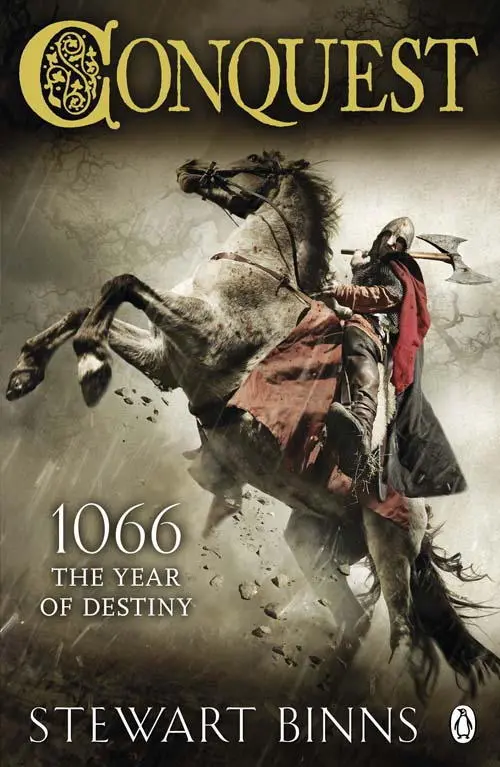
- Название:Conquest
- Автор:
- Издательство:Penguin Books
- Жанр:
- Год:2011
- Город:London
- ISBN:978-0-141-96059-3
- Рейтинг книги:5 / 5. Голосов: 1
-
Избранное:Добавить в избранное
- Отзывы:
-
Ваша оценка:
Conquest: краткое содержание, описание и аннотация
Предлагаем к чтению аннотацию, описание, краткое содержание или предисловие (зависит от того, что написал сам автор книги «Conquest»). Если вы не нашли необходимую информацию о книге — напишите в комментариях, мы постараемся отыскать её.
The battle is hard fought and bloody, the lives of thousands have been spent, including that of King Harold. But England will not be conquered easily, the Anglo-Saxons will not submit meekly to Norman rule.
Although his heroic deeds will nearly be lost to legend, one man unites the resistance. His name is Hereward of Bourne, the champion of the English. His honour, bravery and skill at arms will change the future of England. His is the legacy of the noble outlaw.
This is his story.
Conquest — читать онлайн бесплатно полную книгу (весь текст) целиком
Ниже представлен текст книги, разбитый по страницам. Система сохранения места последней прочитанной страницы, позволяет с удобством читать онлайн бесплатно книгу «Conquest», без необходимости каждый раз заново искать на чём Вы остановились. Поставьте закладку, и сможете в любой момент перейти на страницу, на которой закончили чтение.
Интервал:
Закладка:
‘Macbeth was a great king and a brave man. What he did that day at Lumphanan, in saving all those lives, and accepting a challenge he had little chance of winning, was surely worthy of the Talisman.’
‘Yes, it was.’
‘I don’t understand; you said it wasn’t the right time.’
‘I’m not suggesting Macbeth didn’t have the right to wear the Talisman; I’m sure he did. But you gave it to him to help him win, and it couldn’t do that for him. His life had run its course; he had all the wisdom he needed and the courage to do the right thing.’
‘I should have given it to him earlier, when he paid off his men and began to act like a king again.’
‘It still wouldn’t have altered his destiny. You would still have been with him at the end to retrieve it from the battlefield. Its journey, and ours, goes on.’
Torfida smiled at him with a warmth he had not seen in a long time. He reflected on what she had said before getting to his feet.
‘Give me the Talisman; it is time for me to wear it again.’ He pulled Torfida into a tight embrace. ‘Isn’t it time we got married? I think the Talisman of Truth has just imparted an important message: it’s time I made an honest woman of you!’
They laughed together and swung one another round in a whirl of joy.
At long last, the pain of the events in Scotland could begin to recede. Kiev in the spring presented itself as the ideal place for their union. April was on the fulcrum between the formidable winters of the heartlands of Asia and its equally prodigious summers. And so, as the temperate air of the Levant began to exert its influence, they decided that the time was right to marry in the eyes of God.
Hereward and Torfida were married in April 1059, in the historic wooden cathedral of Kiev by Theodore, Archbishop of the Rus. The cathedral was a towering masterpiece in elaborately carved oak, and the wedding was a glorious occasion. Martin and Einar stood either side of Hereward; Ingergerd and Maria flanked Torfida.
When it came to the time for the two principals to step forward and proclaim their vows, Torfida lost her composure and began to sob. With Hereward holding her firmly and whispering sympathetically, she eventually gathered herself a little. The spontaneous joy of Torfida’s outburst brought tears to the eyes of her female companions.
Hereward had never seen Torfida so unable to control herself, and he realized how vulnerable she was under her veneer of wisdom and self-confidence.
Although she had said her destiny was to be his guide to the intangible mysteries of the Talisman, Hereward knew he would need to be Torfida’s constant guardian in the much more corporeal challenges they would face on their journey together.
Hereward, Torfida and their extended family set sail from Kiev two days after their wedding. It was a week before the festival of Easter and the Dnieper was hectic, with merchants, soldiers and pilgrims hoping to reach their destinations before the festivities began. After a short stay in the bustling Black Sea port of Odessa, they sailed through the Bosporus, the gateway between two worlds, and were soon staring at the immense walls of the golden city of Constantinople.
They remained wide-eyed for days afterwards, overwhelmed by the incomparable sites before them: the Emperor’s Palace and the Hagia Sophia; monasteries, schools of learning, great houses and luxuriant gardens; huge warehouses of traders’ goods and street upon street of shops, selling everything they could think of and much else besides. None of them had ever seen anything like it, and they decided to stay for several weeks.
Torfida spent hours talking to the learned and the devout pilgrims who thronged the Hagia, the greatest church in Christendom. There were travellers from as far away as Baghdad, Jerusalem and Alexandria, all with tales of Arab learning and achievements in mathematics, astronomy and architecture.
When it was time to move on, they bought passage on a Greek merchant ship bound for Brindisi via Athens. As they sailed further and further from Constantinople, Hereward’s admiration for the scale of the Byzantine Empire grew and grew. Even several days out from Athens, and hugging the Greek coastline west of the island of Corfu, they were still within the realm of the Emperor of Constantinople. After finally disembarking at Brindisi, they began their journey across the flat plains and into the rugged hills of southern Italy. They were now at the limit of the Byzantine Empire and on the border of lands under the hegemony of the Norman lords of southern Italy.
Torfida felt invigorated by the warmth of the land and its exotic atmosphere. It was May; everything was in full bloom and the countryside was alive with insects, birds and wildflowers.
Late one evening, as they relaxed in their camp after dinner, Torfida nestled close to Hereward and whispered, ‘I told you we should come south, the warm air obviously agrees with me…’ She paused. ‘… I’m pregnant.’
‘My darling Torfida! I’m so happy. Let’s hope this man, Robert Guiscard, is a man worth fighting for and that we can find a position with him. We are going to need to work for our living… and for our baby.’
‘We will find useful work, worry not.’
They told the others immediately and there was much celebrating that night. Einar, who had grown to like Byzantine wine and always seemed to have a flask somewhere in his baggage, quickly made one appear to ensure that the merriment carried on well into the night. Martin sang his Celtic verses about maidens and heroes, love and comradeship.
Hereward looked at Torfida. He loved her very much, and now she had his child growing inside her. He turned to look out over the hills to the Adriatic Sea in the distance, radiant in the moonlight. What a strange journey theirs was: where would their adventure end?
And what would be their fate when they got there?
The bastion of Robert Guiscard stood menacingly on a strategic hilltop, some way back from the fertile plain of the Adriatic.
A stone keep was under construction within its palisaded walls, and large groups of people seemed to be making their way towards the city. Every building flew a flag or banner of some kind and from the pinnacle of the keep flew the striking red and gold emblem of the Count himself. Robert was the sixth of the nine sons of Tancred de Hauteville, an adventurer of humble birth from Normandy, who had fought his way to success and power. He was like many Normans of his time: brave and daring with an overpowering desire for conquest.
Hereward and his companions soon discovered the cause of the commotion. In three days’ time, Pope Nicholas II would arrive in Melfi to invest Robert as ruler of not only Apulia, but also of neighbouring Calabria and Sicily. The Normans did not yet hold Sicily and Calabria, but there was method in the Pope’s beneficence. Nicholas had been Pope for only five months and faced two rival powers who challenged Rome’s authority. The Saracens, who were men of Islam and a great menace to Christianity, held Sicily, while Calabria was held by the Byzantine Emperor, Rome’s great rival for control of Christendom. By granting Robert Guiscard sovereignty over these lands, even if only in name, the Pope was giving him an open invitation to venture out and conquer them.
Nicholas II also had an internal squabble, which required a solution. He had a rival, Benedict X, who claimed the Holy See, and had declared himself Pope on the death of the previous incumbent. Although he had been forced to flee Rome by Nicholas, Benedict still represented a threat. Nicholas needed Norman martial prowess to make Benedict come to heel. By allying himself with the Normans, and giving holy purpose to their private ambitions, Nicholas hoped to extend his influence to the whole of Italy.
Читать дальшеИнтервал:
Закладка:
Похожие книги на «Conquest»
Представляем Вашему вниманию похожие книги на «Conquest» списком для выбора. Мы отобрали схожую по названию и смыслу литературу в надежде предоставить читателям больше вариантов отыскать новые, интересные, ещё непрочитанные произведения.










Обсуждение, отзывы о книге «Conquest» и просто собственные мнения читателей. Оставьте ваши комментарии, напишите, что Вы думаете о произведении, его смысле или главных героях. Укажите что конкретно понравилось, а что нет, и почему Вы так считаете.