Stewart Binns - Conquest
Здесь есть возможность читать онлайн «Stewart Binns - Conquest» весь текст электронной книги совершенно бесплатно (целиком полную версию без сокращений). В некоторых случаях можно слушать аудио, скачать через торрент в формате fb2 и присутствует краткое содержание. Город: London, Год выпуска: 2011, ISBN: 2011, Издательство: Penguin Books, Жанр: Историческая проза, на английском языке. Описание произведения, (предисловие) а так же отзывы посетителей доступны на портале библиотеки ЛибКат.
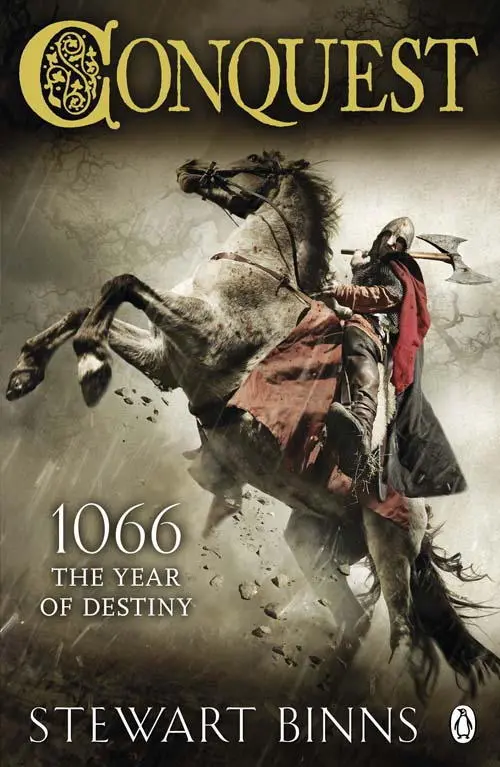
- Название:Conquest
- Автор:
- Издательство:Penguin Books
- Жанр:
- Год:2011
- Город:London
- ISBN:978-0-141-96059-3
- Рейтинг книги:5 / 5. Голосов: 1
-
Избранное:Добавить в избранное
- Отзывы:
-
Ваша оценка:
Conquest: краткое содержание, описание и аннотация
Предлагаем к чтению аннотацию, описание, краткое содержание или предисловие (зависит от того, что написал сам автор книги «Conquest»). Если вы не нашли необходимую информацию о книге — напишите в комментариях, мы постараемся отыскать её.
The battle is hard fought and bloody, the lives of thousands have been spent, including that of King Harold. But England will not be conquered easily, the Anglo-Saxons will not submit meekly to Norman rule.
Although his heroic deeds will nearly be lost to legend, one man unites the resistance. His name is Hereward of Bourne, the champion of the English. His honour, bravery and skill at arms will change the future of England. His is the legacy of the noble outlaw.
This is his story.
Conquest — читать онлайн бесплатно полную книгу (весь текст) целиком
Ниже представлен текст книги, разбитый по страницам. Система сохранения места последней прочитанной страницы, позволяет с удобством читать онлайн бесплатно книгу «Conquest», без необходимости каждый раз заново искать на чём Вы остановились. Поставьте закладку, и сможете в любой момент перейти на страницу, на которой закончили чтение.
Интервал:
Закладка:
Prince John Comnenus got to his feet and stretched himself. He ordered that an extra bearskin be placed over their ancient storyteller and that the fire be replenished. Leo the priest had also fallen asleep.
As the two princes walked towards the east and the rising sun, John Azoukh smiled to himself. ‘He tells the story as if it happened yesterday. But it was sixty years ago!’
‘I suppose he has had plenty of time to remember everything in detail; there’s not much else to do up here in the mountains. I suspect that’s part of the reason he’s here, so that he can remember.’
‘Our storyteller is obviously Hereward of Bourne. Why do you think he has assumed the identity of Godwin of Ely?’
‘I’m sure that will become clear as the story unfolds. We’re still only in 1057. My father was just a nine-year-old boy then. This man has lived a very long time.’
‘Isn’t it interesting how his life has moved in a great circle? Now, he’s a wild hermit, living out his days in isolation.’
‘Exactly as the Old Man of the Wildwood foretold.’
The two princes strolled for a while, deep in thought. After several minutes of reflection, it was John Comnenus who ended the quiet introspection.
‘The Talisman hasn’t yet revealed itself as an object worthy of the respect my father gives it. The King of the Welsh seemed wary of it, while its influence on Macbeth didn’t seem to help his cause!’
John Azoukh looked at his friend and smiled. ‘I suspect the importance of the Talisman is also part of the story to come. It would not have ended up adorning the neck of the Emperor of Byzantium if it didn’t have some significance.’ He paused, seeming concerned for his friend. ‘Would you risk a fight to the death for the Purple of Byzantium, as Macbeth did for his throne?’
‘That is a good question, my friend. I have been thinking about that. Would I have the courage? Would I be prepared to lose everything to fight for what I thought was right?
‘I’d like to think so, but it’s easier to say than to do. Macbeth must have known he had little chance against a stronger, younger man. Perhaps it was his way of regaining his self-esteem after the crushing blow of losing his crown and his sad personal decline. Now, at least, he will be remembered for his courage, not for his defeat.
‘I hope I’m never in the same position and that I never have to make that choice.’
John Azoukh placed his arm around the heir to the throne. ‘I hope so too. Let’s get some sleep.’
It was well past noon before Godwin of Ely was ready to continue his story.
The day had become typically hot. There was no need for bearskins and log fires. Instead, the stewards built shades from leafy branches and drew fresh cool water from the lake.
After a long and relaxed lunch, with much good humour and a little wine, the four men settled themselves for the continuation of the saga of the life of Hereward, Thegn of Bourne.
8. Ancient Wonders
Although Hereward had the trappings and demeanour of a nobleman, he still used the simple title Hereward of Bourne. Even so, wherever they went, they were in demand; everyone wanted to know what sort of man carried such mighty weapons, to meet the beautiful woman at his side and admire their formidable companions.
They journeyed to Göteborg to visit Thorkeld and his father. The old man was delighted to meet the owner of his lethal masterpiece – the Great Axe of Göteborg, as it had come to be known – and thrilled to hear that it had already drawn blood in battle. In Scandinavia, they wandered to most of its major settlements, all the while absorbing Norse culture. Einar and Hereward, in particular, felt a great affinity with the lands of their ancestors.
They then travelled, via the Baltic port of Riga, to the Viking city of Novgorod, where Norse craftsmen were building a new cathedral, a project which captured Torfida’s imagination. She spent countless hours with the master carpenters, learning the many intricate joints they used in their magnificent timber structures.
Martin and Einar both found Viking wives during their extended stay in Novgorod. Martin’s spouse, Ingigerd, was short and slim with flaxen hair and bright blue eyes. Einar had married Maria, a buxom redhead, who treated Ingigerd like a younger sister. And so, the quartet that had left Scotland became a sextet.
They moved on, travelling down the mighty rivers of Russia to Kiev, the southern capital of the Viking Rus. Viking rule was firm in the Rus, a territory that extended from the Baltic to the Black Sea, and the native Slavs had long since given up their armed resistance against the colonizers from the north. Kiev was the seat of the kingdom; it was a bustling, lively city at a crossroads of routes that stretched from the ancient lands of the Mediterranean to the military powerhouse of Scandinavia.
The Rus was still enjoying the benefits of the benign rule of King Jaroslav the Wise, whose long reign had only just ended. Through astute alliances and marriages, as well as skilful military campaigns, Jaroslav had created a powerful empire across a vast tract of territory. Trade from there to the south, to Constantinople – the celebrated capital city of the Empire of Byzantium – was constant, and they saw furnishings, jewellery and clothes of breathtaking finery being carried by caravans of traders.
Torfida longed to continue to Constantinople and then into the Mediterranean to see the cities of the ancient world, especially Rome. There, she could learn more languages, refine her Greek and Latin and hear of new advances in medicine, astronomy and mathematics.
Hereward preferred to return to Scandinavia. In Göteborg, they had heard of the famous exploits of Harald Hardrada, King of Norway, a great warrior, said to be six and a half feet tall. Hereward had been intrigued to learn that while still in his early twenties, Hardrada had been Captain of the Varangian Guard of the Emperor of Constantinople. Hardrada was waging a long-term campaign for supremacy in Denmark against Svein Estrithson, King of the Danes. If ever there was a man worth fighting for, it was surely Hardrada. He might also be a man whose qualities of leadership were such that he would be a worthy recipient of the Talisman, fulfilling Hereward’s mission as a messenger.
Torfida tried to force a decision. ‘We must go south; our destiny leads us to the Mediterranean. I must see Constantinople.’
Hereward was rarely short-tempered with Torfida, but he had yet to come to terms with the death of Macbeth. ‘And what of the rest of us? What of our destinies?’
‘All our destinies are the same; we have already made that choice. My destiny is your destiny.’
‘I would rather fight with Hardrada. He is a Norseman, a man with the blood of my Danish ancestors.’
‘I sense that your quest lies to the south, not to the north. I have heard of a man like Harald Hardrada. He is a Norman called Robert Guiscard. He fights in the Mediterranean from a city called Melfi, in the south of Italy. He has just been proclaimed Count of Apulia following the death of his brother.’
‘Torfida, removing the burden of this Talisman is more important than the direction of our journey.’
‘We have to be patient until we find the man who should wear it. It is not yet time to part with it; your journey still has many twists and turns. A great battle is coming, Europe is in turmoil, I have been listening to all the accounts. Strong leaders are emerging and one of them will bring our mission to an end. One of them will be the right man; you will know.’
Читать дальшеИнтервал:
Закладка:
Похожие книги на «Conquest»
Представляем Вашему вниманию похожие книги на «Conquest» списком для выбора. Мы отобрали схожую по названию и смыслу литературу в надежде предоставить читателям больше вариантов отыскать новые, интересные, ещё непрочитанные произведения.










Обсуждение, отзывы о книге «Conquest» и просто собственные мнения читателей. Оставьте ваши комментарии, напишите, что Вы думаете о произведении, его смысле или главных героях. Укажите что конкретно понравилось, а что нет, и почему Вы так считаете.