John Passos - Three Soldiers
Здесь есть возможность читать онлайн «John Passos - Three Soldiers» весь текст электронной книги совершенно бесплатно (целиком полную версию без сокращений). В некоторых случаях можно слушать аудио, скачать через торрент в формате fb2 и присутствует краткое содержание. Жанр: Историческая проза, Детектив, на английском языке. Описание произведения, (предисловие) а так же отзывы посетителей доступны на портале библиотеки ЛибКат.
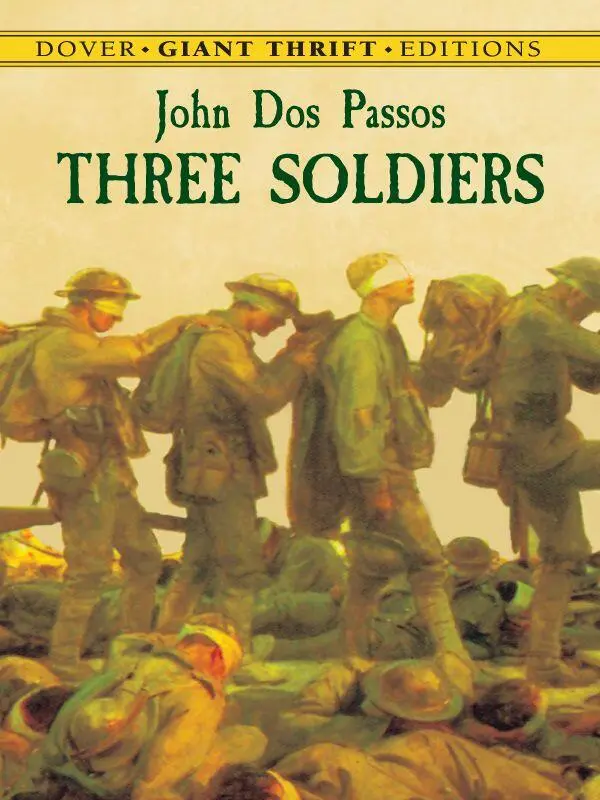
- Название:Three Soldiers
- Автор:
- Жанр:
- Год:неизвестен
- ISBN:нет данных
- Рейтинг книги:3 / 5. Голосов: 1
-
Избранное:Добавить в избранное
- Отзывы:
-
Ваша оценка:
Three Soldiers: краткое содержание, описание и аннотация
Предлагаем к чтению аннотацию, описание, краткое содержание или предисловие (зависит от того, что написал сам автор книги «Three Soldiers»). Если вы не нашли необходимую информацию о книге — напишите в комментариях, мы постараемся отыскать её.
Three Soldiers — читать онлайн бесплатно полную книгу (весь текст) целиком
Ниже представлен текст книги, разбитый по страницам. Система сохранения места последней прочитанной страницы, позволяет с удобством читать онлайн бесплатно книгу «Three Soldiers», без необходимости каждый раз заново искать на чём Вы остановились. Поставьте закладку, и сможете в любой момент перейти на страницу, на которой закончили чтение.
Интервал:
Закладка:
“You can’t mean that. Or do you mean that you think you had abilities which would have been worth more to your country in another position?… I have many friends who felt that.”
“No… I don’t think it’s right of a man to go back on himself… I don’t think butchering people ever does any good… I have acted as if I did think it did good… out of carelessness or cowardice, one or the other; that I think bad.”
“You mustn’t talk that way,” said Sheffield hurriedly. “So you are a musician, are you?” He asked the question with a jaunty confidential air.
“I used to play the piano a little, if that’s what you mean,” said Andrews.
“Music has never been the art I had most interest in. But many things have moved me intensely… Debussy and those beautiful little things of Nevin’s. You must know them… Poetry has been more my field. When I was young, younger than you are, quite a lad… Oh, if we could only stay young; I am thirty-two.”
“I don’t see that youth by itself is worth much. It’s the most superb medium there is, though, for other things,” said Andrews. “Well, I must go,” he said. “If you do hear anything about that university scheme, you will let me know, won’t you?”
“Indeed I shall, dear boy, indeed I shall.”
They shook hands in jerky dramatic fashion and Andrews stumbled down the dark hall to the door. When he stood out in the raw night air again he drew a deep breath. By the light that streamed out from a window he looked at his watch. There was time to go to the regimental sergeant-major’s office before tattoo.
At the opposite end of the village street from the Y.M.C.A. hut was a cube-shaped house set a little apart from the rest in the middle of a broad lawn which the constant crossing and recrossing of a staff of cars and trains of motor trucks had turned into a muddy morass in which the wheel tracks crisscrossed in every direction. A narrow board walk led from the main road to the door. In the middle of this walk Andrews met a captain and automatically got off into the mud and saluted.
The regimental office was a large room that had once been decorated by wan and ill-drawn mural paintings in the manner of Puvis de Chavannes, but the walls had been so chipped and soiled by five years of military occupation that they were barely recognisable. Only a few bits of bare flesh and floating drapery showed here and there above the maps and notices that were tacked on the walls. At the end of the room a group of nymphs in Nile green and pastel blue could be seen emerging from under a French War Loan poster. The ceiling was adorned with an oval of flowers and little plaster cupids in low relief which had also suffered and in places showed the laths. The office was nearly empty. The littered desks and silent typewriters gave a strange air of desolation to the gutted drawing-room. Andrews walked boldly to the furthest desk, where a little red card leaning against the typewriter said “Regimental Sergeant-Major.”
Behind the desk, crouched over a heap of typewritten reports, set a little man with scanty sandy hair, who screwed up his eyes and smiled when Andrews approached the desk.
“Well, did you fix it up for me?” he asked.
“Fix what?” said Andrews.
“Oh, I thought you were someone else.” The smile left the regimental sergeant-major’s thin lips. “What do you want?”
“Why, Regimental Sergeant-Major, can you tell me anything about a scheme to send enlisted men to colleges over here? Can you tell me who to apply to?”
“According to what general orders? And who told you to come and see me about it, anyway?”
“Have you heard anything about it?”
“No, nothing definite. I’m busy now anyway. Ask one of your own non-coms to find out about it.” He crouched once more over the papers.
Andrews was walking towards the door, flushing with annoyance, when he saw that the man at the desk by the window was jerking his head in a peculiar manner, just in the direction of the regimental sergeant-major and then towards the door. Andrews smiled at him and nodded. Outside the door, where an orderly sat on a short bench reading a torn Saturday Evening Post, Andrews waited. The hall was part of what must have been a ballroom, for it had a much-scarred hardwood floor and big spaces of bare plaster framed by gilt-and lavender-colored mouldings, which had probably held tapestries. The partition of unplaned boards that formed other offices cut off the major part of a highly decorated ceiling where cupids with crimson-daubed bottoms swam in all attitudes in a sea of pink-and blue-and lavender-colored clouds, wreathing themselves coyly in heavy garlands of waxy hothouse flowers, while cornucopias spilling out squashy fruits gave Andrews a feeling of distinct insecurity as he looked up from below.
“Say are you a Kappa Mu?”
Andrews looked down suddenly and saw in front of him the man who had signalled to him in the regimental sergeant-major’s office.
“Are you a Kappa Mu?” he asked again.
“No, not that I know of,” stammered Andrews puzzled.
“What school did you go to?”
“Harvard.”
“Harvard… Guess we haven’t got a chapter there… I’m from North Western. Anyway you want to go to school in France here if you can. So do I.”
“Don’t you want to come and have a drink?”
The man frowned, pulled his overseas cap down over his forehead, where the hair grew very low, and looked about him mysteriously.
“Yes,” he said.
They splashed together down the muddy village street.
“We’ve got thirteen minutes before tattoo… My name’s Walters, what’s yours?” He spoke in a low voice in short staccato phrases. “Andrews.”
“Andrews, you’ve got to keep this dark. If everybody finds out about it we’re through. It’s a shame you’re not a Kappa Mu, but college men have got to stick together, that’s the way I look at it.”
“Oh, I’ll keep it dark enough,” said Andrews.
“It’s too good to be true. The general order isn’t out yet, but I’ve seen a preliminary circular. What school d’you want to go to?”
“Sorbonne, Paris.”
“That’s the stuff. D’you know the back room at Baboon’s?”
Walters turned suddenly to the left up an alley, and broke through a hole in a hawthorne hedge.
“A guy’s got to keep his eyes and ears open if he wants to get anywhere in this army,” he said.
As they ducked in the back door of a cottage, Andrews caught a glimpse of the billowy line of a tile roof against the lighter darkness of the sky. They sat down on a bench built into a chimney where a few sticks made a splutter of flames.
“Monsieur désire?” A red-faced girl with a baby in her arms came up to them.
“That’s Babette; Baboon I call her,” said Walters with a laugh.
“Chocolat,” said Walters.
“That’ll suit me all right. It’s my treat, remember.”
“I’m not forgetting it. Now let’s get to business. What you do is this. You write an application. I’ll make that out for you on the typewriter tomorrow and you meet me here at eight tomorrow night and I’ll give it to you… You sign it at once and hand it in to your sergeant. See?”
“This’ll just be a preliminary application; when the order’s out you’ll have to make another.”
The woman, this time without the baby, appeared out of the darkness of the room with a candle and two cracked bowls from which steam rose, faint primrose-color in the candle light.
Walters drank his bowl down at a gulp, grunted and went on talking.
“Give me a cigarette, will you?… You’ll have to make it out darn soon too, because once the order’s out every son of a gun in the division’ll be making out to be a college man. How did you get your tip?”
Читать дальшеИнтервал:
Закладка:
Похожие книги на «Three Soldiers»
Представляем Вашему вниманию похожие книги на «Three Soldiers» списком для выбора. Мы отобрали схожую по названию и смыслу литературу в надежде предоставить читателям больше вариантов отыскать новые, интересные, ещё непрочитанные произведения.





Обсуждение, отзывы о книге «Three Soldiers» и просто собственные мнения читателей. Оставьте ваши комментарии, напишите, что Вы думаете о произведении, его смысле или главных героях. Укажите что конкретно понравилось, а что нет, и почему Вы так считаете.